Blog of early Vickers tanks

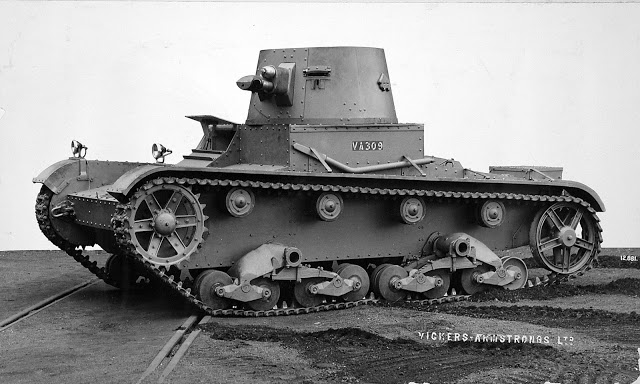
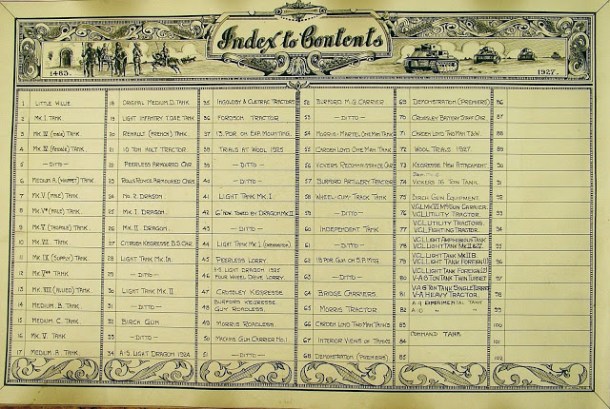
81 1 6 ton tank single turretA new blog has appeared showcasing photos of interwar tank development by Vickers Armstrong Ltd.  According to the blog, Tthe photographs used have come from two works albums from Vickers Armstrong Ltd, held by the Beamish Museum and used here with permission. They also cover other vehicles including half tracks and wheeled transport.  The blog also has a media section featuring videos of early Vickers tanks and a resources page listing some of the better books on the topic.

Click the image below to visit the site.
86 Index

Archive Awareness Blog on Red Army AFV numbers in Operation Barbarossa

BarbarosaOver at the Archive Awareness blog, Peter Samsonov has posted an interesting summary of data from “Order in Tank Forces: What happened to Stalin’s tanks?” by Dmitriy Shein.  In the post, he challenges the commonly held idea that the Red Army had 26,000 tanks at it’s disposal in 1941 versus only 4000 AFVs of the German invader.  In a series of charts, Shein shows the number of those tanks that were in the Western districts as well as what state of functionality they were in.  When taking into account these various factors, the Red Army had, according to Shein,  roughly 7000 – 7500 functional tanks available for battle on June 22nd, 1941.  And while that is still a numerical advantage over the tank forces of the German invader, these Red Army tanks of 1941 were hampered by a number of shortages, particularly in fuel trucks and certain types of ammunition.  In other words, the tanks of the Red Army were woefully prepared to repel an invader.  And while most histories note these issues affecting the “26,000” strong Soviet tank force in 1941, it’s interesting to see the numbers broken and explained.

Read the full blog post here.

Armor for the Ages: SdKfz 234/4

armor for the agesThe Armor for the Ages website has recently updated their website, adding a new article to their Military Vehicles section. These articles describe the various vehicles and weapons that are now in the National Armor and Cavalry Museum (NACM) or the Patton Museum of Leadership. Some of these vehicles were once in the Patton Museum of Cavalry and Armor collection before being transferred to NACM while others came from the Aberdeen Proving Ground (APG) collection.The new article describes the German SdKfz 234/4 armored car. The unit this vehicle was assigned to during World War II has never been officially known until now. Recently acquired photographic evidence proves that the 234/4 was once part of Panzerkorps Feldherrnhalle and was surrendered to U.S. forces in southern Czechoslovakia in 1945.  The article is accompanied by two photo galleries of the vehicle.

Armor for the Ages SdKfz 234/4 article

SdKfz 234/4 Photo Gallery Number One and Photo Gallery Number Two

Inside the Chieftain’s Hatch: M56 Scorpion, Pt 1

Nicolas “The Chieftain” Moran has released a new video in the World of Tanks “Inside the Hatch” series.  This episode examines the M56 Scorpion self propelled gun.

Ken Estes on Tiger II at Carrousel

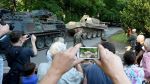
Over at the Tanknet forum, author and researcher Ken Estes recently posted about getting to examine the Tiger II tank at the Musee des Blindes in Saumur.  He was there for their annual Carrousel, an event that includes a public exhibition of some of their historic AFV’s.  Mr. Estes posted some brief observations on the Tiger II along with a few photos. Since the Tiger and Tiger II are such popular vehicles, we figured people would be interested in his comments.

Estes tiger IIIt’s surprisingly roomy inside, if you forget about the 70 rds of 88mm that were stowed in the hull sides forward of the engine compartment to the driver’s compartment, plus up to 22 more in the turret bustle. Tiger I had no main gun ammo in the turret and apparently the crews did not like to store rounds in the Tiger II turret, but the whole thing was an ammo box, and only the turret ammo would have been handy for loading. Perhaps because there is not a turret basket, there is much room for everybody but the gunner. I could stand fully upright in the loader and commander positions.

Gunner and driver controls were OK, and I don’t know why the British found the manual traversing wheel awkward projecting into the gunner’s lap. Interestingly, there is a second manual traverse located in front of the loader, so he could add his energy as well to the traversing load. They should have had this in other tanks as well, especially heavies. My eyes popped out when I saw the 8 speed transmission shifting lever, but it is apparently as easy to drive as the earlier Tiger. Many controls are redundant, for instance braking is via foot pedals and the usual levers; must help a lot for panic stops.

So well engineered I’d say, at first impression, but of course it’s hopelessly underpowered and overtaxed by terrain limitations for which the suspension could not handle. As with the M103, it likely represented the limits of automotive engineering of its day.

Mr Estes noted that he took an extensive number of pictures of the vehicle which will be used for a book to be published in 2017.  He has authored several books on Tanks and AFVs, including Marines Under Armor, Tanks on the Beaches, M103 Heavy Tank (New Vanguard) and US Marine Corps tnak Crewman 1941-45 (Warrior).

While we were not able to find any videos yet of the 2015 Carrousel, here are some clips of the 2014 Carrousel, including the Tiger II tank (video 2).

[Read more…]

More on the basement dwelling Panther

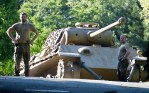
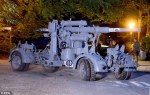
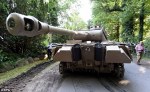
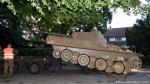
Since we first reported on this story, several new articles have appeared on the topic.  We are posting as many pictures here as we can find.  The name of the 78 year old owner of the tank has not been released.  It seems that his villa had previously been searched as part of an investigation in stolen Nazi art.  Prosecutors in Kiel had been alerted to the presence of the Panther and other military equipment by authorities from this previous investigation.  It has been noted that almost 20 soldiers struggled to remove the tank from the villa, taking nine hours and the use of two modern AFVs to haul the tank out of it’s storage area.  Ulrich Burchardi, an army spokesman, described the difficult task of removing the tank without damaging the house as “precision work”, requiring the soldiers to build a wooden ramp in order to free the tank.  The other notable items found in the villa were an 88mm Flak cannon and a large torpedo.

Peter Gramsch, lawyer for the villa’s owner, claimed that the tank and the anti-aircraft gun could no longer fire their weapons and were therefore not breaking any law.  The lawyer noted that there was even a note from the responsible district office from 2005 stating that the tank had lost its weapons capability.  Mr Gramsch now wants to take legal action against the seizure and also for compensation for his client, stating that “I assume that the tank was damaged in the process.“  The mayor of Heikendorf, Alexander Orth, who was present at the tank’s removal, said the discovery came as no surprise. “The Mayor noted that the owner of the tank “was chugging around in that thing during the snow catastrophe in 1978”.

Tank Chats #7 British Mark II with David Fletcher

The Tank Museum has posted another installment in their Tank Chats series featuring David Fletcher.

The seventh in a series of short films about some of the vehicles in our collection presented by The Tank Museum’s historian David Fletcher MBE.

Only fifty tanks each of Marks II and III were produced. They were unarmoured, in the sense that the steel from which they were built was not heat treated to make it bullet proof. The reason being that these tanks were only intended for use as training machines.

The chief external differences from Mark I lay in the tail wheels, which were not used on Marks II and III and later heavy tanks, the narrower driver’s cab and the ‘trapezoid’ hatch cover on the roof.

Panther tank found in German Basement

panzer468_v-vierspaltigA couple German language articles have appeared in the press the last couple days reporting on a WW2 era Panther tank having been found in a basement of an elderly German collector in Heikendorf.  Apparently, a Bundeswehr unit equipped with two armored recovery vehicles were sent to the residence to recover the vehicle (or vehicles, some reports say two tanks were found.)  It is being reported that a seven meter long torpedo was also removed from the premises.  The articles state that the items were removed as they were in violation of the War Weapons Control Act, a claim the lawyer for the item owner says does not apply since the tank is not operational.  An article from NDR.de has some pictures of the tank being removed from the premises.  The articles does not state the name of the 78 year old collector who owns these items.

Original articles (in German)  

Der Spiegel Online

Kieler Nachrichten

NDR.de (This article has pictures.)

Video: History of US Tanks

This Vietnam war era government documentary showed up on youtube today.  Not sure if this video has appeared online before, but it’s the first time we recall seeing it.

World of Tanks: Virtually Inside the Tanks videos

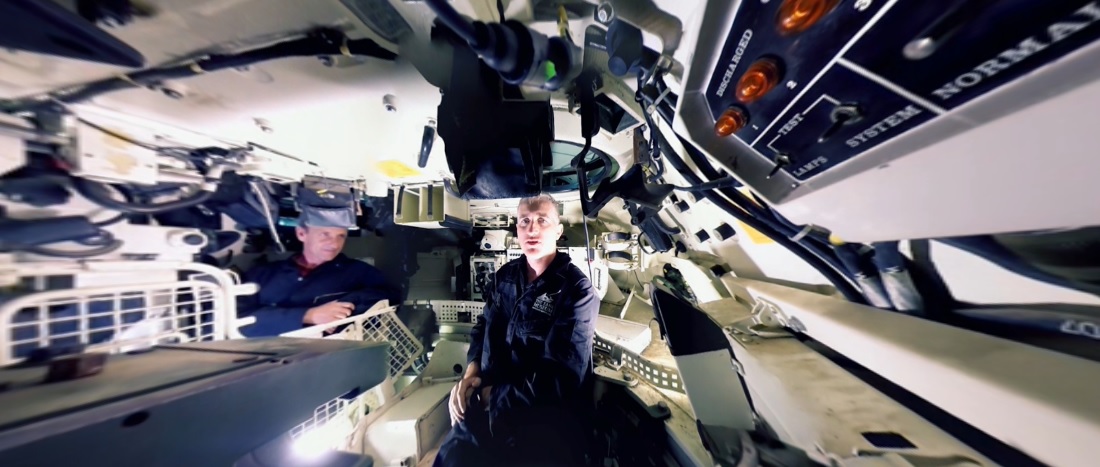
fish eyeWorld of Tanks has released a new website featuring a series of videos titled “virtually inside the tanks.”  These videos feature WoT personalities Nick Moran (The Chieftain) and Richard Cutland (The Challenger) as they ride around inside a tank.  The videos are filmed with a series of cameras, providing a rotatable panoramic view of the inside of the vehicle.  This filming technique creates a very strong “fisheye” effect which is frankly a bit disorientating.  That said, people may find these videos informative and they do provide some good images of the vehicle interiors, albeit a distorted one.  Currently the line up of vehicles featured in this series included the Leopard 1, the Chieftain, the M4 “Fury”, the T-34 and the T-55.

To view the videos, click here.