The Siberian Times has posted an article about three farming brothers that use old tanks to plow their fields. According to the article, Vasily, Dmitry and Ivan Ivanov, from the rural settlement of Karatuzskoye in Krasnoyarsk Krai, bought the vehicles from the military in the 1990s for the price of scrap metal. Initially they bought them to use as cars because the roads in their area are extremely bad. They live about 30km from the district centre and in the winter or bad weather it is almost impossible to travel anywhere. The article identifies the tank hulls used by the brothers as being from T-62 tanks, although judging from the arraignment of the road wheels, the tractors appear to be based on T-55 hulls. The Ivanovs farm about 400 hectares of land, half of which is sown with grain, with the tank used to plough the land and sow the oats and wheat.
Siberian farmers plow fields with tanks
From the Editor: Unusual Soviet target vehicles
In our earlier post today on Soviet auto-loaders, we posted a youtube clip about the T-72 tank. This clip includes a good deal of footage that appears to be of early model T-72 tanks being put through tests or exercises. In a couple instances, they show a T-72 firing at a target tank. The scenes are quite brief, but it is still possible to identify the model of the target tank. The vehicles used were rather surprising.
The first takes place at the 7:03 mark in the video and appears to show an Israeli M51 “Isherman” as the target vehicle.
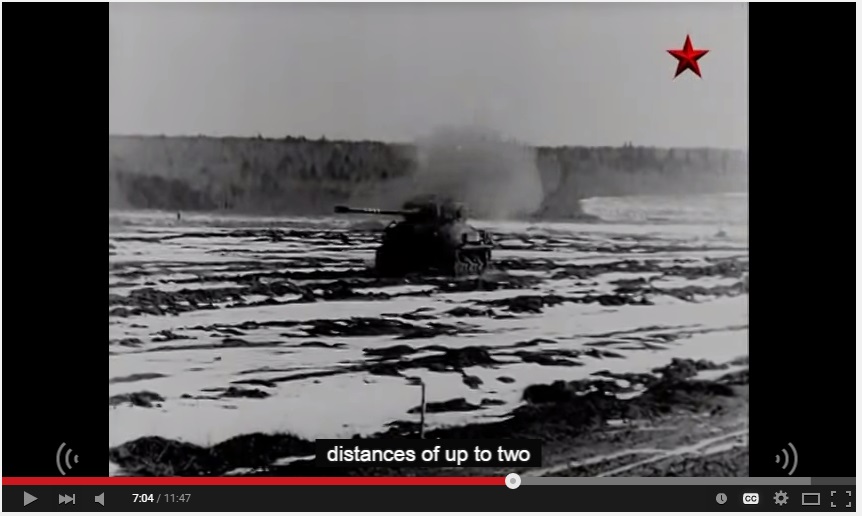
The next scene showing a target tank takes place at the 9:17 mark in the video. This shows a cannon fired missile being launched at what looks like a German Panzer III.

Considering the price that WW2 German armor commands from collectors these days, it’s somewhat painful to see one used for target practice!
German Military – Fact or Fiction
The website for the video game “Armored Warfare” has posted a rather provocative article titles “German Military – Fact or Fiction.” The article focuses almost exclusively on tanks and armored vehicles. The article makes a number of claims that run counter to the popular conception of German WW2 armor. We present it here for the sake of discussion.
Excerpt:
Was the Panther the best German armored vehicle of the war? No. That title probably belongs to a less obvious candidate – the StuG III. Built upon the Panzer III chassis, the StuG III was not expensive, had excellent results and remained effective right until the end of the war. Building these vehicles made much more sense during the war than building over-armored heavy tanks, especially in the price per enemy kill perspective.
Contrary to popular belief, Tigers were (especially late in the war) very rare. Many older wartime accounts mention “Tigers”, “Panthers” and “Ferdinands” destroyed in large numbers but most of these tank kills were other tank models and not the dreaded “big cats” – for an average Allied soldier, however, every tank was a “Tiger”, especially in the east.
One issue of interest is German steel. In the past, various popular sources have attributed nearly mythical qualities to it and the “Kruppstahl” was largely a synonym for “durable”. Recent Russian sources have claimed exactly the opposite – that it was brittle and poor, especially late in the war. The truth, as usual, lies somewhere in the middle. The Krupp steel was certainly hard rather than soft but that is not inherently a good thing. Softer steel has some advantages over very hard steel (which is usually brittle), but it is possible that the (false) “harder means better” notion spawned the German steel reputation. On the other hand, the claim that German steel quality decreased later in the war is false – according to H.L.Doyle the Germans compensated the lack of certain elements of the steel creation process by modifying the formula.
Overlord’s Blog on Universal Carrier
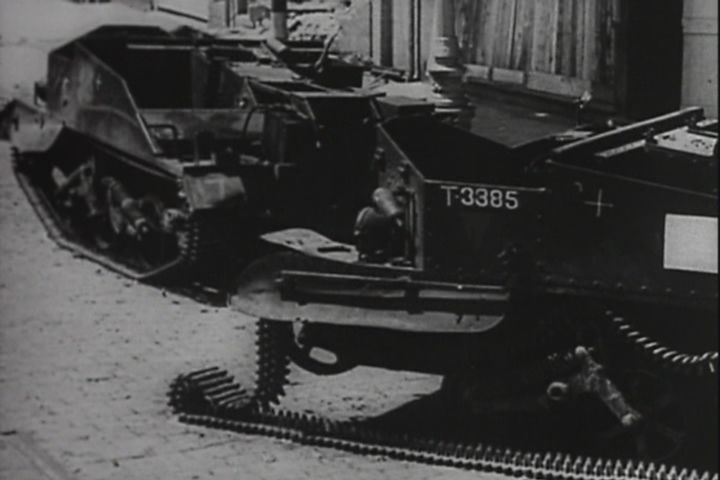 Overlord’s Blog is featuring a post about a heroic action taken by a group of British Bren Gun Carriers during the 1940 campaign in France. The post describes the exploits of Lieutenant Christopher Furness who commanded a section of Bren Gun Carriers belonging to the 1st Welsh Guards. Furness was part of a column which was retreating from the Arras area and in danger of being destroyed by advancing German forces. WIth a group of three Bren Carriers and three Mk VI light tanks, Furness set out to attack the German forces so as to give the rest of the column a chance to escape.
The light tanks set up a base of fire and started shooting at the Germans, however they were all quickly set on fire by the German anti-tank guns. However the lighter, smaller and faster Carriers were able to evade the German anti-tank gun fire. Not so the colossal amount of small arms rounds the Germans fired at the Carriers. Such was the volume of fire Carrier #3 had the bi-pod shot off its Bren gun. Soon all the Carriers had wounded men on them. Lt Furness led his Carriers along until nearly on top of the German position then began to drive in a circle around the German hilltop all the while firing with every weapon they could. They managed several circuits inflicting very heavy casualties on the Germans. However the German return fire was beginning to take its own toll. In Carrier #1 Lt Furness was the only man alive, and when the driver had been killed the Carrier had halted. In Carrier #2, just behind Carrier #1, Guardsman David Williams had been killed and the other crew wounded.
Motor Trend drives a tank
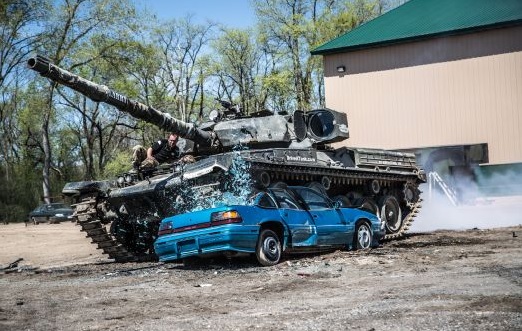 Yet another in the recent rash of articles about reporters driving tanks over cars. This particular article is from Motor Trend magazine and documents their visit to “Drive a Tank”, a small company in Kasota, Minn. The article features a video and a rather nice photo gallery of the vehicles available at Drive a Tank. Vehicles pictured include an Abbott SPG, Chieftain tank, M4A2E8 Sherman tank and at FV-432.
The Motor Trend article can be read here.
The website for “Drive a Tank” can be viewed here.
For those with a spare $2,999 laying around, check out the “Five Star” package at Drive a Tank. This package includes a chance to drive an Abbott SPG, a FV-432, a Russian T55 and to crush a car with a British Chieftain. The package also includes firing a number of machine guns, including a MG42 and a .50 Cal HMG. Or, for a mere $3,599 a person can purchase an opportunity to drive a Sherman tank.
D-Day tanker Cecil Thomas
 Rockingham Now has posted an article about Cecil Thomas, a WW2 veteran who commanded a M4 tank on D-Day. Thomas was part of the 741st Battalion, one of the separate tank battalions equipped with DD Sherman tanks. The article gives a summary of the life and wartime service of Thomas, as well as testimony from some of the soldiers that served with him.
One of Thomas’ soldiers, Staff Sgt. Thomas Fair, later described the landing:
“The ramp was dropped (on the LCT) in pretty deep water and we left the craft. The water was up over the turret ring. We finally pulled upon the beach, but still stayed in the water enough for our protection, our bow gunner started spraying the trees and hillside with .30-caliber (machine gun fire) while we looked for anti-tank guns and pillboxes.”
The tanks made rapid progress in their drive south. They shelled a farmhouse that had been converted into a gun position, reducing the enemy’s shelling barrage on two of the tanks that had become separated from the rest of the unit. They carried on with their mission, the report said, “penetrating to such depth that they found the enemy completely unprepared for attack. In one case, the tanks fired upon three of the enemy who were on bicycles riding along the road.”
The Chieftain on WW2 US gyrostabilizer issues
 Over at the World of Tanks forum, Nicholas Moran “The Chieftain” has published a new article summarizing a report he found in the archives from the Armored Board on the issue of tank gun stabilizers. US tanks had a gyrostabilizer system on the main gun starting with the M3 Medium tank, a feature no other country could brag of. However, many sources note that the stabilizer system was not popular with US crews and was often not used or disabled. The Armored Board noticed that troops were not satisfied with the stabilizer and so in April of 1944 they commissioned a study of the issue. The Chieftain’s summary of the study is essentially that the stabilizer worked, but that US troops were not trained to effectively make use of it.
Excerpt:
Summary:
1. The “secret” and “confidential” classification of the gyrostabilizer during the early stages of its use was the cause of much ignorance in its employment and maintenance, and led to a hesitancy on the part of officers and men to make any use of it; consequently, when gunnery was attempted, the device was usually inoperative. This led to all but a few organisations abandoning its use. Those few, including the 3rd Armored Division and the 753rd Tank Battalion, have promoted the use of the gyro and believe that it is a useful instrument. The 3rd Armored Division went so far as to devise a very useful gadget, a sliding weight, so designed that the gun could be breech-heavy without the gyro, and balanced with the gyro. When TM 17-12 was published with a statement that the gyro should not be used beyond 600 yards, the men of the 3rd Armored Division were disappointed because they had been using it successfully at greater range. The 753rd Tank Battalion has reported outstanding success in the use of the gyrostabilizer against enemy tanks in Italy.
2. Many reports of the unreliability of the gyrostabilizer in combat areas have been received. This reliability is in all probability caused by:
a: Old type equipment, now obsolete
b: Lack of training in simple first and second echelon maintenance.
Tankfest Northwest
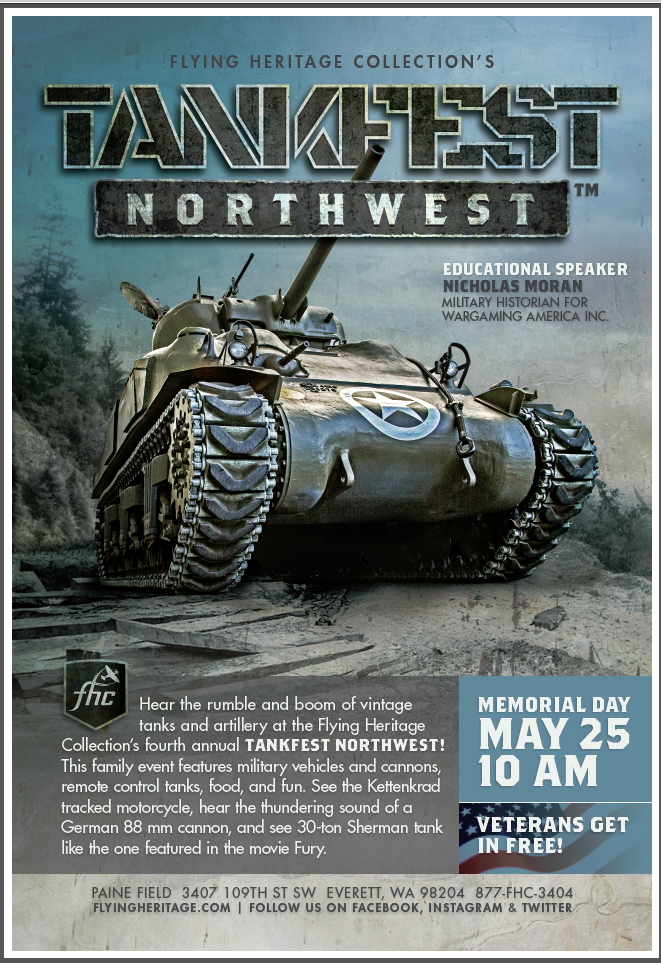
For those that plan to be in the Seattle area on Monday May 25, the Flying Heritage Collection will be hosting Tankfest Northwest. The event will feature educational speaker Nicholas Moran aka “The Chieftain.”
Tankfest Northwest
12:00 AM – 4:00 PMBring the family out to enjoy tanks, military vehicles and artillery weapons at this festive annual event, which includes driving and firing demonstrations of tanks and artillery. There will also be a Puget Sound Military Vehicle Collectors Club parade. This year we are proud to announce we will be joined by two military units, the 1-161 Combined Arms Battalion which will bring an M1 Abrams tank and the 1-303 Cavalry Squadron which will bring a Bradley Fighting Vehicle. Both units are part of the 81st Brigade Combat Team and will demo their vehicles.
20 Years ago: Tank rampage in San Diego
U-T San Diego has published a story commemorating an incident from 20 years ago in which an M60 tank was stolen from a National Guard armory and driven through a San Diego neighborhood. The driver of the tank, an former army serviceman named Shawn Nelson who had a history of drug and alcohol abuse, led police on a 23 minute chase which caused extensive property damage. Much of the rampage was captured on video by helicopters and later aired repeatedly on cable TV shows. The chase ended when Nelson lost a track trying to climb a concrete highway barrier. The tank was boarded by police officers and Nelson was shot and killed after refusing to surrender. According to the article, Shawn Nelson had fallen victim to methamphetamine addiction, which very likely played a role in his decision to take a tank for a joyride.
The Chieftain’s Hatch: The Super Pershing
Wargaming’s resident tank expert “The Chieftain” has posted a new article on the T26E4, commonly called the Super Pershing. Using materials unearthed from the archives, the article explains how the extra long 90mm gun of the Super Pershing (T15E2) was found to be unsatisfactory by army testers.
The exploits of the T26E4 in Europe are well known. Indeed, there is much anticipation for the release of the HD model of the tank in the upcoming update. It is, of course, known that the Super Pershing we all know and love was not an entire success, not least because the ammunition its T15E1 rifle used was single-piece and incredibly unwieldy. It is also known (albeit slightly less so) that an improved version of the T15E1 was developed, the creatively named T15E2, and that was designed to use split-piece ammunition, supposedly to fix this problem. Yet when M26’s replacement was developed, M46, it still retained the shorter 90mm M3-based gun. What happened?

 Tank and AFV News