Stars and Stripes has posted an article on German made Leopard 2 tanks in service with Turkey being destroyed in the fight against Islamic State militants in Syria.
KAISERSLAUTERN, Germany — The reputation of Germany’s vaunted Leopard 2 tank, which forms the mainstay of NATO’s armored forces, has taken a pounding in battles with Islamic State militants in Syria.
At least 10 of the 60-ton main battle tanks have been destroyed during a Turkish attempt to recapture the strategically important northern town of al-Bab, located just 15 miles south of the Turkish border, media reports have said.
The Turks have deployed several thousand soldiers in the operation, which began in September. But despite airstrikes by Russian warplanes in support of the advancing troops, they have been unable to take the town in the face of determined opposition.
Several dozen Turkish soldiers and local allies have died in the combat. Germany’s Die Welt newspaper said at least 10 Leopard 2s were destroyed and many others damaged in street fighting on the outskirts of al-Bab. The rebels are said to have used both U.S.-made TOW and Russian Kornet anti-tank missiles in attacks on the tanks.
Read the full article at Stars and Stripes.

 MELBOURNE, Australia — Japan’s Ministry of Defense (MoD) has unveiled a prototype eight-wheel drive armored personnel carrier (APC) as part of a research project for a new class of modular vehicles. The project, known for now as the Wheeled Armoured Vehicle (Improved), will eventually lead to a new vehicle type to replace the Type 96 eight-wheel drive armored personnel carrier in use by the Japan Ground Self-Defense Force (JGSDF). The new vehicle will feature improved protection against a variety of threats such as improvised explosive devices, versatility and room for future growth in capabilities compared to the Type 96 it is replacing. It will also be fitted with a more powerful engine and a strengthened suspension to cope with the increased weight and payloads.
 Thailand’s Ministry of Defense has decided to terminate its contract with Ukraine for the purchase of several dozen T-84 Oplot main battle tanks, citing Kiev’s inability to deliver them on time, according to Thai media reports. In 2011, Thailand signed a $241 million contract with the Kharkiv-based Malyshev Factory on the delivery of 49 T-84 ‘Oplot’ (‘Stronghold’) MBTs. The tanks were meant to become the backbone of Thailand’s tank forces, replacing the army’s 1957-vintage US-made M-41s, which are set to be decommissioned. However, after being plagued by never-ending problems with the delivery of the Ukrainian tanks, the Thai Defense Ministry has apparently decided to cancel the contract.
 As a commercial and potentially consumer product, one might assume it very unlikely to see the Microsoft HoloLens in the military marketplace. And that assumption would be completely wrong. One company from the Ukraine is currently working on using the mixed reality head-mounted computer for 360-degree vision inside armored tanks. If a tank crew could see the entire battlefield there are in, they would likely have a better chance of accomplishing their mission and avoiding damage. Tanks are large, enclosed, metal shells, and visibility is a serious concern since each portal that is made for vision potentially weakens the vehicle and endangers the crew within.
 KIEV, Ukraine, Jan. 5 (UPI) — Ukraine’s state-owned defense contractor Ukroboronprom has transferred over 50 BTR-3 armored personnel carriers to the country’s armed forces. The company completed manufacturing the vehicles in 2016. The products are armed with modernized weapon systems including 30mm guns and additional missile munitions, and were transferred to Ukraine’s army and national guard. To support the production process, Ukrobornprom established a new manufacturing plant dedicated to BTR-3-related operations.
 Army and Marine Corps may add a more-lethal 30mm cannon to its new JLTV to improve lethality for the emerging high-tech platform and better prepare it for large-scale, mechanized force-on-force warfare. The Army’s new Joint Light Tactical Vehicle is a new fast-moving armored vehicle engineered to take bullets, drive over roadside bombs and withstand major enemy attacks; the vehicle was conceived and engineered as a high-tech, more survivable replacement for large portions of its fleet of Humvees.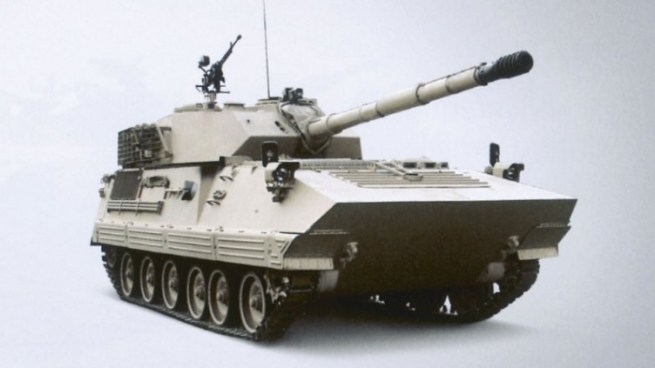

 By pure numbers, Poland had an impressive amount of armoured vehicles in WWII: about 870 units (against approximately 2700 German tanks in Army Group North and South). However, three quarters of them were rather unusual vehicles: TK-3 and TKS tankettes. What were the machines that formed the backbone of the Polish armoured forces like?
 On May 13th, 1924, a demonstration of medium tanks built according to the Char de bataille program took place in Rueil-Malmaison. FAMH, FCM, Renault, and Schneider each built a prototype. The plan was to pick the most successful design and split up the contract for 120 tanks between the companies. However, it turned out that none of the tanks completely satisfied requirements of the military. As a result, General Estienne, the originator of the Char B program, was forced to create new requirements in March of 1925 for an improved tank which would use the most successful technical solutions from its predecessors.
 The Char B1 and its improved version, the Char B1 bis, stand as the symbol of French tank building in WWII. At the start of WWII, these were the best medium tanks, combining shell-proof armour and serious armament, capable of destroying any tank in the world. Meanwhile, several elements of the Char B1, such as its suspension and its short barreled 75 mm howitzer in the hull, were rather archaic. Naturally, there was a good reason for this. Even though the Char B1 was accepted into service in 1934, five years before the start of the war, its story begins more than a decade and a half prior…
 On March 25th, 1931, the US Wheel Track Layer Corporation and Bureau of Ordnance signed a contract to build five Christie M.1931 tanks, later expanded to seven. American infantry received three Convertible Medium Tanks T3 and cavalry received four Combat Cars T1. It seemed that the long struggle between Christie and the American military finally ended with Christie’s victory, and a large order will follow the first batch of tanks any day now. However, history took a different path, and the Christie suspension was a dead end for the American tank building school. However, the evolution of American convertible drive designs led to several interesting vehicles, one of which was the Convertible Medium Tank M1, which was standardized for service.
 In January of 1935, the Light Tank T2E1 arrived at Fort Benning for military trials. This vehicle was the result of nine years of trial and error, which began with the design of the Light Tank T1. Over time, the concept of the light tank changed radically. It transformed from a two man tank with an engine in the front and a 37 mm gun as the main armament to a 4 man tank with a rear engine, front transmission, and machineguns in a two man turret. As a result of the trials, the Light Tank T2E1 was accepted into service as the Light Tank M2A1.
 The front line passed near Kryukovo in late November of 1941: a settlement and a railway station. The Red Army and the Wehrmacht pushed against it like two boxers. One, more vicious and more experienced, was still attacking, but his blows lacked the crushing strength they had at the start of the bout. The other, forced to keep his guard up, was barely standing. He missed hits, spat blood, fell down. But every time he got up again and kept fighting.
 The Light Tank Mk.I, later renamed to Medium Tank Mk.I, entered production in 1923 and left a notable mark in not only British tank building history, but tank building history in general. Its excellent maneuverability and armament for the time set a trend for the later part of the 1920s. Nevertheless, its lifespan was brief. Two years later, it was replaced by the most numerous tank of the 1920s: the Medium Tank Mk.II.
 In the late 1950s, the Soviet government received information that NATO nations developed and adopted new 105 mm tank guns, which made the T-54 and T-55, the most common types of Soviet tank, vulnerable. The 100 mm rifled gun on the T-55 could not penetrate the front of the M48 Patton III, and the Americans were already developing the M60 Patton IV. In case of a duel, the T-55 would be at a disadvantage.
 During WWII, the German army became the leader in the amount of SPGs produced. The most numerous armoured vehicle in the German army was not a tank, but an SPGs. The Germans were also the first to use self propelled gun mounts. These SPGs were, as a rule, made from obsolete tank chassis, usually light tanks. However, the Germans had a custom built self propelled gun mount, not converted from an already existing tank, but built from scratch. This unusual vehicle is known as the Dicker Max.
 In the middle of November of 1943, the Germans tried to take Kiev, recently liberated by the Red Army. A powerful strike force struck at Soviet forces in two directions on November 15th, 1943: west of Fastov and south of Zhitomir. Among others, the 1st SS Tank Division “Leibstandarte” attacked towards the Zhitomir direction. This division included 96 Panther and PzIV tanks and 27 Tigers. The division was tasked with capturing Brusilov. The Germans circled around it and prepared for an offensive from the east. The village of Yastrebenka lay between Leibstandarte and Brusilov, and the Germans had to take it first.
 Tank and AFV News