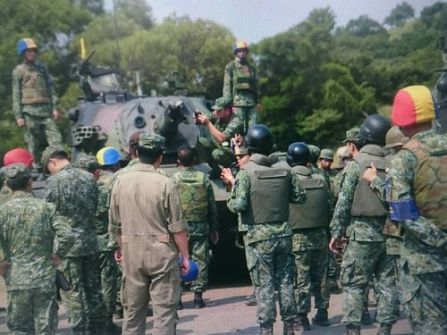
War is Boring Article on OpFor Vismods

The blog War is Boring has posted an article on US army armored vehicles visually modified to be used as opposing forces stand-ins during training.

Article excerpt:

1-ouak0twmhymkoybmxe4mrwIn 1979, the Army responded by opening the National Training Center at Fort Irwin, around 100 miles northeast of Los Angeles. The sprawling desert environment gave troops the space to use tanks, howitzers and other heavy weapons in big, conventional exercises.
To give these events added weight, the Center got a number of captured Soviet vehicles, including at least one tracked MT-LB armored personnel carrier and a BTR-60 wheeled troop carrier. But there simply weren’t enough of these real examples to form large faux enemy units.

Enter the Army’s “visually modified” tanks and armored vehicles, commonly referred to as VISMODs.

The ground combat branch built the first of these using old M-551 Sheridans. Designed with paratroopers and scouts in mind, these small tanks were light but heavily armed with an unusual and troublesome 152-millimeter combination gun- and missile-launcher.
With the exception of a single battalion off Sheridans in the 82nd Airborne Division, the Army rushed to replace the vehicles with new Bradley fighting vehicles or Humvees in the early 1980s.

But out in California, the tiny tanks got new life — with the help of numerous cosmetic add-ons — playing the role of Soviet T-80 tanks and BMP-1 personnel carriers. Technicians turned other vehicles into mocked up 2S3 self-propelled howitzers and ZSU-23-4 mobile anti-aircraft guns. In addition, a number of modified UH-1 Hueys played the role of iconic Soviet Mi-24 gunship helicopters.

Read full article here.

US Army to get new Bridging Tank

p1000890Defense News is reporting that the Army is readying production of a new bridging system after awarding DRS Technologies, Inc., a $400 million production contract to integrate the bridge platform onto an M1 Abrams tank. According to the article, the Joint Assault Bridge (JAB) will replace a couple of older bridging systems, the Armored Vehicle Launch Bridge (AVLB) and the Wolverine.  The AVLB system is on an M60 chassis, which is not only slower than the rest of the vehicles resident in an Armored Brigade Combat Team but is also becoming more difficult to maintain and sustain.  The JAB will also replace the Wolverine bridging system which came online in the late 90s and early 2000s with the intention to replace the AVLB.  The Wolverine found to be difficult to operate and maintain, an few were built due to cost. The Army built over 400 AVLBs for its own inventory and foreign militaries and produced only about 40 Wolverines.

Full Article here.

Book Review: Images of War: The Panther Tank

Images of War is a long running series by Pen and Sword books, primarily focused on WW2.  While most of the titles in the series focus on either a particular campaign or a military unit, they also include titles on different WW2 era tanks.  The latest tank themed entry in the series is The Panther Tank: Hitler’s T-34 Killer (Images of War) by Anthony Tucker-Jones.
The book is a softcover volume of 120 pages and contains over 100 photographs as well as a selection of color drawings.  The book is roughly the same dimensions as an Osprey New Vanguard or Duel book, although considerably thicker.  The paper quality is good, as is the quality of the images.  While the title of the series might make one assume this book is strictly a photo collection, there is actually a good deal of text included in the book.  A quick count reveals that roughly one of out every three pages is text, typically divided in two or three page sections addressing different models of the tank or different campaigns the Panther was involved in.

Tucker-Jones does a good job in presenting the history of the vehicle in the relatively limited number of pages available.  The book does not go in depth into the technical features of the Panther, rather focusing on the reasons for its development and combat history.  The author gives a well-balanced history of the Panther, noting that while the vehicle had some significant technical advantages over its Allied foes, it ultimately was not well suited to the needs of the German war machine in the later stages of the war.  The descriptions of various combat actions involving Panthers illustrate quite well the frustrations German crews and commanders had with these vehicles due to their size, fuel consumption and mechanical unreliability.  Our only nitpick would be that while the title of the book references the Panther as “Hitler’s T-34 Killer”, little attention is given to the Panther on the Eastern Front beyond the vehicles introduction at the battle of Kursk in 1943.  Given the limited size of this book, this omission is probably excusable.

As to the photographs, some are ones that have been reprinted in other books, some were unfamiliar to this reviewer.  The color plates are attractive and may be of use to modelers, although there are only ten pages of these.

For those looking for an introductory level book on the Panther, this book will do nicely. For those already familiar with the topic, most of the content of this book will be familiar.  That said, it’s a handsome volume with a reasonable price tag.  Currently, quite a few copies are available through third party vendors on Amazon at nearly half off the cover price, making this book a veritable bargain.

Defence Technology Review: Land 400

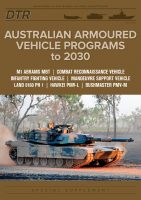
AAVP-Supplement-cover-lo-res-141x200For those looking to keep abreast of modern AFV development and news, be sure to check out the downloadable magazine Defence Technology Review.  This is an Australian based magazine that started in August of 2014 and publishes monthly.  All issues are available for download on their website.  There are also a number of special supplements, some of which deal exclusively with AFVs.  Since this is an Australian magazine, it naturally focuses on Australian defense issues.  In particular, a good deal of coverage is given to Land 400, the Australian Army’s plan to upgrade their family of armored vehicles.  The special supplements pertaining to AFVs cover the Boxer Combat Reconnaissance Vehicle, the Lynx Infantry Fighting Vehicle and Australian Armoured Vehicle Programs to 2030.

Issues of Defense Technology Review may be downloaded here.

Photos of the Day: Merkava with broken gun

The previous post about the Taiwanese CM-11 tank with the broken barrel reminded us of this series of images of an Israeli Merkava IV with a broken barrel.  These pictures come from 2014, cause of the damage not known.  If anyone knows more about this incident, let us know!

Gun Barrel snaps off Taiwanese CM-11

Taiwan seems to be having a string of bad luck regarding their CM-11 tanks this month.  A couple weeks ago they had one drive off a bridge, resulting in the deaths of several crew men.  Now, according to Focus Taiwan news channel, the gun barrel of one of their CM-11 tanks broke during live fire training.  According to the article:

201608310016t0001The incident occurred when the gun barrel cracked and then snapped at a point just behind its fume extractor after the CM-11 involved fired a second shot during a test by the 542nd Armor Brigade of the 6th Army Corps at a base in Hukou in Hsinchu County, the Army said.
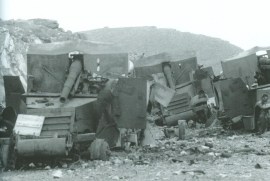
Nobody was injured during the incident, according to the Army, which is looking into what caused the gun barrel’s failure.

The Army Command Headquarters has ordered all CM-11 model armored vehicles to stop firing shots pending an investigation into the incident, the 6th Army Corps said.

The tank was more than 20 years old, a military source confirmed.

The CM-11, also known at the “Brave Tiger”, is a combination of the hull of a US made M60 MBT and the turret of M48 medium tank with a 105mm gun and improvements to the fire control systems.

Tank Destroyer article from War is Boring blog

A few days ago we posted about a new video by World of Tanks Nicholas “The Chieftain” Moran talking about US WW2 tank destroyers.  For those looking for some written background on the Tank Destroyer story, the blog War is Boring has posted a competent write up of the history of this US Army Branch during WW2.  The information in this piece will probably be familiar to anyone with a decent knowledge of US Armor history.

Excerpt:

1-ebbwRiXRR5CdPI9JNr5_pwThe tank-destroyer force was the Army’s response to the wild successes of German armor in Poland and France in 1939 and 1940. Panzer divisions would concentrate more than a hundred tanks on a narrow front, overwhelming the local anti-tank weapons of defending troops and rolling deep into enemy lines.

In 1941, the Army concluded that it needed mobile anti-tank units to intercept and defeat German armored spearheads. Towed anti-tank guns took too long to deploy on the move and it was difficult to guess where the enemy would concentrate for an attack. Instead, self-propelled anti-tank battalions would wait behind friendly lines.

When the German armor inevitably broke through the infantry, the battalions would deploy en masse to ambush the advancing tank columns.

Read the full article here.

Video: The Churchill Trust gets a Centurion

The tank restoration group The Churchill Trust has posted a video showing off their newly acquired Centurion tank.

Video Description from The Churchill Trust:

We have had a busy year, but one of the highlights has been the arrival of a Centurion tank. This represents the era after the Churchill Tank, with its Merlin derived engine, and a history that stretches from the end of World War 2 to the 1960’s and in that period, the main armament traces the development of the 20 Pounder and the 105mm gun as well as the ammunition for them. This tank is a 105mm version with an IR searchlight and gun stabilisation: the latest of the line.

To find out more about The Churchill Trust (and to view photos of their collection of Churchill tanks), be sure to visit their website or at facebook.

The Chieftain on Tank Destroyer History

In this video, World of Tanks researcher Nicholas “The Chieftain” Moran gives an hour long talk on the history and role of WW2 US tank destroyers.

Video: WoT asks What is a Tank?

This video from World of Tanks answers the question “what is a tank?”  The information is pretty basic but the production values are decent.  Certainly not essential viewing, but not the worst way to kill fourteen minutes either.