Book Alert: Mobility, Shock and Firepower: The Emergence of the U.S. Army’s Armor Branch, 1917-1945

51S16MJjknL._SX346_BO1,204,203,200_Typically our “Book Alert” posts are about books that have yet to be released.  This book alert is a little different, this is a book that was released a few years back but is available for free download.  For those interested in the history of the US Armor branch from 1917 – 1945, this book by Robert S. Cameron will be a welcome addition to their PDF library.

Download the book here.

Publishers Description:

CMH Pub 30-23-1. Army Historical Series. Captures the multifaceted development of the Armored Force from its inauspicious beginnings in World War 1 to its fully mature, operational status at the close of World War 2. Provides an excellent case study in force transformation. Gives attention to training maneuvers conducted in the interwar period. Source material includes reports, memorandums, and correspondence of the majors, lieutenant colonels, and colonels associated with armored development since World War I. First published in 2008.

Nicaragua to buy T-72?

4060858ICR News is reporting that Nicaragua is seriously considering the purchase of T-72B3 tanks following its participation in the Russian hosted “World Tank Biathlon.”  According to the article, Nicaraguan ambassador to Russia said that “We hope that soon our army will receive the T-72. I think we can discuss a purchase.”  Ties between Russia and Nicaragua have been growing, including a visit to Nicaraqua by Russian President Putin last year.  Currently, the heaviest AFV used by the Nicaraguan armed forces is the T-54/55, originally acquired via Bulgaria & Libya.

Full article here.

From the Vault: Uncle Sam Grooms his Hell Buggies

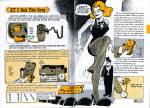
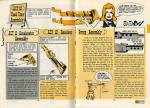
Today in the mail we got an article we bought off of ebay from the April 1940 issues of Popular Science.  The article is titled “Uncle Same Grooms his Hell Buggies: A Close up View of our Hard Hitting Tank Force.”  This article, written just before the fall of France, paints a rather optimistic picture of the quality of US tanks at the time:

While the US Army can’t compare with European mechanized forces in number of tanks, American officers are confident that we are away ahead of them in quality–that in the M2A4 model tank now being built we have the best light tank in the world.

The article goes on to describe a powerful new medium tank being developed with four machine guns and a 37mm gun.  Of course, the events of the summer of 1940 would show these American officers just how wrong they were in this article (assuming they were not just talking up US equipment for the sake of public morale.)  The article has a few interesting pictures and tells of how the armor force used a remotely controlled FT-17 as a moving target.

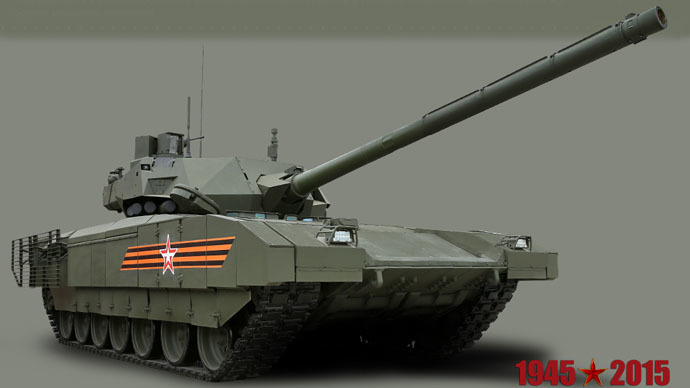
T-14 Armata stealth claims questioned by experts

armata.siJane’s has posted an article about how armor experts are sceptical over claims made by the manufacturer of the new Russian T-14 Armata that it is essentially invisible to radar.  According to the article, the invisibility claim was made by the director of the Nizhi-Tagil-based UralVagonZavod (UVZ) plant, Vyacheslav Khalitov, on Ekho Moskvy radio on 3 July.  Khalitov said the T-14’s hull is coated with special radar-absorbing paint and other materials and appliqués that make it difficult to be detected.  The article quotes and unnamed retired US army flag-rank officer with experience in AFV development who states that “these claims would have to be proven. Placing heat-generating components ‘deep inside’ in the vehicle won’t help; modern thermal technology is very sensitive and when the tank is moved, or a weapon is fired, or a person is exposed, the thermal signature will light up. Plus, no matter where the engine is, when an engine big enough to move a 40- to 50-ton tank is fired up, it will have a signature.”  The article also notes that Russian specialists familiar with radar signature reduction techniques said that most of the research in this area has been done with aircraft in mind and that the technology is not optimised for protecting ground targets.

The full article can be read here.

Column on General Devers

20150807__726402-s300-p1_500The regional history section of the York Daily Record (Pennsylvania) has posted a column about  local researcher Rich Robinson, working on a biography of General Jacob Devers.  Devers, also a resident of York PA, was head of the US Armor force during WW2, Robinson is quoted in the article saying “I would very much like to do him (Devers) justice in view of the way he has been maligned over the years but without making him some kind of one dimensional figure.”   Robinson will serve on a panel of Devers experts as part of a two -day event: “Quiet Streak of Lightning: York’s World War II General Jacob L. Devers.” That program is set for Nov. 6-7 at the York County Heritage Trust.  Renowned World War II historian Dr. Scott Wheeler will lead off the conference, presenting on his book: “Jacob L. Devers: A General’s Life.”  The full column can be read here.

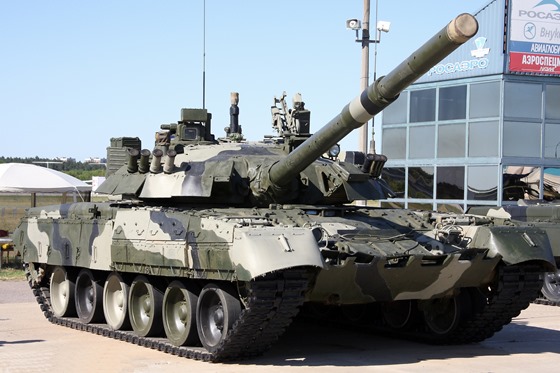
War is Boring blog declares T-80 overrated

T80FrontView_thumbThe blog War is Boring has posted an article declaring the T-80 to be Russia’s most overrated tank.  For those interested in reading their analysis, you may do so here.  The article has also appeared on the National Interest website with the even more inflammatory headline ” This is Why Russia’s T-80 Tank is a Total Disaster.”  The article seems to basing it’s conclusions on the fact that the T-80 did not perform well during the 1994 Chechen war and that the T-80 was relatively expensive an suffered from high fuel consumption.  Do these factors justify calling the vehicle a “total disaster?”  In our opinion probably not.

From the Vault: M85 .50 Caliber Machine Gun

In honor of being declared the “blog of the month” over at The Firearms Blog (TFB), we will be posting about tank and afv related small arms this month.  A few days ago we posted about the not so successful M73/M219 7.62mm coax machine gun.  Today we will be taking a look at it’s larger cousin, the M85 .50 cal machine gun.  Much like the M73, the M85 had a very mixed reputation among US tankers.  It was intended to replace the venerable M2 .50 cal machine gun which had acquired an excellent reputation throughout WW2 and into the post war era.  However, the M2 was considered rather heavy and bulky for use inside the enclosed commander cupolas common on US postwar tanks.  By the time the M60 MBT was introduced, the M85 went into service, mounted in the commanders cupola/turret.  The M85 was also used by the Marine Corps in the LTVP7.  The M85 was almost 11 inches shorter and 20 pounds lighter than the M2 and featured a quick barrel change option and two different rates of fire.  The M85  could be configured for either left or right hand feeding and in its tank gun configuration was fired by means of a solenoid.  The M85 gun suffered from a history of reliability problems which it was never able to shake.  By the time the US adopted the M1 Abrams MBT in  the 1980’s, the M85 was replaced by the gun it was originally designed to supersede, the M2 .50 cal.  Oddly enough, while the M85 and M2 both fire the same .50 cal round, ammunition for the two weapons is not interchangeable due to the use of different style belt links.   According to globalsecurity.org, the USMC has in storage 3 million .50 caliber cartridges loaded in belts designed for the M85, despite the fact that they removed the gun from their inventory, replacing it on the LTVP7 series (now designated AAV-P7)with the M2.

PS Magazine article on the M85 (Issue #146 1965)

PS Magazine article on the M2 .50 cal (Issue #168 1966

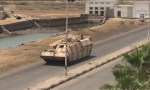
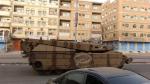
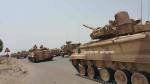
AMX Leclerc deployed in combat in Yemen

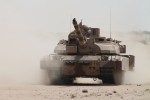
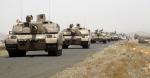
Jane’s has posted an article about how armored units from the UAE have spearheaded a breakthrough in the conflict in Yemen.  The Emirati armored brigade helped pro-government forces push out from the southern port city of Aden and capture Al-Anad Air Base 48 km to the northwest.  While the UAE did not publically announce the deployment of its armored forces in the conflict, it became apparent to astute observers that the vehicle types appearing in pictures indicated UAE involvement.  By the end of July, BMP-3 IFVs had been filmed by AL-Jazeera and in early August, news footage showed Leclerc MBTs advancing in a column.  Somewhat amusingly, one of the best quality videos that emerged of these Leclerc tanks is a clip from RT Ruptly which mistakenly identifies the vehicles as “Hundreds of Abraham M1 Abrams, provided by Saudi Arabia.”  This represents the first use of the Leclerc MBT in combat, although it had been previously used in peace keeping missions Kosovo and Lebanon by French forces.

Also identified have been the SPG Denel G6.  Video of this vehicle was taken during fighting for Anad airbase.

According to the Jane’s article, some of the Leclercs in Yemen are equipped with the AZUR urban warfare protection package. The UAE is known to have bought at least 13 AZUR kits, so the presence of Leclercs without the additional armor suggests a second battalion has been deployed to Yemen.  The Leclerc tanks operated by the UAE are known as the “tropicalised” variant, differing from French Army Leclerc in that the UAE vehicles have a MTU MT883 engine and Renk transmission rather than the French SACM V8X Hyperbar engine and  SESM ESM 500 transmission.

Photo gallery of UAE armored vehicles in Yemen

Overlord’s Blog on “A Killa” Sherman tank

Overlord’s Blog has posted a piece by David Lister on the wartime career of WW2 British tank commander George Dring.  While the details are a bit unclear, George Dring and his tank, named “Akilla”, managed to destroy or damage several heavy German AFVs during the Normandy campaign.

Excerpt:

MBa47HyAs Sgt Dring approached a crossroads his habit of getting out for a shufti payed off. He sneaked through a cornfield and saw five tanks in a copse of trees below him, suddenly one started moving out. This is where some confusion comes in. By Sgt Drings words it appears he thought it might be a new tank that had recently been reported by intelligence, a Jagdtiger. However with hindsight we know it can’t have been. Sgt Dring does say it was a very large tank, which he’d ever seen before. However a later intelligence report simply calls it a “Panther”, but Sgt Dring was familiar with Panthers. So your guess is as good as mine as to what it could have been, a King Tiger? A Jagdpanther? Or a normal Panther? Either way it was bad news for a 75mm armed Sherman! Sgt Dring reversed his Sherman a little way up a side road and waited, the enemy tank moved out in front of him, and his first shot hit it in the drive sprocket shredding the track and immobilising the tank. The crew promptly bailed out.

Read the entire article at Overlord’s Blog.

Armata themed food truck?

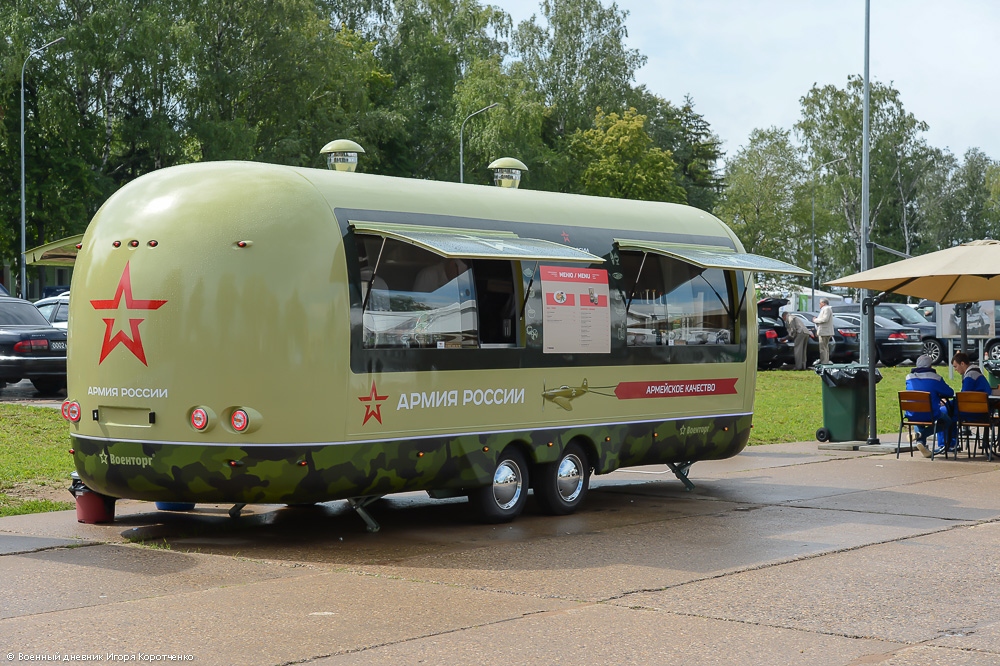
These pictures were brought to our attention in a forum recently.  Apparently the Russians are so excited about the Armata that they are painting them on the side of food trucks?  Anyone care to translate the text on the truck for us?

1cNBF q6vyb