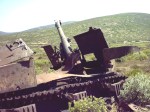
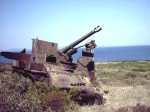
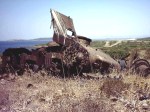
A Tank and AFV News reader from Italy has submitted some interesting pictures of some Sexton SPGs used as range targets in Italy. These vehicles differ from standard Sexton SPGs in that they were re-armed with the 105mm Obice da 105/22 gun (but still retaining the original 25 pounder gun recoil system.) These two wrecks are located at Cape Teulada, at the Italian Army training range. The reader who submitted the pictures states that he and two others of the 1st Regiment were ordered to select 14 vehicles from the Italian army armor storage area at Lenta in November of 1986 to be transported to the firing range. Of the 14 Sexton SPGs that were selected, one was retained as a monument at the barracks while the others were used as range targets. (This information was sent to us written in Italian, we have translated it as best as possible using Google translate.)
Bradley IFV stops traffic in Houston
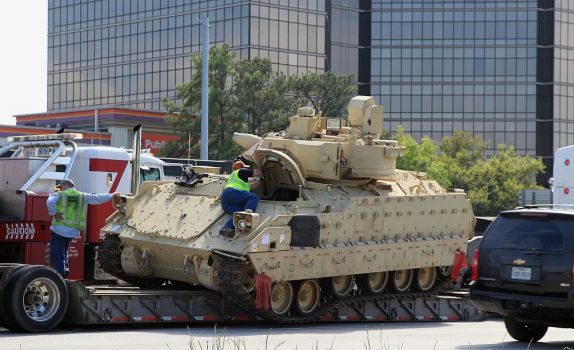 The Houston Chronicle is reporting that yesterday a Bradley Infantry Fighting Vehicle slide off the trailer it was being carried on causing traffic to be shut down as well as providing an interesting sight for passing motorists. According to the article TranStar spokeswoman Dinah Massie said the Bradley IFV partly fell off a trailer that was transporting it. Photos from the scene indicate the trailer may have collapsed under the tank. The article may be viewed here, including a small gallery of photos of the incident.
New issue of ARMOR released
 The October-December 2014 issue of ARMOR was posted online on March 20th. ARMOR is the official magazine of the US Armor Branch and has been published in one form or another for 125 years. As the Armor Branch’s professional-development bulletin, ARMOR issues will vary in terms of how much they will be of interest to the average person interested in tanks and armored vehicles. Fortunately, there is a search feature on the eArmor page and select back issues are available for download. Of particular interest is a series of articles from past issues collected as eArmor Heritage Historical Series. It is worth noting that this list includes an article by Richard Ogorkiewicz titled “The Ten Ages of Tank” from the May-June 1952 issue. Considering that Ogorkiewicz just recently had a book on tanks published by Osprey, it’s fair to say he much hold the record for longest writing career on the topic!
The newest issue of ARMOR may be downloaded here. Back issues are available here.
Kurganets BMP-25 shown in photo
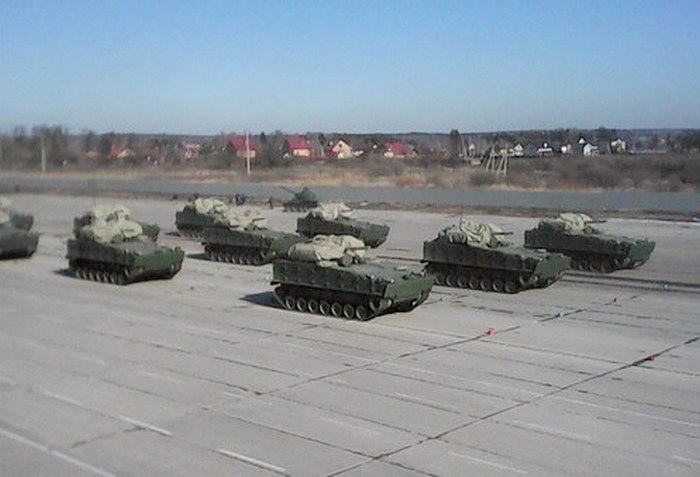 Sputnik News has posted a brief article about the new Russian Kurganets BMP-25 infantry fighting vehicle. The article features a picture of these vehicles rehearsing for the upcoming May 9th Victory Day parade. The article notes that the Kurganets-25 weighs 25 tons and is protected with modular armor that can be adapted to meet specific mission requirements. It is armed with a 30mm cannon and four Kornet-EM anti-tank guided missile launchers, all of which will reportedly be controlled by an onboard automatic firing system capable of choosing its own targets. The turret is remotely operated by the three-man crew. Full article here.
Turkish firm to produce tank engine
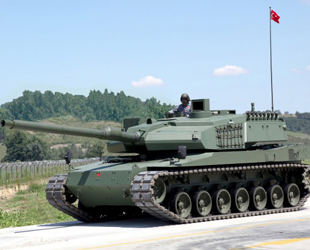 Defense News is reporting that a privately owned Turkish engine maker has signed a contract to produce an engine for the Turkish Altay tank. TUMOSAN’s Power Group Development program signed the US $206.35 million contract on March 17 with the country’s procurement office, the Undersecretariat for Defense Industries (SSM). The program involves the indigenous design, development, prototype production, testing and qualification of an engine for the Altay. TUMOSAN also says it will design and develop a transmission for the tank and produce critical parts for its engine, including the diesel pump, electronic control unit and injector. TUMOSAN set a goal of 54 months for the project. This announcement follows news from earlier this month that Turkey’s months-long negotiations with Japan’s Mitsubishi Heavy Industries for joint development and production of an engine for the Altay have failed largely due to the Japanese government’s near total ban on arms exports. Full article here.
Q & A with Jim Warford about Soviet/Russian Armor
 Tank and AFV News recently had the chance to do a Q & A with retired US Armor officer and writer James M. Warford. Mr. Warford was commissioned in Armor in 1979 as a Distinguished Military Graduate from the University of Santa Clara, Santa Clara, California. Mr. Warford has held a variety of Armor and Cavalry assignments, ranging from tank platoon leader to brigade S3, and has served as a tactics instructor both at Fort Knox, Ky. for AOAC, and at CGSC, Fort Leavenworth, Kan. Upon retirement in September, 1996, he was awarded the Silver Medallion of the Order of St. George. He has written numerous articles for ARMOR, the official journal of the Armor Branch, many of which focus on Soviet and Russian armor. He is also a regular contributor at the online forum TankNet.com.
T&AFVNews – You served in armor from 1979 to 1996. Can you tell us what positions you held during your career? What vehicles types did you command?
British Army has twice as many horses than tanks
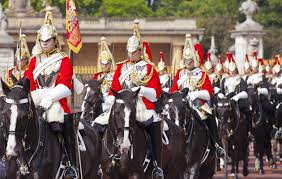 The Mirror is reporting that the British Army has twice as many horses than tanks currently. Obviously, these horses are not used in actual military service but rather are for ceremonial purposes. The Mirror is a tabloid and the article is written in a rather sensationalist style, including a rather ridiculous online poll asking people “What would you rather ride into battle, a tank or a horse?” That said, the article does point out the effects that budget cuts have had on the British Military, which currently has a total number of 227 Challenger 2 Main Battle Tanks with another 141 Challenger variants in use. The article notes that currently there are 485 horses in service with the Household Cavalry Mounted Regiment, the King’s Troop Royal Horse Artillery, the Household Division and at the Defence Animal Centre.
Armata tank purportedly filmed
International Business Times is reporting that the new Russian tank Armata has purportedly shown up in a video released on Monday. According to the article, the video was uploaded to YouTube by a user named Alexander Smirnov, who captured the video at an undisclosed location using a handheld video camera from the drivers seat of a vehicle. The actual type of tank in the video has yet to be verified. The article notes that Oleg Siyenko, general director of Uralvagonzavod, which developed the Armata system, told ITAR-TASS that “a whole family of armored vehicles based on the Armata platform” would be displayed at this year’s Victory Day parade. Still photos of vehicles purported to be Armara tanks are available here.
Tanks in the Antarctic: Unidentified US light tank?
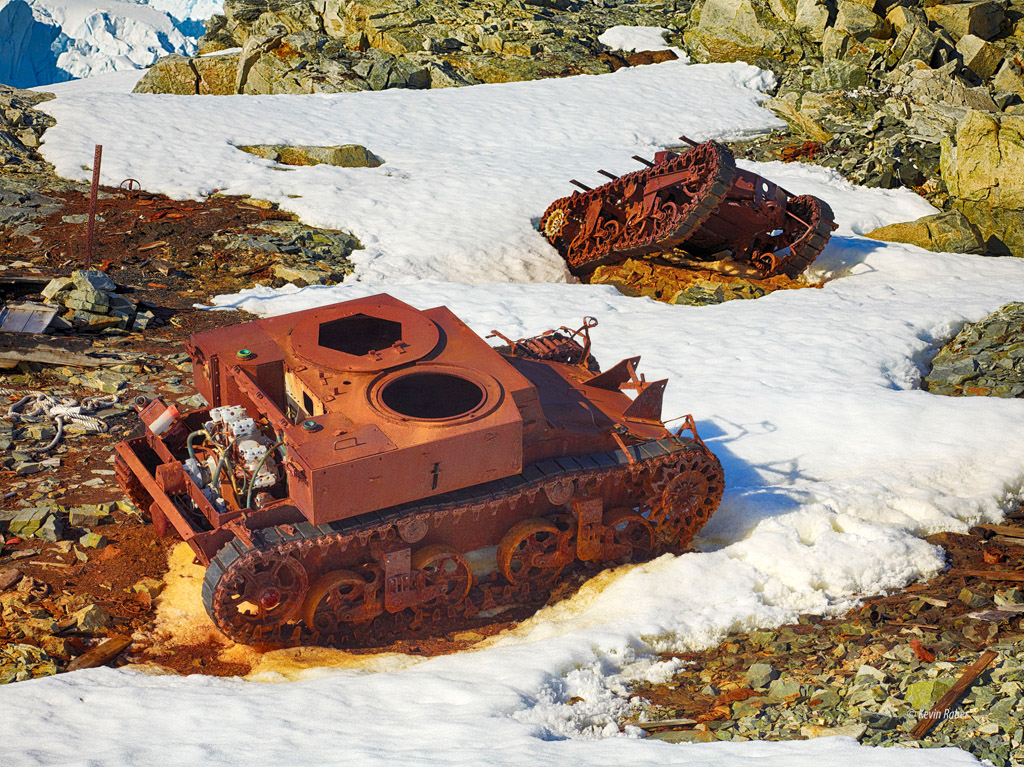 Status Report has an interesting article about three M2A2 light tanks sent to the Antarctic in 1939 as part of an expedition. Russian tank researcher Yuri Pasholok was able to find a Soviet report about the expedition in the Russian archives detailing some of the technical issues encountered with the light tanks in the rather harsh climate of the Antarctic. These details are translated and available over at the Archive Awareness blog for those that are interested. The Status Report article can be read here. Pictures of the rusting M2A2 tanks can be found on the photography websites of Kevin Raber and Martin Grace.
Kevin Raber Pictures: Tanks in Snow, Antarctica ,Tanks and Ice , Rusty Tank treads and gears, Antarctica
Martin Grace Picture Gallery here
The photos by Martin Grace reveal that while one of the vehicles is an M2A2 as stated in the Status Report article, the other vehicle is not. [Read more…]
Painful Birth of the BMP-2
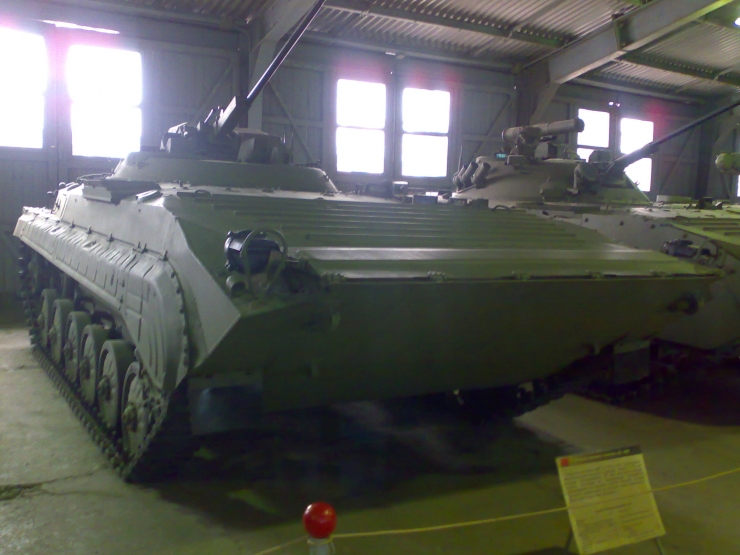 Over at Armored Warfare, they have published a two-part article on the history of the BMP-2 IFV.
“The concept of an infantry fighting vehicle (also known as the IFV) is not a new one. It evolved from the original armored personnel carriers that in turn appeared – in some cases – even before WW2. It was however only much later before this class of vehicles became prominent on the battlefield, thanks to its massive use by NATO and Warsaw Pact forces. There are many vehicles of this class both in and outside of NATO and the former Warsaw Pact countries, but there are two vehicles representing the teething issues of this vehicle class very well – and those are the Bradley IFV and the Soviet BMP.”
To read the complete article, please click on Part 1 and Part 2.

 Tank and AFV News