NYT: Mark Renton of the Museum of American Armor

Earlier this month the New York Times ran a profile piece on Mark Renton of the Museum of American Armor at Long Island.  The title of the article is Keeping the Tanks Rolling. Jeeps and Cannons, Too, it’s worth a read.

Article excerpt:

13CHARACTER2-master675OLD BETHPAGE, N.Y. — The well-being of the intimidating fleet of tanks, cannons and jeeps at the Museum of American Armor on Long Island is held securely in the greasy hands of Mark Renton. Mr. Renton is the museum director, though the title might be slightly lofty. After all, he is the museum’s only salaried employee and he cares little for paperwork or administrating.

But if you need someone to drop a new motor in a Sherman tank, or build a 1940s jeep completely from spare parts, Mr. Renton is your man.

In a hangarlike building here, Mr. Renton restores and maintains one of the few operational fleets of World War II vehicles and artillery in the country. There are 45 military vehicles, and the artillery includes antiaircraft and antitank guns, although the guns no longer fire.
Read the full article here.

Photo of the Day: Ordnance in a Box

antitaknround0823

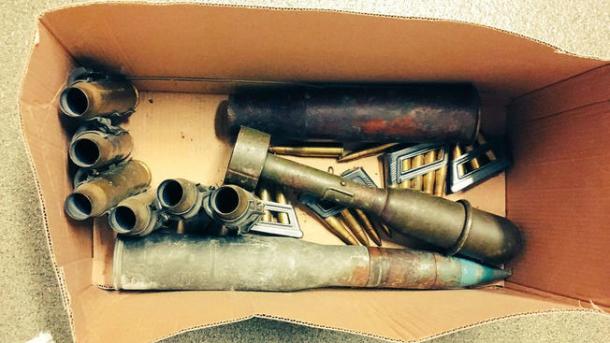
This picture shows some old ordnance in a cardboard box that we recently dropped off at the Dixon IL police department.  The box was dropped off by an elderly gentleman who had an affiliation with a nearby gun range and appears to contain a M9 anti-tank rifle grenade.  The munitions were taken to a nearby garage and later disposed of by the county bomb squad.  The Dixon Police department posted a picture of the box on Twitter with the message “If you find an unexploded WWII anti-tank round in your home, PLEASE, don’t drive it to the police department in a cardboard box.  Call us and we will come to you to help dispose of it.”

source


Book Alert: British Battle Tanks: British-made tanks of World War II

Osprey Publishing has released a new hardcover book by David Fletcher titled British Battle Tanks: British-made tanks of World War II.  This book is a follow-up to last years book British Battle Tanks: World War I to 1939.  For those familiar with the WWI book, this new book follows the same format, although with a slightly higher page count (280) than the previous book.  This is a well illustrated book, with photos, drawing or charts on every page accompanying the text.  These books are both published in association with the Tank Museum at Bovington.  Author David Fletcher served for many years as the Museum historian and is widely regarded as one of the most knowledgeable researchers on the topic of British armor.
Publisher’s Description:

Building on the earlier volume dealing with British armor of the First World War, this is the second of a multi-volume history of British tanks by renowned British armor expert David Fletcher MBE.

This volume traces the story of the British use of the tank through the early years of World War II, when Britain relied on its own tanks built in the late 1930s, and those designed and built with limited resources in the opening years of the war. Plagued by unreliable vehicles and poorly thought-out doctrine, these were years of struggle against an opponent well versed in the arts of armored warfare. It covers the development and use of the Matilda, Crusader, and Valentine tanks that pushed back the Axis in North Africa, the much-improved Churchill that fought with distinction from North Africa to Normandy, and the excellent Cromwell tank of 1944–45. It also looks at Britain’s super-heavy tank projects, the TOG1 and TOG2, and the Tortoise heavy assault tank, designed to battle through the toughest of battlefield conditions, but never put into production.

100 Years Ago: British Tank “Fray Bentos”

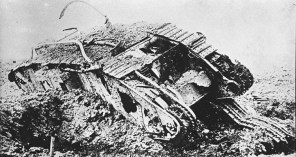
Mark-IV-female_Ypres_1917_1007-A6-CopyIn August 22 of 1917, the British Mark IV tank named “Fray Bentos” experienced the longest tank action of the war, being caught in battle for 60 hours.  Commanded by Donald Richardson, a wholesale grocer who named the tank after a brand of canned meat, this tank became trapped near enemy lines during the Third Battle of Ypres.  Despite almost all the crew being wounded, they were able to fight off repeated attacks by German forces.  Eventually, with the crew out of water, they decided to risk an escape, running back to British lines.  Remarkably, during the entire period of the action, only one crew member was killed.  The crew of the Fray Bentos would be awarded for their bravery, becoming the most highly decorated tank crew of the war.
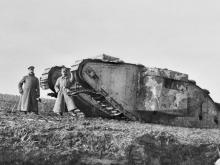
Of course, there is much more to this story.  Fortunately, several articles have appeared recently marking the centenary of this tank and her brave crew.  Click on the links below to find out more of this story.

The Tank Museum – Tank 100 – Trapped: The Story of Fray Bentos

The Telegraph – The Siege of Fray Bentos: the World War One tank heroes who survived 72 hours trapped in No Man’s Land

Daily Echo – The incredible story of tank ‘Fray Bentos’ is being told at the Tank Museum

Tank Chats #42 Elefant

Tank Museum curator David Willey does a nice job describing the history of the German Elefant tank destroyer.

Video: The M2A2 Mae West, circa 1936

The 102d Public Affairs Detachment has released a video about the M2A2 light tank on display at the Mississippi Armed Forces Museum.  The video features Staff Sgt. Mike Needham explaining the significance of this vehicle as the first American designed tank to be accepted and put into production by the US Army.  We would add one point of clarification.  The Mark VIII Liberty tank was partially designed by the US and 100 were assembled at Rock Island Arsenal.  However, the hull components were manufactured in the UK and then shipped to the US.  The M2A2 represents the first tank solely designed and built in the US and adopted into service.

World War I: Archaeological dig at the Somme turns up ‘missing’ British tank that fled due to ‘cowardice’

The Daily Telegraph has posted a new article about an archaeological dig that has turned up a WWI era British tank.

Article excerpt:

8046a3e42ee4a541e24901049c0de9ffThe first major archaeological dig in 100 years at the site of one of Australia’s biggest military defeats has turned up a “missing” British tank that Aussies long thought had fled the Bullecourt battleground due to cowardice.
The British Ministry of Defence (MoD) backed team of British and Australian archaeologists and volunteers have just unearthed tank armour plates with original racing green paint work, bits of track, its six pounder shells and other metal objects belonging to “Tank 796”.

The French Government had issued an extraordinary permit for the first dig of an Anzac battlefield in the Somme since the end of the Great War, to solve the mystery of the fate of a dozen British tanks that were deployed to Bullecourt to support the 1917 assault of the German line by the Australian 4thDivision but “disappeared” leading to the slaughter of 10,000 Diggers.

Read the full article here.

Soviet T-10: Q&A with Stephen “Cookie” Sewell

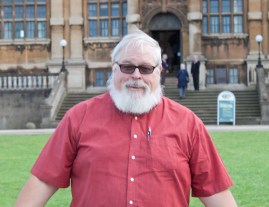
Stephen Sewell croppedTank and AFV News corresponded recently with Stephen “Cookie” Sewell, co-author of the new book Soviet T-10 Heavy Tank and Variants published by Osprey.  Mr. Sewell was born in New York and is a retired US Army chief warrant officer and Department of the Army intelligence analyst.  Trained in both the Vietnamese and Russian languages, Mr. Sewell has written numerous intelligence articles as well as many pieces on American and Russian armor.  He is an enthusiastic scale model builder and the founder of the Armor Model Preservation Society in 1992.  He is also a prolific reviewer of model kits and books.

——————————————————————————

Can you give us a description of your career in the US Army and US government?

I entered the Army in September 1968 and was trained as a Vietnamese linguist. After a short tour in Vietnam and then at NSA was retrained as a Russian linguist in 1973. Spent a total of nine years on strategic intelligence assignments and nine years tactical ones. Retired in 1990 as a Chief Warrant officer. Due to expertise hired back three months later into same job I retired from and arrived two weeks before Desert Shield/Desert Storm started. Changed to the National Ground Intelligence Center predecessor in 1991 and then to that organization when created in 1994. Retired from there in 2011

How did you get the nickname Cookie?

I came back from Vietnam in 1971 and my brother wanted me to see a new kids’ show on PBS called “Sesame Street”. First Muppet I saw was the Cookie Monster, who in the space of two minutes ate an entire box of cookies, the box, and a telephone. My kind of guy! When I got to NSA I started drawing him doing stuff like eating MiG-21s and people in my office started referring to me as “Cookie Monster”. Stuffed my desk with chocolate [Read more…]

Book Alert: Dubno 1941: The Greatest Tank Battle of the Second World War

According to Amazon, today marks the North American release of the new book Dubno 1941: The Greatest Tank Battle of the Second World War by Aleksei Isaev.  This is a 224 page hardcover published by Helion and Company.  Mr. Isaev has written numerous books on the Eastern Front during WWII, primarily in Russian.

Publisher’s Description:

In June 1941 – during the first week of the Nazi invasion in the Soviet Union – the quiet cornfields and towns of Western Ukraine were awakened by the clanking of steel and thunder of explosions; this was the greatest tank battle of the Second World War. About 3,000 tanks from the Red Army Kiev Special Military District clashed with about 800 German tanks of Heeresgruppe South. Why did the numerically superior Soviets fail? Hundreds of heavy KV-1 and KV-2 tanks, the five-turret giant T-35 and famous T-34 failed to stop the Germans. Based on recently available archival sources, A. Isaev describes the battle from a new point of view: that in fact it’s not the tanks, but armored units, which win or lose battles. The Germans during the Blitzkrieg era had superior T&OE for their tank forces. The German Panzer Division could defeat their opponents not by using tanks, but by using artillery, which included heavy artillery, motorized infantry and engineers. The Red Army’s armored unit – the Mechanized Corps – had a lot of teething troubles, as all of them lacked accompanying infantry and artillery. In 1941 the Soviet Armored Forces had to learn the difficult science – and mostly ‘art’ – of combined warfare. Isaev traces the role of these factors in a huge battle around the small Ukrainian town of Dubno. Popular myths about impregnable KV and T-34 tanks are laid to rest. In reality, the Germans in 1941 had the necessary tools to combat them. The author also defines the real achievements on the Soviet side: the Blitzkrieg in the Ukraine had been slowed down. For the Soviet Union, the military situation in June 1941 was much worse than it was for France and Britain during the Western Campaign in 1940. The Red Army wasn’t ready to fight as a whole and the border district’s armies lacked infantry units, as they were just arriving from the internal regions of the USSR. In this case, the Red Army tanks became the ‘Iron Shield’ of the Soviet Union; they even operated as fire brigades. In many cases, the German infantry – not tanks – became the main enemy of Soviet armored units in the Dubno battle. Poorly organized, but fierce, tank-based counterattacks slowed down the German infantry – and while the Soviet tanks lost the battle, they won the war.

Video: Military Museum under Construction

This video showed up last month on Youtube showing a small boy running around a military museum under construction.  According to the description, the boy is the son of the museum architect.  Little other information is given in the video description, although it would appear that this facility will house quite a few tanks and armored vehicles.  The location of this museum is not provided.  Obviously, it’s somewhere in the Middle East (perhaps Egypt?)  If anyone knows the answer, please say so in the comments.  Also, beware the bad pop-music soundtrack to the video.