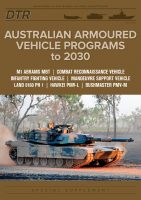
 For those looking to keep abreast of modern AFV development and news, be sure to check out the downloadable magazine Defence Technology Review. This is an Australian based magazine that started in August of 2014 and publishes monthly. All issues are available for download on their website. There are also a number of special supplements, some of which deal exclusively with AFVs. Since this is an Australian magazine, it naturally focuses on Australian defense issues. In particular, a good deal of coverage is given to Land 400, the Australian Army’s plan to upgrade their family of armored vehicles. The special supplements pertaining to AFVs cover the Boxer Combat Reconnaissance Vehicle, the Lynx Infantry Fighting Vehicle and Australian Armoured Vehicle Programs to 2030.
Issues of Defense Technology Review may be downloaded here.


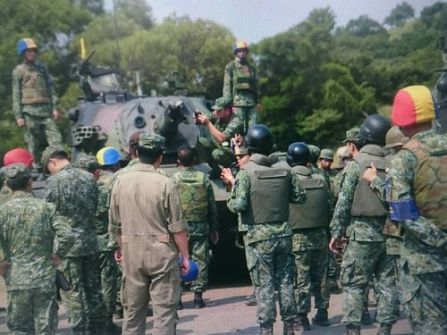 The incident occurred when the gun barrel cracked and then snapped at a point just behind its fume extractor after the CM-11 involved fired a second shot during a test by the 542nd Armor Brigade of the 6th Army Corps at a base in Hukou in Hsinchu County, the Army said.
 The tank-destroyer force was the Army’s response to the wild successes of German armor in Poland and France in 1939 and 1940. Panzer divisions would concentrate more than a hundred tanks on a narrow front, overwhelming the local anti-tank weapons of defending troops and rolling deep into enemy lines.
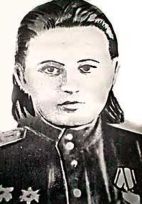 Flying was all the rage among Soviet youth in the few years preceding the Great Patriotic War. “Komsomol, to the skies!” the slogans called. Among the many young men and women who answered the call was a citizen of the city of Biysk named Nina Ilyinichna Bondar. In the late 1930s, while still in school, she joined and aero club and learned to fly the light U-2 biplane.
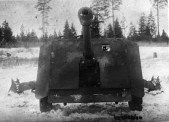 The development of anti-tank artillery followed more or less the same process in many countries. This resulted in the USSR creating a 100 mm BS-3 gun in 1944 and the Germans with the 88 mm Pak 43 gun, a weapon with excellent characteristics that forced Soviet tank designers to rethink their requirements for armour protection. However, the British arrived at the best solution, creating the Ordnance Quick-Firing 17-pounder, which had the most balanced characteristics. You can familiarize yourself with the gun in detail by viewing these photos and read about its creation and trials in the Soviet Union here.
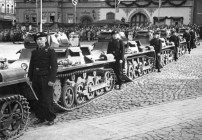 German generals often call PzKpfw I and PzKpfw II tanks “training” tanks in their memoirs. This is true in some way, as many converted PzKpfw I tanks were used to train crews. However, during the development of these tanks, there wasn’t a word uttered about training as their main function. The Wehrmacht’s first tanks were created as typical light tanks of the early 1930s, which mostly had machinegun armament. With this design, the Germans aimed towards the ideal concept of a German tank, setting the foundation for all subsequent vehicles of the Third Reich. The first member in the family that would become the weapons of blitzkrieg was the PzKpfw I Ausf. A.
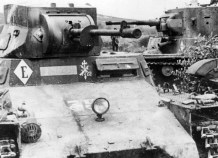 The Spanish Civil War began on July 17th, 1936. By the end of the month, the rebels gained the support of Italy and Germany, who promised, among other things, supplies of military hardware. In mid-August, Italian L3/35 tankettes arrived in Spain. German tanks arrived much later: 32 PzKpfw I Ausf. A tanks and one command vehicle were received in October of 1936. At approximately the same time, the first Soviet T-26es arrived in Spain and became the main opponents of the rebel tanks. As for the “Spanish” PzKpfw I Ausf. A, one of them became a Soviet trophy and was run through a whole spectrum of trials. What did the Soviet testers discover and what conclusions did they make?
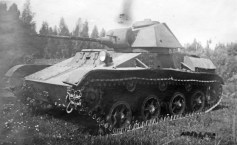 GABTU had to reach a compromise on many issues when it accepted the T-60 tank for service. It was obvious that this tank is inferior to the T-50 in nearly all characteristics, but its production could be set up very quickly and it could be produced by the thousands. However, GABTU was seriously worried about the tank’s armament. Trials of the 20 mm TNSh gun showed that its penetration was equal to the DShK high caliber machinegun. It is not surprising that the issue of improving its armament was raised even before the first prototype was built. This modernization went in several directions, one of which resulted in the T-45 tank.
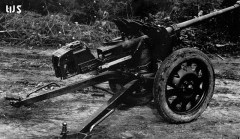 In 1942, the Allies captured an interesting anti-tank weapon designed for the German army and actively used on all fronts of WWII since 1914. Its distinguishing feature from other anti-tank rifles and cannons was its conical barrel, the caliber of which was larger at the breech than at the muzzle.Officially, the gun was called 2,8 cm schwere Panzerbüchse 41 (2,8 cm s.Pz.B. 41). German nomenclature placed it into the small arms category, but both the Red Army GAU and the military ministries of Great Britain and the United States classified it as artillery. The difference in classification comes from the fact that this weapon has all the characteristics of a cannon: carriage (upper and lower), shield, mount with a recoil brake, but the aiming was done by hand, by moving the gunner’s body and moving the barrel up and down.
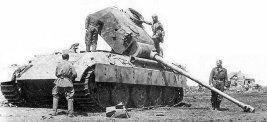 The Voronezh Front, protector of the south flank of the Kursk salient, found itself in the way of a powerful German offensive. However, this scenario played out quite unlike what German commanders expected. Most problems were faced by the 48th Tank Corps, which got stuck at the first Soviet line of defense on July 5th, 1943. Even 200 Panthers, thrown into battle near Cherkasskoye where Grossdeutschland division was spinning its wheels did not improve the situation.
 Tank and AFV News