This video of a T-90 cardboard target tank showed up on youtube a few days ago. These target tanks are being used by the US 3rd Battalion, 69th Armor Regiment and their Bulgarian allies as they practice firing main gun rounds and small arms and crew-served weapons in Bulgaria at Novo Selo Training Area, Bulgaria, June 25.
Edit: Several views have pointed out that this vehicle resembles a T-72M1 much more than it does a T-90. We agree with them.
 In the afternoon five Type 95 Ha-Go tanks approached the roadblock. The lead tank was spewing out smoke in an attempt to conceal the other four. As they approached the roadblock they began to rake the US positions with their machine guns and the 37mm main guns. PFC Vlug grabbed his M9 Bazooka and charged the Japanese tanks.
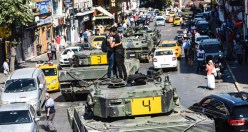 A chef at a restaurant in Istanbul, Danyal Şimşek, and the restaurant owner, Mehmet Şükrü Kintaş, told Anadolu Agency in Istanbul Thursday that they stopped almost 10 tanks this way.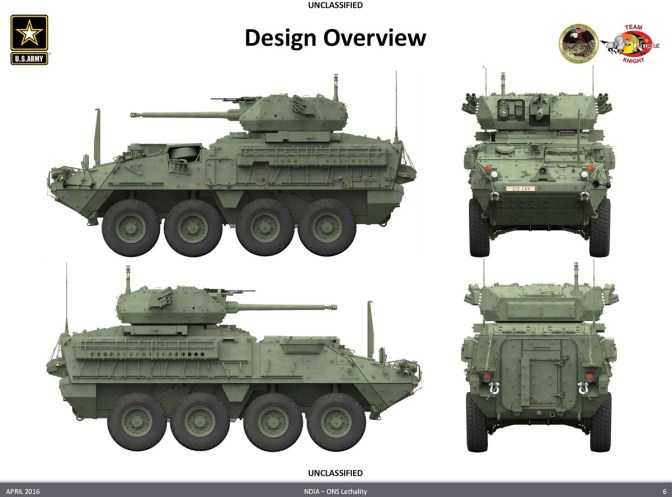
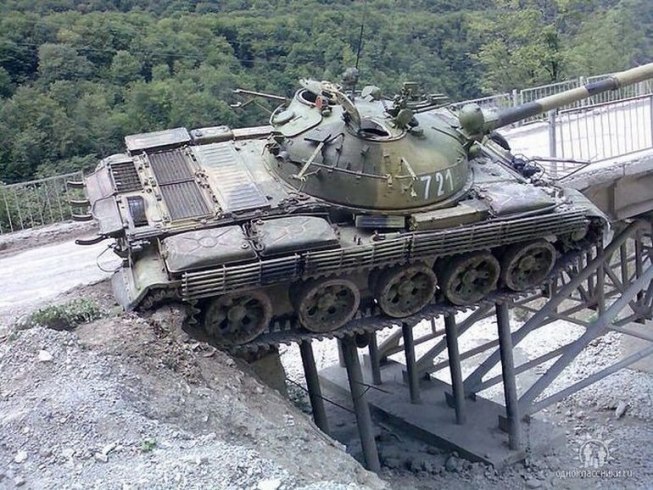
 “So what do you think of France’s new super tank, the Leclerc?” a retired colonel in the French army’s logistical brigade jokingly asked me in 2002. “You know, the one we paid a fortune for and that we’ll never use in battle.”
 Do you need a Soviet-designed surface-to-air missile defense system to deter your neighbors? If so, a small U.S.-based arms broker named the Redfish Trading Company is offering to sell a complete Buk-MB complex—a Belarusian modification of the original Soviet-era SA-11 Gadfly air defense system—to a paying customer. The emailed sales pitch came with a detailed brochure outlining the technical characteristics of the weapon and an animation from Almaz-Antey showing off the capabilities of Russia’s layered integrated air defense system.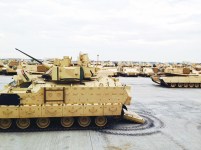
 Russian Uralvagonzavod (UVZ) scientific-research corporation has halted the deliveries of armoured vehicles to Iraq due to delayed payments last year, according to the UVZ`s 2015 annual report. “In 2015, the UVZ Corporation stopped the shipping of the defense production to the No.356 customer (Iraq) due to delayed payments. The contracts signed with the No.012 (Algeria) and the No.356 (India) customers were implemented in strict accordance with the terms of the signed documents. The export sales of the UVZ’s defense production increased by 35% last year (compared to 2014),” TASS reported, citing the UVZ document.
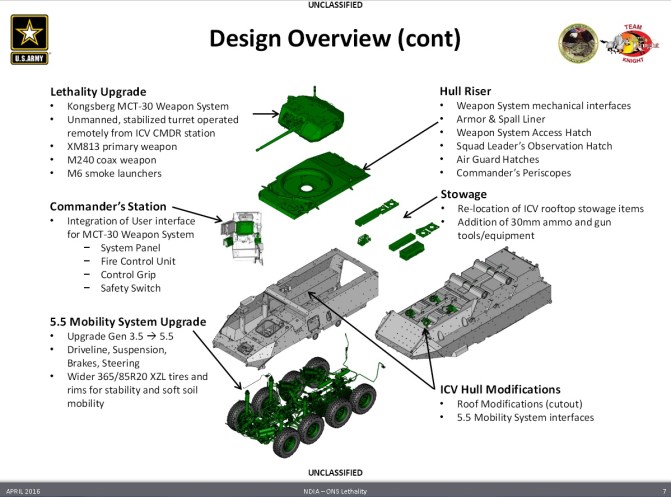
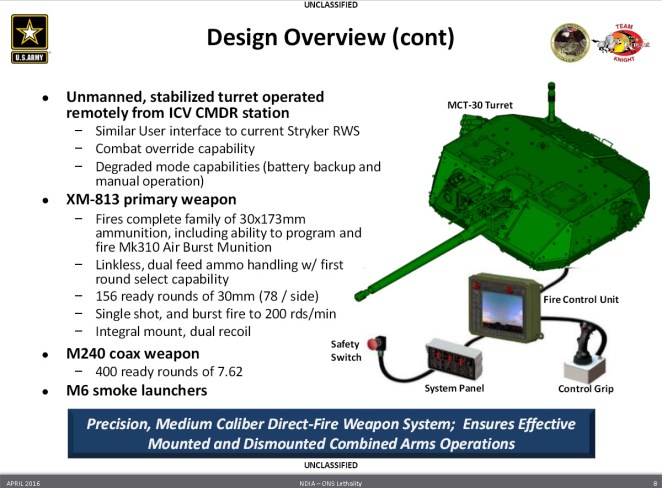
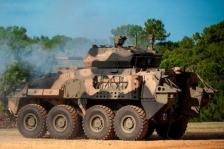 Senior U.S. Army maneuver officials recently took part in a firepower demonstration of reconnaissance vehicle prototypes less than two months after the service killed the Light Reconnaissance Vehicle effort. Lt. Gen. H.R. McMaster, along with leaders from the Maneuver Center of Excellence at Fort Benning, Georgia, attended the June 15 live-fire event at Benning’s Red Cloud range to demonstrate the firepower potential of mounting 30mm cannons on different recon vehicle prototypes.
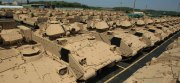 The U.S. Army’s M-2 IFVs (Infantry Fighting Vehicle) fighting vehicle proved to be the workhorse of the 2003 Iraq campaign. But that came at a cost that was not anticipated. Like most armored vehicles, the M-2 runs on metal tracks that have rubber pads attached to save wear and tear on roads and give better traction. Naturally, the rubber pads, as well as the entire track, wears out. Normally, a heavily used M-2 might need a new set of tracks once a year. In 2003 there were nearly 700 M-2ss in Iraq, and many needed a new tracks every few months. A set of tracks is normally good for 1,300-1,600 kilometers of travel. To keep the M-2ss in Iraq supplied with replacement tracks, the army’s only depot that refurbishes worn tracks (about 80 percent of the track is reused) has had to go from one shift a day, five days a week, to 24/7 production.
 In April 2011, the appearance of heavy armor indicated that a violent crackdown had become a full-fledged war.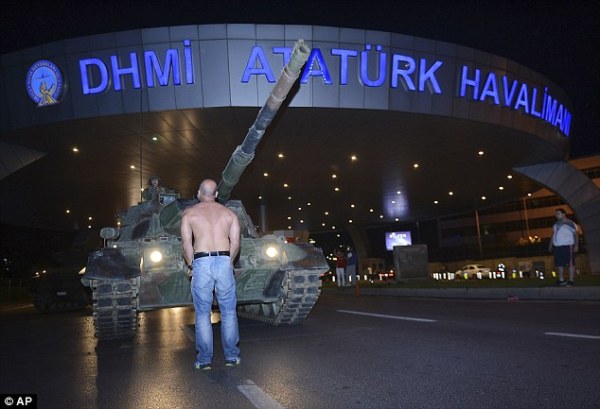

 Tank and AFV News