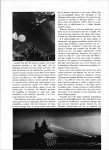
Today we present an article from the July-August 1973 issue of ARMOR magazine titled “The Sheridan: Airborne Cavalryman’s Big Punch.” This three page article by Lieutenant Colonel Robert E. Helton is interesting not so much for what it tells us about the Sheridan light tank, but rather because it illustrates just how unpopular the vehicle was in US service. The author does all he can to put the Sheridan in a good light, going so far as to blame the crews that operate the vehicle for any failings the Sheridan may have. For example, he states “The departure from past practices and the quantum jump forward in technology which the Sheridan exemplifies, coupled with the reluctance of many to accept change were, to a great extent, responsible for its adverse reputation at the outset.” Seems to us that blaming the troops is a pretty sad way to make excuses for the poor reputation of a vehicle with legitimate issues such as the Sheridan. You can view the article as individual pages in the gallery below or download a PDF of the July-August 1973 issue of ARMOR here (article starts on page 19)


News From Around the Web
Some tank and AFV related news stories from around the Web.
Connect Business Magazine – Drive-A-Tank
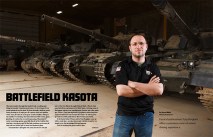 Kasota businessman Tony Borglum offers customers a one-of-a-kind driving experience.
The tank crashes through the underbrush, crushing anything in its path. It lumbers past trees, a 25-foot-long, 62-ton metal behemoth on the hunt. It plows through a shallow pond, barely slowing its 30 mph pace as it sprays mud and splashes water. Soon, it hones in on its prey: a rusty Cadillac, sitting in the middle of a clearing. The tank rolls inexorably closer, gears grinding. It reaches the car and keeps going. The sound of metal wrenching against metal fills the air as the Cadillac flattens like a Styrofoam cup. As the tank continues on its way, all that’s left is a twisted pile of metal and shattered glass.
The Diplomat – Good News for Pakistan? Turkey’s New Tank Is Ready for Mass Production
 Turkey’s first indigenously-designed, third generation+ main battle tank (MBT), designated Altay, is ready for serial production, the Hurriyet Daily reports. Hurriyet cites Turkish military vehicles manufacturer Otokar, a branch of the Koç Group, the country’s top industrial conglomerate.
The chairman of the board at Otokar, Ali Koç, told reporters in April that his company is “ready to fulfill all the obligations with the highest sensitivity and ambition in the Altay tank project, which is Turkey’s biggest land systems project.”
Popular Mechanics – Army and Marines To Test Israeli-Built Missile-Killing Tank Defense System
 The U.S. Army and Marine Corps will jointly test a so-called “active protection” system. These tanks and other armored vehicles will be fitted with an Israeli-developed system that shoots down and jams enemy anti-tank weapons. According to U.S. Naval Institute News, this will be the first test of Trophy on American equipment.
The Army is leasing four Trophy units, enough for a platoon, and will test them on M1A2 tanks and Stryker interim armored vehicles. The services will then test Trophy on older Marine Corps M1A1 tanks. The Marines will be particularly interested in the Stryker test, as the vehicle bears a similarity to the Corps’ new Amphibious Combat Vehicle 1.1. If the experiments are successful, Trophy could become an important upgrade to protect U.S. armored vehicles from anti-tank missiles and rockets.
The National Interest – Will the Russian Army Really Get 100+ Armata Tanks by 2018?
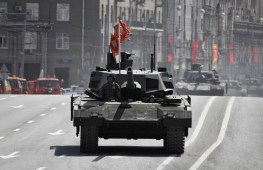 Uralvagonzavod is set to deliver the first batch of 100 operational T-14 Armata main battle tanks to the Russian Ground Forces between 2017 and 2018.
Russian industry officials had earlier indicated that the new tank was already in production—which came as a surprise to many observers who believed that the new armored fighting vehicle would not be ready for production until the early 2020s.
Popular Mechanics – The Best Radio Antenna Is One That’s a Tank
 “Whip” antennas—those long metal rods that used to extend from our cars—look pretty cool in a Smokey and the Bandit kind of way. But for military vehicles, they’re not such a great solution.
Troops in the field communicate using relatively low frequency radio signals. The upside is that they don’t require much power and can travel long distances. But to operate efficiently, antennas need to be at least one-quarter the length of the radio waves they transmit. Since military comms use the HF band where radio waves can range from 10 to 100 yards in length, big antennas are better. But putting huge antennas on a Humvee or an armored personnel carrier or a tank just isn’t practical. Short antennas, meanwhile, are inefficient, operating in a narrow bandwidth and dissipating as much as 90 percent of input power as useless heat instead of useful broadcast radio signals.
Inside the Chieftain’s Hatch: M47 Part II
Part 2 of Nicholas Moran’s “Inside the Chieftain’s Hatch” video on the M47 Patton.
Video of the Day: Armata on Parade
This video of Russian Armata T-14 tanks on parade appeared on youtube yesterday.
Latest News from Jane’s IHS
Here is a collection of news stories from Jane’s IHS. Click on the title to go to the article.
French Army Leclerc upgrade gets under way
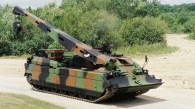 Nexter Systems is moving forward with the upgrade of the French Army Leclerc main battle tanks (MBT) and armoured recovery vehicles (ARV).
In March 2015, the French Procurement Agency, the DGA, awarded Nexter Systems a EUR300 million (USD339.5 million) contract covering 200 Renovated Leclerc MBTs and 18 Renovated Leclerc ARV.
RUAG Defence develops upgraded M109
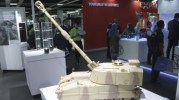 RUAG Defence has developed an enhanced version of the M109 155 mm self-propelled (SP) artillery system aimed at the export market. The company has already upgraded 348 Swiss Army M109sto the Pz Hb 88/95 standard, which represent the only SP artillery deployed by the Swiss Army. Among the improvements are a modified turret and the use of locally manufactured 155 mm/47 calibre chrome plated ordnance in place of the original 155 mm/39 calibre type. This offers an extended range and has a burst rate of fire of three rounds in 15 seconds due to the installation of a flick rammer.
SAGEM Paseo enters production
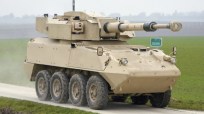 SAGEM is producing its Paseo modular advanced stabilised sighting (MASS) system for an undisclosed export customer. The Paseo MASS has already been shown fitted to CMI Defence Cockerill’s 3030/40 and 3105 turrets on a General Dynamics European Land Systems MOWAG Desert Piranha 5 8×8 armoured fighting vehicle (AFV). That fit features two Paseo MASS systems installed on the right side of the turret mounted one above the other, the top unit for the commander and the lower one for the gunner.
Belarus develops Adunok RWS
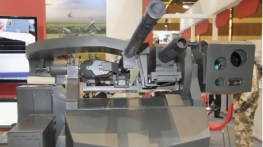 The Design Office Display of Belarus has developed a new version of its Adunok remote-controlled weapon station (RCWS) designated Adunok-W.
While the original Adunok RCWS was armed with a single 7.62 mm PKT machine gun (MG), 12.7 mm Kord (MG), or a 30 mm AG-17A automatic grenade launcher (AGL), the Adunok-W is armed with a Russian 12.7 mm NSVT MG on the right and a 30 mm AG-17A AGL on the left. The 12.7 mm MG is provided with 100 rounds of ready-use ammunition, while the 30 mm AGL has 50 rounds. Ammunition is fed from the right for both weapons.
Vietnam may update Soviet era ASU-85s
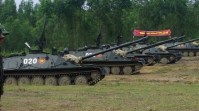 Officials from the Minotor-Service Corporation of Belarus attending the Defense Services Asia (DSA) 2016 exhibition told IHS Jane’s that Vietnamese officials had expressed “strong interest” in purchasing Minotor’s upgrade package for their ASU-85 airborne self-propelled anti-tank guns (SPATGs).
Minotor’s upgrade package includes a new more powerful diesel engine powerpack that would increase speed from 45 to 60 km/h and range from 400 km to 450 km.
Russia to develop new BTR-87 APC
Russia is developing the new BTR-87 armoured personnel carrier (APC), the Director General of Military-Industrial Company (VPK), Alexander Krasovitsky, told IHS Jane’sat Defence Services Asia 2016 exhibition at Kuala Lumpur.
“BTR-87 features rear apparel [ramp], new internal layout, and more comfortable seats for the crew and mounted soldiers. The vehicle’s engine is located in the front part. The new APC could hardly be defined as the modification of previously developed BTR-82A APC. It is a new vehicle. A BTR-82A can be converted to a BTR-87, but such conversion is not expedient,” Krasovitsky said. He mentioned that the Russian Ministry of Defence (MoD) has shown keen interest in the new APC, although VPK is developing BTR-87 on its own initiative.
Book Alert: Illustrated History of the Sturmgeschütz-Abteilung 202


Publishers Description:
The Sturmgeschütz-Abteilung 202 was one of the most successful German assault gun units in the Second World War. It had been deployed exclusively on the Eastern Front against the Red Army between 1941 and 1945. The StuGs of this unit were very effective AFVs on the battlefield in the role of heavy weapons for infantry fire support and also as mobile antitank firepower. Dr. Norbert Számvéber, author of Waffen-SS Armour in Normandy and Days of Battle, presents a detailed combat history of this unit, primarily based on archival sources. The book includes a significant number of rare photographs and several maps.
Amazon page for Illustrated History of the Sturmgeschütz-Abteilung 202
Tank Chats #19 Matilda II
From the Bovington Tank Museum:
The name Matilda means Strength in Battle from the Germanic roots Maht, meaning strong and Hild meaning battle.
The Matilda was regarded as a superb tank in its day and carved a remarkable career for itself. A few served in France in 1940 but in the early stages of the North African campaign, under General Wavell, it virtually ruled the desert. Even when the Afrika Korps arrived it remained a formidable opponent, immune to everything but the notorious 88mm gun. Its main failings were its slow speed and small gun, which could not be improved.
Photo of the Day: M48 with sandbags
Today we present this photo of an M48 in Vietnam with a rather impressive collection of sandbags around the turret.

This photo appears in Armored Combat in Vietnam
Book Review: Valentine Infantry Tank 1938-1945
Valentine Infantry Tank 1938-45 (New Vanguard)

The Valentine was produced in greater numbers by the British Commonwealth than any other model of tank and yet it generally receives little attention, as evidenced by the fact that this book is the 233rd in the series. Compared to its German and American counterparts, relatively little ink has been devoted to this vehicle, being limited to the old AFV Profile series from the 1970’s, the Museum Ordnance Special from the 1990’s and the more recent books on the Valentine by Dick Taylor.
Given the large number of Valentine variants and the relatively small page count, this book does not give much in-depth detail to any particular Valentine model. One deviation from previous New Osprey titles is the use of fairly large charts. These account for roughly seven pages of the book and are quite useful for providing the details of the various Valentine models in a concise manner. Also addressed in this book are the Bishop and Archer self-propelled guns as well as the ill-fated Valiant “assault” tank. Given the small page count of the New Vanguard series, it might have been better to address these other vehicles in a separate volume. Certainly, there is enough to say about the Valentine to fill two volumes of 48 pages. That said, Dr. Newsome has packed as much information into the book as the New Vanguard format allows.
Valentine Infantry Tank 1938-45 (New Vanguard)
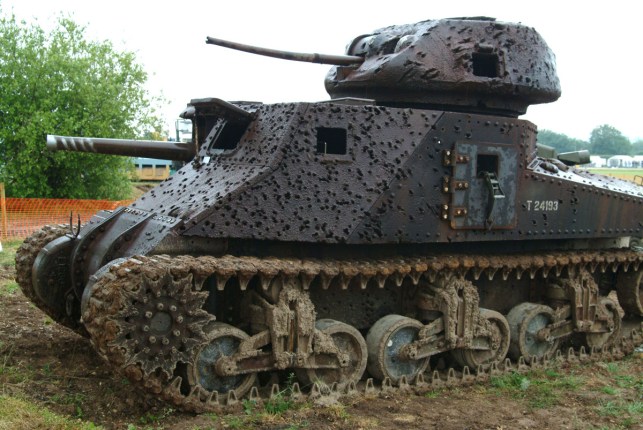
Photo of the Day: M3 Grant with just a bit of damage
This photo shows an M3 Grant that, despite the condition of the hull, has been restored to running order. This former range wreck was brought back to life by John Gillman (according to the fellows over at tank-net.com)

 Tank and AFV News