The Chieftain’s Hatch: Equipping the Force Part 2

chieftains hatchNicholas “The Chieftain” Moran has posted part two of an article based on his archive digger regarding US armor in WW2.  In particular, this article looks at Army Ground Forces and how they determined with vehicles and tanks should be developed and fielded during the war.

Excerpt:

Situation in March 1942

When Army Ground Forces was established, many of the basic decisions for the tank program had already been made by other agencies of the War Department and the Ordnance Department. At this time, the Armored Force was a semi-autonomous command which played an important part in developing its equipment. Although it came nominally under the control of Army Ground Forces, it continued to exercise many of its powers by direct contact with the Tank Automotive Center in Detroit.

The M3 medium tank was in current use, the M4 medium tank was in production but had yet to see a battlefield. Development of the Medium Tank M7 was also well under way. This had been conceived in 1941 as a 16-ton vehicle, mounting a 37mm gun, and was classified as a light tank. Successive changes requested by the Armored Force had resulted in a tank of 25 tons, mounting a 75mm gun, which thus approached the weight class of the M4 (33 tons) and was reclassified as a medium tank. During 1942 Armored Force enthusiasm for the M7 tank was quite pronounced.

All of these tanks had been developed primarily for the purpose of exploiting break-throughs and conducting operations in the traditional cavalry manner. First of all, their sponsors wanted speed and mobility, with mechanical reliability a necessary corollary. Sufficient fire power was only needed to subdue enemy infantry and minor strong points, and armor was required only to withstand enemy small arms. These tanks had narrow, high-speed treads. Unit ground pressure was not a serious factor because it was contemplated that slashing tank tactics then advocated would not be possible through soft, marshy terrain. [Chieftain’s Note: As you will recall, Armored Force, not AGF, are the folks who created tank doctrine and tank manuals, we’ve gone over in the past the position of Devers and AF on the matter of what they expected medium tanks to do against tanks. That AGF had this interpretation need not be an accurate reflection of what AF thought]
Read the full article here.


Nicholas Moran on WoT tank research

While we don’t usually present items on tank themed video gaming, this presentation by Nick “The Chieftain” Moran may be of interest to those interested in how World of Tanks conducts their vehicle research.

Inside the Chieftain’s Hatch: M56 Scorpion Part 2

World of tanks researcher Nicholas “The Chieftain” Moran has released the second part of his “Inside the Hatch” video on the M56 Scorpion self propelled anti-tank gun.

For those that missed part one of this series, here it is.

The Chieftain’s Hatch: Unmanned Patton

hatchlogoOver at his corner of the World of Tanks forum, Nicholas “The Chieftain” Moran has posted a new article about an attempt to make a remote control tank back in 1956.  The project involved an M48A1 tank equipped with a variety of video cameras, remote control devices and electronics at Aberdeen Proving Grounds.  A good number of pictures are included in the report.  As could be guess given the state of the technology of the day, the experiment was not all together successful.   All in all, a very ambitious project considering how new TV technology was in the mid 50’s.

Be sure to check it out at “The Chieftains Hatch.”

Book Alert: Reprint of ‘Firepower” by Hunnicut is planned

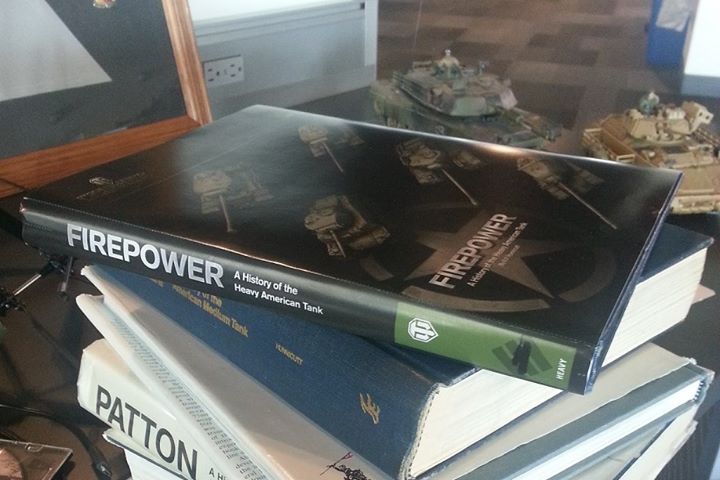
Nicholas “The Chieftain” Moran has posted on his facebook account that his employer WarGaming is planning a World of Tanks reprint edition of the book “Firepower” by R. P.  Hunnicutt.  This book is long out of print and typically commands several hundred dollars for used copies in good condition.  Here is the post:

11755787_988543301185451_5192717826878223814_nOK, so we’re suffering from a bit of a dilemma. We’re hoping to release a WoT Edition of a book. Improved on the original a bit, we’ve sent them recent scans of photos from the archives, foreword and some addenda by myself, and so on.

The idea is that we do a single print run, and pass on the economy of scale to you guys. So, the more that are sold, the cheaper it is for everyone. (We also don’t care much about the book profit, so that’s a cost reduction too. The bottom line is that it’ll never be cheaper). Fine in theory. The catch: Usually these low-volume books are made ‘print-on-demand’, which may be a slightly lesser quality, is certainly more expensive in volume, but is decidedly faster.To do this right, highest quality printing, lowest cost, etc, has a long turnaround time from the printer. In theory, if we went by “Announce on Day 1. Close orders Day 30. Tally number of orders. Print that many”, it could take up to three months between when someone clicks “Checkout, take my credit card info” to when the book is shipped. I don’t understand the technology/process, that’s just what the publisher has told me. In effect, it’s a pre-order. For ease, we may go with a fixed price, and then add gold codes of a value to make up the difference.

The alternative is that we take a wild guess as to how many might be sold, order that many in advance, and hope not too many people get disappointed (and that we didn’t wildly over-estimate). Those X many people will get their books pretty much immediately. We have absolutely no idea how big a number “X” should be, we don’t really have a basis for comparison.

So, on the basis that we want to get the most people to benefit for the least cost, the question becomes “Just how patient are you guys? Are you willing to wait several months for this?” My personal opinion is that anyone who’s willing to pay dollars for this particular book is also willing to wait, but you never know, especially when our customers are used to clicking ‘purchase’ and having their goods deposited in their account within a few minutes.

Photo is prototype. Expect the final product to look a little different (Author’s name on spine, etc)

Inside the Chieftain’s Hatch: M56 Scorpion, Pt 1

Nicolas “The Chieftain” Moran has released a new video in the World of Tanks “Inside the Hatch” series.  This episode examines the M56 Scorpion self propelled gun.

The Chieftain’s Hatch: The Super Pershing

chieftains hatchWargaming’s resident tank expert “The Chieftain” has posted a new article on the T26E4, commonly called the Super Pershing.  Using materials unearthed from the archives, the article explains how the extra long 90mm gun of the Super Pershing (T15E2) was found to be unsatisfactory by army testers.

The exploits of the T26E4 in Europe are well known. Indeed, there is much anticipation for the release of the HD model of the tank in the upcoming update.  It is, of course, known that the Super Pershing we all know and love was not an entire success, not least because the ammunition its T15E1 rifle used was single-piece and incredibly unwieldy. It is also known (albeit slightly less so) that an improved version of the T15E1 was developed, the creatively named T15E2, and that was designed to use split-piece ammunition, supposedly to fix this problem. Yet when M26’s replacement was developed, M46, it still retained the shorter 90mm M3-based gun. What happened?

Read the full article here.

WoT’s Chieftain posts new article: US Centurion Part 4

chieftains hatchWorld of Tanks researcher Nicholas Moran, aka “The Chieftain” has published part 4 of his article on US testing of the Centurion III tank.  Part one dealt with the US assessment of the Centurion III’s fighting compartment.  Part 2 dealt with automotive tests.  Part three covered the gun control systems.  Part four examines the fire on the move capability of the Centurion.

All the Chieftain’s articles can be read at The Chieftain’s Hatch.

Article excerpt:

This is the last in the series of articles stemming from the US Army’s testing of Centurions II and III in late 1949/early 1950. We’ve already seen that they concluded that Centurion was a fairly competent vehicle, albeit that it was expected that the next generation of American tank would be no worse than equal in various characteristics, but they were particularly curious about the stabilization system as up until that point, nothing had been put into service on a tank which was claimed to provide a true fire-on-the-move capability. The gyrostabilised guns on American tanks in WWII, being single-axis only, could not make such a claim. As we go through the observations below, I suspect that even in the M4 the Americans had already started noticing such things, but it is still interesting to see how they are officially reporting them below. Anyway, I’ll let you read the observations, and will come back to you afterwards.

WoT’s Chieftain posts new article: US Centurion Part 3

chieftains hatchWorld of Tanks researcher Nicholas Moran, aka “The Chieftain” has published part 3 of his article on US testing of the Centurion III tank.  Part one dealt with the US assessment of the Centurion III’s fighting compartment.  Part 2 dealt with automotive tests.  Part three covers the gun control systems.  The Chieftain summaries the report saying: “So, overall, the US generally liked Centurion. They appear to have considered it to be inferior to the new generation of tanks they were designing, but quite competent for an already-extant vehicle. Some features, like the tracks and transmission, they didn’t like. Some, like the stabilisation system and general capability, they did. The engine power they deemed insufficient for the future tank. The entire evaluation process was more of a learning experience, learning some lessons, both good and bad, from the tank the British had built, it was never an attempt to comparatively rate the tank in order of preference.”

Read the entire post at the Chieftain’s Hatch

Articles on Nicholas Moran, WoT’s “The Chieftain”

2ebzecyMilitary Times has published two new articles about Wargamming’s North American tank researcher and “chief evangelist” Nicholas Moran, aka The Chieftain.  One article focuses on Moran’s role as an employee of Wargamming.  It also looks at “The Chieftain’s Hatch” section of the World of Tanks forum where Moran publishes articles based on his research.  Here is one of the more interesting excerpts from the article:

He sees part of his mission at Wargaming as helping dispel myths and misconceptions — perpetuated mostly by movies — about armored warfare during World War II.

Consider the M4 Sherman tank, he says, long disparaged as the scrappy, if inadequate, answer to the Nazis’ armored divisions. [Read more…]