

Kirkus Review:
A scrapbook of the Israeli Army’s Armored Corps, retrospectively including a twenty-year history of its accomplishments and a close account of its role in the June War. (Tammuz is June.) There are novelistic vignettes of commanders and soldiers–especially Israel Tal, who has headed the Corps since 1964. The Army first realized the tanks’ potential in the 1956 Sinai campaign. During the June War they fought the crucial vanguard ground battle, breaking into Sinai again without direct air cover, then pushed the Egyptian Army back toward the Canal and cracked the Syrian frontier. Teveth, a prominent journalist, rode with the tanks; one can see how an inch-by-inch eyewitness report would become a best-seller in Israel, but fewer American readers will want this degree of military detail. Teveth begins the book with the May 1967 mobilization in Israel, pressing the prevalent view that war was imperative. He uses General Tal, among others, as a vehicle for his further messages: Jewish nationalism may be philosophically questionable, but Israel must survive in a world of nation-states; Israeli militarism may be regrettable, but Jews must survive in a region of powerful enemies. . . and at least the army is as democratic as discipline will permit. The book comes with Dayan’s recommendation.
 HAIFA, Israel — Elbit Systems, the Israeli firm whose Helmet Mounted System (HMS) is used on helicopters and fighters worldwide, including the new F-35, is debuting a similar sensor-fused system that allows tank commanders to essentially see through the walls of their armored vehicles. Called IronVision, the vehicle-adapted HMS provides “protective glass walls” for tank or armored fighting vehicle crews who may need to operate in so-called closed-hatch mode when maneuvering in high-threat areas, according to Boaz Cohen, director of Elbit’s land systems division.
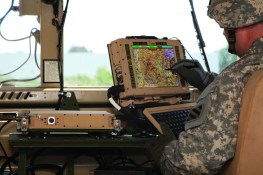 The Army is now expanding a new, high-speed, vehicle-mounted force tracking technology to include a wider range of combat platforms such as Stryker vehicles, Bradleys and Abrams tanks, service officials said. The system, now on Army jeeps or HMMWVs, allows Soldiers in combat to instantly know their location in relation to fellow Soldiers, enemy locations and surrounding terrain, service developers said. The technology, called Joint Battle Command – Platform, has already been fielded with the Army’s 3rd Infantry Division and 10th Mountain Division.
 PARIS — CMI Defence is the second company to announce a partnership arrangements to compete for the British Army’s upcoming life extension program for the Challenger 2 Main Battle Tank. The Belgian weapon systems designer and manufacturer said it is teaming with British systems integrator Ricardo UK to respond to a request for information issued by the Ministry of Defence. CFM will act as prime, with Ricardo acting as systems engineering and delivery partner.
 General Dynamics European Land Systems-Santa Barbara Sistemas is exhibiting the artillery observation variant of their Pizarro infantry fighting vehicle (IFV) family at Eurosatory 2016. The Pizarro forward observation vehicle (FOV) has a crew of five comprising the commander and gunner in the two-person turret, a driver, and two observers in the rear, one of whom can be used in the dismounted role with a link to the platform.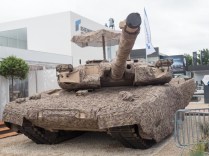
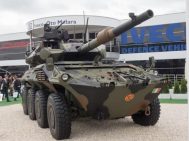
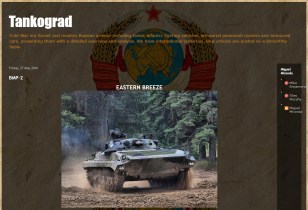 This iteration of the BMP family is technically excellent in the application of available technologies and the number of features it has, but if there is one thing that nearly all BMP-2 crewmembers know, it is that it is a rather unpolished product, if a brilliant one for its time. To the untrained eye, it might seem that the BMP-2 is simply a marginally more impactful rehash of the old and obsolete BMP-1 design, and while that is true, the sentiment and the connotations behind such an accusation point to an incorrect mindset. The BMP-2 is a product improved BMP-1, but it is not quite the same thing as its predecessor. Far from it. It is so heavily modified that the only similarities are in the general layout, and the powertrain, which was retained as is. Everything else was changed to some extent, the most obvious being, of course, the new turret, now bristling with gadgets appropriate with its era.
 by Charles C. Roberts Jr. This is a 272 page hard cover from Stackpole Books.


 Tank and AFV News