 Lately we have noticed a number of older public domain publications being listed for sale as Kindle books on Amazon. We would suggest that before people spend money on these items, do a quick Google search. In many cases, you can find a free PDF of the same document. One example of this is Spearhead in the West 1941-1945. This book, written in 1945, documents the history of the US 3rd Armored Division during the Second World War. The book can be downloaded as a PDF file here. If you don’t mind spending six bucks for the kindle version, you can do so here

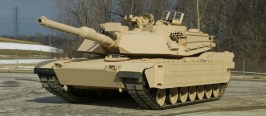 General Dynamics’ (NYSE:GD) Lima, Ohio-based tank-building factory is back from the dead (the rest of General D was already doing just fine). But it’s still a complicated situation — so let me explain. Last quarter, General Dynamics reported a 3% decline in sales across its four major divisions. Combat systems, the division that builds Abrams main battle tanks, LAV light tanks, and Stryker armored personnel carriers took it on the chin, with sales down 7% year over year. This obviously was not great news for the company’s Lima plant, which builds both the Abrams and the Stryker, and where the payroll has been slashed from a high of 1,200 employees 10 years ago, to about 400 today. But there’s better news rumbling down the pike.
 Governor Pat McCrory spent time Saturday at the North Carolina National Guard’s 2016 Leaders Workshop honoring a tank crew. The four-member crew is based in Southern Pines and won the 2016 Sullivan Cup at Fort Benning, Georgia back in May during a six-day competition against 15 other teams from across the country. Gov. McCrory presented each team member with a Governor’s Coin. The team is made up of: crew commander, First Lieutenant John Dupre of New Bern; crew gunner, Sergeant Curtis Bowen of Winston-Salem; crew loader, Specialist Brandon Sinor of Morehead City; and crew driver, Specialist Phillip Hill of Greensboro. The Governor also recognized Lieutenant Colonel Miriam Martinez, who served at the governor’s Office of Federal Relations in Washington, D.C. from 2014 to May of 2016. Martinez will be promoted to Colonel in October.
 For sale: tanks, good condition, some used during D-Day. The Normandy Tank Museum is selling its entire collection at auction next month before closing its doors because it failed to attract enough visitors. The sale includes tanks, military vehicles, trucks, aircraft and motorcycles, many of which have been restored to working order. More than 40 armored vehicles, along with thousands of military items used during World War II and dozens of mannequins in full battle dress, will be sold on September 18 by Artcurial, a Paris-based luxury auction house. The sale will be held in Catz, a town a few kilometers from Normandy’s Utah beach, where the Allies landed to liberate German-occupied northwestern Europe in June 1944.
 Russia’s Tractor Plants Concern is developing a new amphibious tracked armoured personnel carrier (APC) called the BT-3F, a defence industry source told IHS Jane’s . The new APC is intended for the use by naval infantry/marine units. “The Tractor Plants Concern is finishing the designing of the BT-3F APC in order to exhibit its demonstrator at the Army 2016 military-technical forum outside Moscow in September 2016. The vehicle may partially replace the BTR-80 APC of Russia’s Naval Infantry. We suppose that the Ministry of Defence (MoD) will take a close look on the new vehicle at the forum,” the source said.
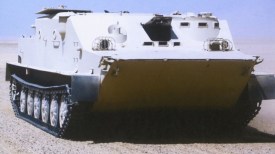 The Minotor-Service Enterprise of Belarus has developed an upgrade suite for the Russian BTR-50PK amphibious armoured personnel carrier (APC). Called the BTR-50PKM, Minotor-Service states that the package is also applicable to other members of the BTR-50 family of tracked armoured fighting vehicles (AFV) including the BTR-50P, BTR-50PU, the Czech OT-62 Topaz APC (which is their equivalent of the BTR-50PK) as well as the Russian PT-76 light amphibious tank. The upgrade enhances the BTR-50PK APC by reducing its fuel consumption, improving its maintainability and reliability, as well as extend its operational life.
 by Christopher Foss and Peter McKenzie.
 On August 25, Osprey books will be releasing their latest offering in the long running New Vanguard book series.


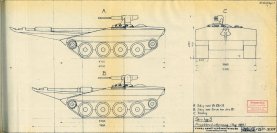 In 1957, the Swedish army initiated a study of the future of warfare, in order to determine what weapons technology it should pursue during the 1960’s – as well as many other things. One of the sub-committees of this study was tasked with studying direct-fire infantry support weapon systems, such as tanks, anti-tank weapons, direct-fire crew-served weapons, etc. The central question that the sub-committee was tasked with answering was: “How should our system for direct fire (both anti-tank and anti-personnel fire) work around 1970 and in the time immediately thereafter?”
 On August 25, a new book on

 Tank and AFV News