A new entry in the Osprey New Vanguard series is scheduled for release on Thursday, Feb 23. South African Armour of the Border War 1975-89 (New Vanguard)
Publisher’s Description:
The Border War saw the biggest armoured battles in Africa since World War II. Starting as a counter-insurgency operation by the South African Defence Force (SADF) against the South West Africa People’s Organisation, South Africa became embroiled in the complex Angolan Civil War, where they came up against enemies well supplied with equipment and armoured vehicles from the Soviet Union.
With the aid of stunning illustrations and photographs, this study details the characteristics, capabilities and performance of the wide variety of armoured vehicles deployed by the SADF, from the Eland armoured car to the Ratel infantry combat vehicle and the Olifant tank. Designed for the unique conditions of the region, South Africa’s armour was distinctive and innovative, and has influenced the design of counterinsurgency armoured vehicles around the world.
Frequently requested by Osprey readers, and written by two renowned experts on armoured vehicles, this will appeal to all those interested in modern armour and the Cold War proxy wars.

 DIVERS working on a project to map the wreckage of top secret D-Day tanks sunk in Poole Bay have appealed for help. The Valentine 75 Project was launched in Purbeck, last week, to find out more about the seven amphibious tanks sunk during Operation Smash – the Normandy landings rehearsal that took place off Studland almost three quarters of a century ago. Project members are now anxious to hear from anyone who may have underwater images, taken in the 1970s and 80s, of any of the Second World War vehicles, which were known as Valentine tanks.
 When the producers of “Fury” planned to make a technically correct film about an American World War II tank crew’s exploits, they ran into a problem. The type of tank they wanted to use was nowhere to be found, the result of heavy casualties on the battlefield. So they had to use the wrong tank. And that’s a problem that a lot of collectors, or rather would-be collectors, of certain World War militaria can encounter. Many of the most desirable collectibles, like early tanks, airplanes and certain armaments, no longer exist except in photographs, old newsreels and the occasional museum.
 (MENAFN – Gulf Times) The hulking grey war machine resembles a ship’s upturned hull, with one stumpy barrel protruding above the Iron Cross insignia. It’s a far cry from the Tiger and Panther tanks that ravaged WWII battlefields, but a sombre testimony to the start of a terrifying new chapter in modern warfare. The first German tank, the A7V, was presented to the top brass for inspection in Berlin in January 1917, only a few months after the British deployed this revolutionary weapon in France in World War I.
 These are the incredibly rare photographs showing the British ingenuity that brought the dawn of the tank age and changed the Allies fortunes in the First World War. The images show triumphant British troops atop the world’s first tanks, as well as life from the inside manning the machine guns. These black-and-white photos are taken from the new book ‘Armoured Warfare in the First World War 1916 – 1918’ by Anthony Tucker-Jones and published by Pen & Sword Military. Mr Tucker-Jones said: ‘The first tanks came about through the desperate need to break the terrible deadlock in the trenches.
 The Iraqi Federal Police is currently in the process of receiving the Textron Commando Select armoured vehicles that were ordered last year, Jonathan Dalrymple, vice president for business development at Textron’s Marine and Land Systems division, told Jane’s at the IDEX show in Abu Dhabi. “We are delivering tranches of vehicles; the first got there about two months ago and went straight to the front,” he said. The Iraqi Federal Police has become an increasingly heavily armed force that is playing a major role in the operation to retake the northern city of Mosul from the Islamic State militant group. It has been using the earlier Commando Armoured Security Vehicle (ASV) variant since 2004, when it received the first of more than 300 vehicles.
 Hyundai Rotem has released details of the new combat engineer vehicle (CEV) under development to meet the operational requirements of the Republic of Korea Army. The company has already developed and manufactured armoured recovery vehicle (ARV) and armoured vehicle-launched bridge (AVLB) to support the K1 and K2 main battle tanks in service with the ROK Army. The new CEV is designed for use in a wide range of battlefield missions, including clearing battlefield obstacles, preparing fire positions for MBTs and artillery, and carrying out breaching operations.
 Feb. 20 (UPI) — Russia’s Uralvagonzavod scientific-production corporation is ready to export the latest variant of the T-90 main battle tank, Russian news agency Tass reports. General of the Army Alexei Maslov, the special representative of UVZ for military-technical cooperation, was quoted by the news agency as saying the decision comes as production of the T-90MS is ready to accelerate. “We have established the low-rate initial production of these vehicles,” he said at the IDEX 2017 trade show in Abu Dhabi. “It has been almost mastered, and we are ready to conduct export deliveries.
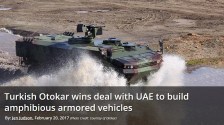 ABU DHABI — Turkish company Otokar won a deal worth $661 million to build Arma 8×8 amphibious armored infantry vehicles for the United Arab Emirates land forces. Otokar signed an agreement establishing a joint venture to build the vehicles with UAE company Tawazun Holding at the Abu Dhabi International Defense Exhibition underway. The vehicle — under the joint venture — has been dubbed “Rabdan” and will be built at the Tawazun Industrial Park manufacturing facilities in Abu Dhabi. The vehicle will carry 11 passengers, designed to keep them safe from mines and missile threats, and will be able to easily traverse over rivers and ponds.
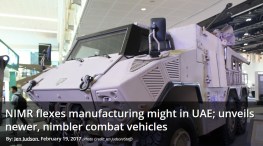 ABU DHABI, United Arab Emirates — Leadership at the Abu Dhabi International Defense Exhibition announced — among a variety of deals made by the United Arab Emirates on the first day of the show — that NIMR Automotive would manufacture several hundred 8×8 armored vehicles for the country’s armed forces. The work will be performed at the company’s new manufacturing facility in Ajban, Abu Dhabi — the region’s leading facility for wheeled military vehicles. The agreement was a part of 4.4 billion AED — roughly $1.2 billion — in total deals announced for a productive first day at IDEX on Sunday.
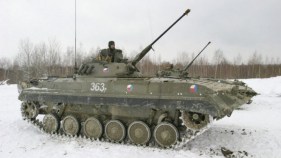 The Czech Ministry of Defence (MoD) plans to proceed with a tender worth over CZK50 billion (USD1.9 billion) to fulfil an urgent requirement for over 200 new tracked armoured fighting vehicles (AFVs) for the Army of the Czech Republic (ACR). General Josef Becvar, chief of staff of the ACR, stated on 14 February that the ACR plans to hold industry days in mid-2017 and invite domestic and foreign manufacturers of tracked armoured vehicles to demonstrate their platforms in mobility and live fire modes before an ACR selection team of experts.
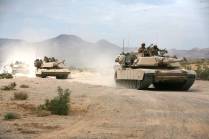 The Army is fast-tracking an emerging technology for Abrams tanks designed to give combat vehicles an opportunity identify, track and destroy approaching enemy rocket-propelled grenades in a matter of milliseconds, service officials said. Called Active Protection Systems, or APS, the technology uses sensors and radar, computer processing, fire control technology and interceptors to find, target and knock down or intercept incoming enemy fire such as RPGs and Anti-Tank Guided Missiles, or ATGMs. Systems of this kind have been in development for many years, however the rapid technological progress of enemy tank rounds, missiles and RPGs is leading the Army to more rapidly test and develop APS for its fleet of Abrams tanks.
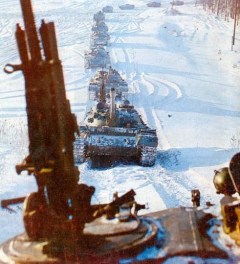 The T-54 was reasonably advanced for its era, arguably more so than the American Patton family up til the M60, but it could never quite be described as being on the cutting edge. It is rationally constructed and technically excellent where the traditional three criteria of mobility, firepower and protection are concerned, but it was also plagued by drawbacks that may not be immediately obvious at first glance. Some of the drawbacks have received quite a lot of attention, like the issue of internal space. Others, like the cooling system that threw dust 20 feet into the air, are less well known. The usual criticism that Soviet tanks had subpar fire control systems is partially true with the T-54, as it lacked a rangefinding device. But what is less well known is that the sight was very well made, very convenient to use and had higher magnification than the ones used in contemporary Western tanks. A thorough inspection of the tank will tell you that the T-54 was very competitive for its time, and remained capable of fulfilling front line roles well after newer and better designs took its place in the limelight.
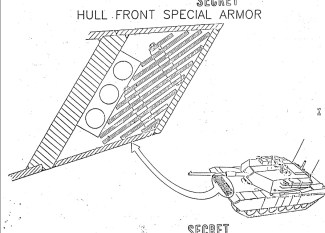 On the TankNet forums, a user with the nickname “whelm” has posted drawings from a formerly classified document on the earliest iteration of the US M1 Abrams main battle tank (MBT). He got this document from Vollketten, a user with accounts at the Sturgeon’s House forum, the WoT forum and other places. It details the armor layout of the tank, showing were the Burlington composite armor is located and how it is specifically implemented on different areas.
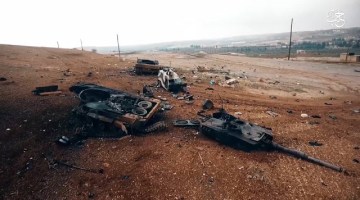 Yesterday a new video was released by ISIS terrorists showing a bunch of destroyed main battle tanks (MBTs) and armored personnel carriers (APCs) near the Syrian city of Al-Bab. This video however has proven something, that I understimated a certain weapon. Not anti-tank guided missiles (ATGMs), not improvised explosive devices (IEDs). A much older weapon: propaganda. The same weapon that turned the Tiger heavy tank – a rather mediocre design of it’s time – to a supposed super tank, that still is being worshipped by some individuals today. However the propaganda worked, invoking a Tiger-phobia on the side of the allies.
 The World of Tanks series books are now available for the first time in English! They include never-before-seen photos, diagrams, and documents from Soviet archives—which is why we distinguish each volume as “The Russian View.”
 The latest version of the USA Historical AFV Register is now available for download. For those not familiar with this document, it is a list of every tank and AFV on public display in the US organized by state. This latest version is authored by Neil Baumgardner and Michel van Loon. It can be downloaded in PDF format either
 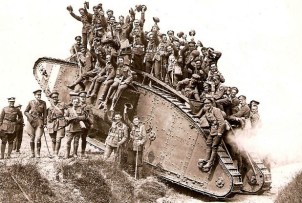 This summer sees the 100th anniversary of the start of the
  Israel’s Defense Ministry Property Director, together with the IDF’s ground forces and the Yad Lashiryon Organization, has announced a project to restore a variety of historical displays, including historical tanks which fought in all of Israel’s wars.
 Tank and AFV News