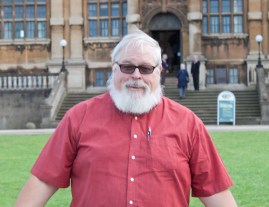
 Tank and AFV News corresponded recently with Stephen “Cookie” Sewell, co-author of the new book Soviet T-10 Heavy Tank and Variants
——————————————————————————
Can you give us a description of your career in the US Army and US government?
I entered the Army in September 1968 and was trained as a Vietnamese linguist. After a short tour in Vietnam and then at NSA was retrained as a Russian linguist in 1973. Spent a total of nine years on strategic intelligence assignments and nine years tactical ones. Retired in 1990 as a Chief Warrant officer. Due to expertise hired back three months later into same job I retired from and arrived two weeks before Desert Shield/Desert Storm started. Changed to the National Ground Intelligence Center predecessor in 1991 and then to that organization when created in 1994. Retired from there in 2011
How did you get the nickname Cookie?
I came back from Vietnam in 1971 and my brother wanted me to see a new kids’ show on PBS called “Sesame Street”. First Muppet I saw was the Cookie Monster, who in the space of two minutes ate an entire box of cookies, the box, and a telephone. My kind of guy! When I got to NSA I started drawing him doing stuff like eating MiG-21s and people in my office started referring to me as “Cookie Monster”. Stuffed my desk with chocolate [Read more…]
 by Aleksei Isaev. This is a 224 page hardcover published by Helion and Company. Mr. Isaev has written numerous books on the Eastern Front during WWII, primarily in Russian.
 The Israeli Ministry of Defense (MoD) has unveiled a prototype of an upgraded version of its Namer heavy armoured personnel carrier (APC) fitted with a turret that is armed with a 30 mm gun. In a statement released on 31 July, the MoD said the prototype was developed by its Merkava Tank Administration together with the Israeli Defense Forces (IDF) Ground Forces and will begin a series of trials in the coming days.
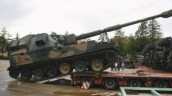 Deliveries of Krab 155 mm self-propelled howitzers (SPHs) to the Masurian Artillery Regiment (11 MPA) will be completed this month, marked by a ceremony on 31 August in the presence of officials from the ministry of defence, the unit said on its website. Fourteen Krabs were delivered to the regiment by tank transporters on 31 July.
 ANKARA — Turkey’s procurement authorities have decided to go ahead with a draft program for the local production of scores of armored amphibious assault vehicles. Turkey’s procurement agency, the Undersecretariat for Defense Industries (SSM) and FNSS, the company that has been tasked to design, develop and manufacture the vehicles, held a “successful” review meeting over the program mid July.
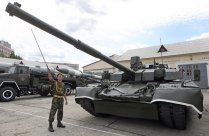 WARSAW, Poland — Ukraine is negotiating the sale of 100 T-84 Oplot main battle tanks to Pakistan, and plans to use the funds to modernize the production capacities of its state-owned defense industry and invest in research and development, according to daily Gazeta Wyborcza. The potential deal, which is to be handed to Ukraine defense group Ukroboronprom, would mark another export contract for the supply of the tanks following a deal signed in 2011 with Thailand. Bangkok is to obtain a total of 49 Oplots.
 Three years ago, Ukraine announced it would sell 50 of its T-64BV-1 tanks to an unspecified foreign customer, rumored to be the Democratic Republic of the Congo. This became official in 2016 with the delivery of 25 of the tanks to the country, according to information just released by Ukraine to the U.N. Register of Conventional Arms.
 In the summer of 2016, a French magazine published some curious photos of a Leclerc main battle tank of the French Army, painted in the jagged new Scorpion camouflage scheme—and sporting a massive 140-millimeter, fifty-five-caliber gun. You can check out pictures here and here and here. The huge smoothbore gun came from the experimental T4 gun turret built in 1996 by GIAT and the Bourges arsenal.
 The U.S. Army‘s chief of staff said he wants future versions of its main battle tank, the M1 Abrams, and other ground combat vehicles to feature active protection systems, as-yet-undeveloped lighter armor and a driverless option. Gen. Mark Milley outline such technologies when speaking Thursday at the National Press Club in Washington, D.C. He was responding to a question about whether he was concerned that Russia plans to field a new tank, the T-14 Armata, in 2020.
 A FINAL series of blast tests have been completed on the two short-listed contenders vying for a multi-billion-dollar Australian Defence Force contract to build its new Combat Reconnaissance Vehicle. The bid — hotly contested between Victoria and Queensland — would be based at the old Holden factory should defence giant BAE Systems be awarded the $5 billion contract to build 225 combat vehicles.

 The story of the PzII tank was an unusual one. In many ways, it owes its “accidental” existence to the attempts of mounting a 20 mm autocannon in the Kleintraktor (future PzI). Due to issues with production of the Z.W. tank (future PzIII), the PzII was the most numerous front line tank for the first two years of WWII. Germany’s most common tank was not even originally included in the armament plans.
 The light PzII tank played an important role in the structure of the German tank forces. Despite the opinion born of German generals’ memoirs, this was not a training tank. On the contrary: at the time of its inception, the PzII was one of the best light tanks in the world. It appeared almost by accident, but occupied a significant part of the Wehrmacht’s order of battle. The PzII remained in production for five years, with some small breaks. What is the history of the PzII, and what did its first versions look like?
 The Americans considered improving the firepower of the Medium Tank M4 back in September of 1941. A year later, experiments with installing the 76 mm T1 gun into the stock turret commenced. Even though the gun fit, the military was unsatisfied with this rearmament. A decision was made to equip the M4 with the turret from the Medium Tank T23, which did not enter production. This was not hard, since the turret ring diameter was the same.
 Starting in the second half of 1943, the approach to sending British and American Lend Lease armoured vehicles to the USSR changed. Instead of immediate large scale shipments, the Western Allies sent a few samples of new vehicles. If the tank or SPG was satisfactory for the Soviet side, full scale shipments followed. The first vehicle to arrive on this trial basis was the Light Tank M5A1. By that point, production of light tanks in the USSR was wrapping up, so the American novelty never made it into service.
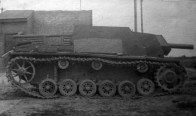 Work on SPGs, especially heavy ones, stopped in the USSR after the start of the Great Patriotic War. This was largely caused by the fact that the factories were busy with other orders. In addition, many factories were evacuated eastward. Only light SPGs were put into production at the start of the war, and these were largely improvised. Meanwhile, due to the number of factories that switched from making artillery tractors to tanks, the artillery branch was forced to revisit SPGs towards the end of 1941.
 The German superheavy Maus tank left a mark in the history of tank building. This was the heaviest tank in the world, developed as an assault tank, practically invincible to enemy fire. In many ways, its fate was the same as the fate of another giant, the French FCM 2C, which holds the title of the world’s largest tank to this day. Like the French heavyweight, the German tank never saw combat. In both cases, the tanks were blown up by their own crews. Another similarity was that the tanks became the subject of a careful study.
 One of the distinguishing characteristics of German tank building in WWII was an aim to use up obsolete vehicles, including those which used to be the backbone of the German tank force. If a German tank became obsolete, that didn’t mean that it would be scrapped. Some tanks were sent to training units, other were modernized. Obsolete tanks, especially light ones, were often converted to SPGs or engineering vehicles. This was the fate that awaited the PzI, Germany’s first mass produced tank, which was already obsolete at the start of WWII.
 Coming up with tank ratings is a hobby of many tank experts, as well as people who consider themselves as such. As a rule, the creators try to determine the best tank. While some kind of systematic approach was developed over the years, picking out the worst tanks is usually more complicated. Often, creators of lists of the worst tanks make their choices according to no set system and end up naming a number of tanks that didn’t earn such a shameful label.
 Putting the PzI Ausf. B into production was the correct decision, albeit a late one. The problem wasn’t only that the concept of a light tank with machineguns for armament was obsolete. The 6th Department of the Armament Directorate was disappointed in the chassis developed by Krupp’s engineers overall. Even though the power to weight ratio of the PzI grew from 11.1 to 17.2 hp/ton after modernization, there was no drastic improvement in mobility. 40 kph is not what was expected with such a boost.
 The creation of the PzI light tank did not come easily for German tank building. The tank was redesigned several times while still in the development stage, starting out as a 3 ton tank with a 20 mm autocannon, and ending up as a 5 ton tank, where nothing larger than a pair of MG-13 machineguns could fit into the turret. Even though the PzI entered production and became a mass produced tank, easily numbering over 1000 units, the German tank forces were not completely satisfied with its characteristics even before production began. Modernization was only a matter of time. What results did it bring?
 As of the end of July, 2017,
  MetroWest Daily News is reporting that the Planning Board of Stow, Massachusetts and the Collings Foundation have reached a settlement that will allow construction of a new museum to move forward. In 2014 the Collings Foundation came into possession of much of the AFV collection from the Military Vehicle Technology Foundation. The MVTF collection was the largest privately owned collection of tanks and armored vehicles in the world, and was the work of Jacques Littlefield, who
 Tank and AFV News