Book Alert: M50 Ontos and M56 Scorpion 1956-70: US Tank Destroyers of the Vietnam War

Osprey Books has released a new entry in their New Vanguard Series titled M50 Ontos and M56 Scorpion 1956-70: US Tank Destroyers of the Vietnam War (New Vanguard). Written by Kenneth Estes, this volume looks at two of the more unusual vehicles adopted by the US Military during the cold war, the M50 Ontos and the M56 Scorpion. This book follows the same format as others in the series, being a softcover book of 48 pages. As far as we know, this is the first book devoted exclusively to these two vehicles. Ken Estes is the author of what can be fairly described as the most authoritative book on the history of Marine Corps Armor history, Marines Under Armor: The Marine Corps and the Armored Fighting Vehicle, 1916-2000.

Publisher’s Description:

Designed in the 1950s, the US Marines’ M50 Ontos and the US Army’s M56 Scorpion were both intended to be fast, light, air-droppable tank-killers for the Cold War battlefield – an answer to the cumbersome and ineffective World War II-vintage tanks that had taken to the battlefield during the Korean War. Although they shared the aim of bringing light, mobile and lethal antitank firepower to the infantry the two vehicles varied wildly in design to cater for their unique mission demands. They first saw service in the Lebanon intervention of 1958 but it was in the Vietnam War that they made their name, with the M50 Ontos seeing intense combat action in the Battle of Hue in 1968.

Detailed illustrations and expert analysis provide the reader with a comprehensive history of these deadly antitank vehicles, from early development through to their combat history and the eventual disbandment of the Marine Corps’ last antitank battalion with M50A1s in 1971.

To view the amazon listing for this book, click here.

Book Alert: Bazooka vs Panzer: Battle of the Bulge 1944

Osprey books has released a new entry in their Duel Series, this one titled Bazooka vs Panzer: Battle of the Bulge 1944 (Duel) by Steven Zaloga. As the title implies, this book looks at the contest between German armor and US infantry equipped with the M1 Anti-Tank Rocket Launcher, aka, the Bazooka during the December 1944 German offensive. Like the other books in this series, it is a softcover volume of 80 pages with color and black and white photos and illustrations.

Publishers Description:

World War II saw tanks assume a dominant role in warfare, capable of tearing through the enemy lines if left unchecked. To combat the threat posed by these armored behemoths, the United States developed the M1 Anti-Tank Rocket Launcher, better known as the Bazooka. First employed in combat during 1942, the weapon required a great deal of skill and courage to use effectively. By late 1944 it was a mainstay of the US infantry’s anti-tank capabilities, alongside towed weapons, anti-tank grenades, and other longer-established measures.

Focusing on the savage close-quarters fighting between Germany’s armored divisions and the US infantry during the Battle of the Bulge, Steven Zaloga’s absorbing study compares and assesses the strengths and limitations of the cutting-edge technology used by both sides. Featuring specially commissioned full-color artwork and explosive battle reports, this volume casts a new light on the evolving nature of infantry-versus-tank combat in the closing months of World War II.

Bazooka vs Panzer: Battle of the Bulge 1944 is available from Amazon here.

Book News: Egyptian Shermans by Christopher Weeks

8055122-f23c188bac0ddbf18752541e7f906d47When the topic of Sherman tanks in the Middle East comes up, most people generally think about the Israeli “Super Shermans.”  However, Egypt also operated a number of Sherman tanks in the period of 1949 – 1973.  For those wanting to learn about these Egyptian Sherman tank, author Christopher Weeks has put together a short new book titled “Egyptian Shermans: A Photographic History of the M4 Sherman Tank in Egyptian Service 1949-1973.”  This 38 page book includes a variety of photos showing Egyptian Sherman tanks, including the unmodified M4A4 tanks that made up the early 1950’s Egyptian tank force to the M4/FL10 hybrid (AMX-13 style turret) used in the 1967 and 73 wars.  This book is available through the self-publishing service Blurb.  As such, it’s a bit pricey compared to books from established publishers.  That said, this is the only book on the topic and will most likely provide some fresh reading material for even the most well read of Sherman tank fans.  The book is available here.

Authors Description:

The M4 Sherman tank is one of the world’s most famous tanks, with a long and storied career with foreign armies well into the post-World War II era. One of the least-well known users was Egypt, which used the tank in combat during its 1956, 1967 and 1973 wars with Israel, including its own unique variation with a French 75mm gun turret.

“Egyptian Shermans” is the most comprehensive work in the English language covering the M4 medium tank in Egyptian Army use. Over 45 photographs are featured, the vast majority of which have never before appeared in an English-language publication, including details of vehicle insignia, and rare photographs of Sexton self-propelled guns and a bridging tank used in the 1973 war.


Book Alert: “Everything worked like clockwork…”: The Mechanization of British Regular and Household Cavalry 1918-1942

While we try to keep track of all the new books coming out, sometimes one slips past our notice.  In this case, the new book “Everything worked like clockwork…”: The Mechanization of British Regular and Household Cavalry 1918-1942 (Wolverhampton Military Studies) came out last month without us doing a book alert on it.  This is a 328 page hardcover from Helion and Company authored by Roger Salmon.
Publisher’s Description:

The mechanization of British and Household Cavalry regiments took place between the two World Wars and on into 1942. This book describes the process by which many horsed cavalrymen were retrained to operate and fight in Armoured Fighting Vehicles (AFVs) and the experiences of some of the men and regiments involved. Extensive use has been made of regimental and War Office archives, and particularly from the Imperial War Museum’s sound archives – the oral testimonies of soldiers who had experienced this huge change. A small number of veterans are, or were, still living and were interviewed by the author for this work. The reason given for the delay in cavalry mechanization – cited in some military histories and much influenced by the writings of Sir Basil Liddell Hart – was the reluctance by the cavalrymen to part with their horses and their technophobic attitude.

This book tests the accuracy of this assertion, together with what was the availability of suitable and sufficient armored fighting vehicles to replace the cavalry’s horses. Of special interest is the examination of the historical papers of the tank manufacturers Vickers, held at the Cambridge University Library, regarding tank development and production. This story of mechanizing the cavalry has been set against the backdrop of the social, economic and political climate of the 1920s and 1930s, and the pressure on politicians of the wider franchise and public opinion. In researching this aspect, the Britain by Mass Observation archives – held at the University of Sussex – have been most illuminating. The interwar impact on cavalry mechanization; the role of the British Army in general; disarmament; and rearmament are describe – again with illustrations from oral testimonies.

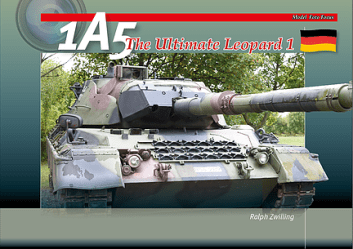
Book Alert: Trackpad Publishing Leopard 1A5

Trackpad publishing has released a new entry in their Model Foto Focus series on the German Leopard 1A5 MBT.  This is the latest in a series of walk-around style photo reference books by Trackpad, who specialize on the German Leopard 1 and 2 battle tanks.  Other entries in their catalog include books on the Danish Leopard 1A5DK1, the Leopard AS1 in Australian service, the Leopard 2A4M and the Leopard 2A6M in Canadian service.  Their online catalog may be viewed here.

Publishers description:

5076e8_31c022519f8b4f0a8574ae1811393013-mv21A5 – The Ultimate Leopard 1. This Model Foto Focusreference books includes colour full-view and walkaround captioned photos of  the last Leopard 1 introduced into the Bundeswehr.

 It takes a thorough look around the exterior of  the Leopard 1A5. For the modeller, this is the ultimate walkaround for an accurate model. For the armour enthusiast, it describes Leopard 1A5 in great detail.

 Leopard 1 was originally conceived in the 1960s to face the threat of the Soviet T-54, T-55 and T-62. By 1980, it had to face the more formidable T-64 and T-72. Fitted with a revolutionary fire-control system, it was the first to use a laser rangefinder allowing all-weather, day or night, vision. Together with an upgrade in ammunition and many other modifications, it became the Ultimate Leopard 1.

Book Alert: Tank Action: An Armoured Troop Commander’s War 1944–45

A new WWII tanker memoir is scheduled for release on October 4, 2016 according to Amazon. Tank Action: An Armoured Troop Commander’s War 1944-45 by David Render (2016-06-16) by David Render and Stuart Tootal is a hardcover book of 320 pages.  The book chronicles the experiences of David Render, who commanded a troop of British Sherman tanks following the D-day invasion.

Publisher’s Description:

In 1944 the average life expectancy of a newly commissioned tank troop officer on the frontline in Normandy was estimated as being less than two weeks. David Render was a nineteen year-old second lieutenant fresh from Sandhurst when he was sent to France to join a veteran armoured unit that had already spent years fighting with the Desert Rats in North Africa. Joining the Sherwood Rangers Yeomanry five days after the D-Day landings, the combat-hardened men he was sent to command did not expect him to last long. However, in the following weeks of ferocious fighting in Normandy, in which more than 90 per cent of his fellow tank commanders became casualties, his ability to emerge unscathed from countless combat engagements defied expectations and earned him his squadron’s nickname of the ‘Inevitable Mr Render’.

In Tank Action David Render tells his remarkable story, spanning every major episode of the last year of the Second World War in Western Europe, from the D-Day landings to the fall of Germany. Ultimately it is a story of survival, friendship and measuring up to the expectations of the men he commanded.

Book Alert: Tanks: 100 Years of Armoured Warfare

Amazon is listing an October 4 release for a new book covering a century of tank history. Written by David Willey (curator of the Bovington Tank Museum) and Robin Cross, Tanks: 100 Years of Armoured Warfare is a 132 page hardcover volume. Included in the book are 20 removable recreations of archival documents. Based upon the sample images provided, this book contains many photographs and charts. This looks like a very handsome product, probably best suited for those looking to learn the basics of tank development.

Publisher’s Description.

A century of the weapon that changed modern warfare.
In 1916, for the very first time, the tank entered the military arsenals at a small engagement on the Somme. And despite its shortcomings, it altered the course of World War I. Tanks charts the weapon’s first century, from its early stumbling attempts to the lethal killing machines of today: the technical developments, the various types and models, the tacticians who used it best, and the famous battles where they played a role. The book also contains 20 removable documents from the archives of the museum, including diaries from tank soldiers, blueprints, instruction manuals, and handbooks.

Book Alert: Panther on the Battlefield 2

panther-on-the-battlefield-2-480x346Peko Publishing has announced that the upcoming title Panthers on the Battlefield 2 is available for pre-order and scheduled for a Sept. 30 release date.  Little information is given regarding this title on the publisher’s website, but according to Armorama.com, this book will feature large photographs covering almost the entire page with detailed captions.  The text is in both Hungarian and English and the photos document vehicles both destroyed and in service.  The book is a hardcover of 112 pages. Page samples from the book can be viewed at the Armorama site here.  The book is priced at 25 euros with free world wide shipping and can be ordered at the Peko website.

Book Alert: BT Fast Tank: The Red Army’s Cavalry Tank 1931-45

On August 25, Osprey books will be releasing their latest offering in the long running New Vanguard book series.  BT Fast Tank: The Red Army’s Cavalry Tank 1931-45  by Steven Zaloga promises to give readers a good look at these Soviet pre-WW2 series of “fast” tanks.  This book follows the format of previous New Vanguard titles, being a softcover book of 48 pages with numerous photos and color illustrations.

Publisher’s Description:

When the Red Army needed to mechanize its cavalry branch in the 1930s, the BT fast tank was its solution. Based on the American Christie high-speed tank, the Red Army began a program to adapt the design to its own needs. Early versions were mechanically unreliable and poorly armed but by the mid-1930s, the BT-5 emerged, armed with an excellent dual-purpose 45mm gun. It saw its combat debut in the Spanish Civil War in 1937 and was later used in the border battles with the Japanese Kwangtung Army in the late 1930s. The final production series, the BT-7, was the most refined version of the family.

One of the most common types in Red Army service in the first years of the Second World War, BT tanks saw extensive combat in Poland, Finland, and the opening phases of Operation Barbarossa in 1941 and latterly during the 1945 campaign against the Japanese in Manchuria – this is the story of their design and development history.

By our count, this is the 11th New Vanguard title that Mr. Zaloga has written on Soviet tanks.  Others in the series include:

T-26 Light Tank: Backbone of the Red Army (New Vanguard)
KV-1 & 2 Heavy Tanks 1939-45 (New Vanguard)
T-34/76 Medium Tank 1941-45 (New Vanguard)
T-34-85 Medium Tank 1944-94 (New Vanguard)
IS-2 Heavy Tank 1944-73 (New Vanguard)
T-54 and T-55 Main Battle Tanks 1944-2004 (New Vanguard)
T-62 Main Battle Tank 1965-2005 (New Vanguard)
T-64 Battle Tank: The Cold War’s Most Secret Tank (New Vanguard)
T-72 Main Battle Tank 1974-93 (New Vanguard)
T-80 Standard Tank: The Soviet Army’s Last Armored Champion (New Vanguard)

Book Alert: British Battle Tanks: World War I to 1939

On August 25, a new book on British Battle Tanks: World War I to 1939 (General Military) by David Fletcher is being released.  This book is from well known publisher of military history titles Osprey Books and is a hardcover of 236 pages.  While the UK is blessed with many fine authors on tanks and AFVs, David Fletcher is in a class by himself.  For those with an interest in pre-WW2 British tank development, this book should prove a worthwhile purchase.  We have a copy on pre-order, expect to see a review of it here sometime next week.

Publisher’s Description:

When British soldiers charged across the Somme in September 1916 they were accompanied by a new and astonishing weapon – the tank. After a stuttering start armoured behemoths such as the Mark IV, Mark V and Whippet played a crucial role in bringing World War I to an end.

Marking the centenary of their battlefield debut, this comprehensive volume traces the design and development of the famous British invention during World War I and the increasingly tense years of the 1920s and 30s, from the first crude but revolutionary prototype to the ever-more sophisticated designs of later years. Bolstered by historic photographs and stunning illustrations, author David Fletcher brings us the thrilling history behind the early British battle tanks.