New Book Alert: British Tank Crewman 1939-45

Osprey Publishing has released a new volume in their Warrior series looking at British tank crewment in the Second World War. British Tank Crewman 1939-45 (Warrior) is written by Neil Grant and follows the pattern set by preceeding entries in the Warrior series, bein a softcover book of 64 pages.

Publisher’s Description:

Great Britain had introduced the tank to the world during World War I, and maintained its lead in armored warfare with the “Experimental Mechanized Force” during the late 1920s, watched with interest by German advocates of Blitzkrieg. Despite these successes, the Experimental Mechanised Force was disbanded in the 1930s, making Britain relatively unprepared for World War II, both in terms of armored doctrine and equipment.

This fully illustrated new study examines the men who crewed the tanks of Britain’s armored force during World War II, which was only four battalions large in 1939. It looks at the recruitment and training of the vast numbers of men required, their equipment, appearance and combat experience in every theater of the war as the British armored division sought to catch up with the German Panzers.

Available on Amazon here.

Book Alert: M113 APC 1960–75: US, ARVN, and Australian variants in Vietnam

A new entry in the long running New Vanguard series by Osprey is available titled M113 APC 1960–75: US, ARVN, and Australian variants in Vietnam (New Vanguard).  Written by Jamie Prenatt, this book follows the well established format of other New Vanguard titles, being a soft cover of 48 pages.

Publisher’s Description:

The M113 is the most widely used and versatile armored vehicle in the world. Fielded in 1960 as a simple “battlefield taxi,” over 80,000 M113s would see service with 50 nations around the world and 55 years later, many thousands are still in use. In addition to its original role of transporting troops across the battlefield, specialized versions perform a multitude of other functions including command and control, fire support, anti-tank and anti-aircraft defense, and casualty evacuation.

This new fully illustrated study examines the service record of the M113 from its initial fielding through the end of the Vietnam War. It will also describe the many US, South Vietnamese, and Australian variants of the M113 used in the Vietnam War as well as information on tactics, unit tables of organization and equipment, and a selection of engagements in which the M113 played a decisive role.

Available on Amazon here..

Book Alert: The Tanks: The History of the Royal Tank Regiment, 1976-2017

A new book by WWII historian Charles Messenger has been released and is available for sale. The Tanks: The History of the Royal Tank Regiment, 1976-2017 examines the last 40 years of the Royal Tank Regiment. This is a hardcover book of 232 pages, published by Helion and Company.  Charles Messenger served for 19 years as a regular officer in the Roayl Tank Regiment, including service in Libya, Germany and Norther Ireland.

Publisher’s Description:

The Royal Tank Regiment celebrates its centenary this year (2017). This, the fourth volume of the Regiment’s history, begins in the midst of the Cold War, with the four RTR regiments mainly based in Germany. They experienced NATO’s rearmament in the early 1980s and the implementation of General Sir Nigel Bagnall’s revolutionary new concept for the defense of the NATO Central Region. The Troubles in Northern Ireland were also at the height and the RTR served there on numerous occasions. In addition, the Regiment saw service with the United Nations in Cyprus.

The Berlin Wall came down at the end of 1989, signaling the end of the Cold War. Yet, President Bush’s New World Order proved anything but. Saddam Hussein’s invasion of Kuwait resulted in the First Gulf War, in which the Regiment played its part in many ways. However, the so called Peace Dividend meant that the RTR was reduced just two regiments. Then came the horrors of the civil war in former Yugoslavia, in which the Regiment also became involved. While it did operate in tanks in Kosovo, it was also demonstrating its versatility in many other roles in this increasingly uncertain time. Not least was the formation the Joint NBC Regiment, made up of 1 RTR and the RAF Regiment.

The RTR was at the forefront of the assault on Basrah in the 2nd Gulf War and thereafter served a number of tours in Iraq. Indeed, the Regiment was among the very last troops to withdraw from the country at the end of Operation Telic in 2009. By this time, the British Army was heavily committed to Afghanistan and the Regiment would spend the next five years deploying on Operation Herrick. As in Iraq, it carried out a variety of missions and in many different types of vehicle. The book makes plain how tough conditions, as in Iraq. The Army, however, faced further reductions and the RTR was cut to a single Challenger 2 regiment.

This History not only covers the Regiment’s numerous operational tours. It details the vehicles it has used and provides an idea of how life in the RTR has changed over the past forty years. It does not duck controversy and allows the voices of all ranks to be heard. ‘The Tanks’ reflects an ever changing British Army, the one constant being the character of the RTR soldier, the Tankie.

Available on Amazon here.

Book Review: Can Openers

We will start this book review with this video produced by book author Nicholas Moran giving a description of the work in his own words.   The background footage scrolling behind him gives a pretty good idea as to the layout of the book for those that are curious.


Mr. Moran was kind enought to provide us with a review copy of the book so that we may share our thoughts on it with our readers.  From this point forward, we will refer to Mr. Moran by his nickname “The Chieftain” for the simple fact that it’s a pretty cool moniker.

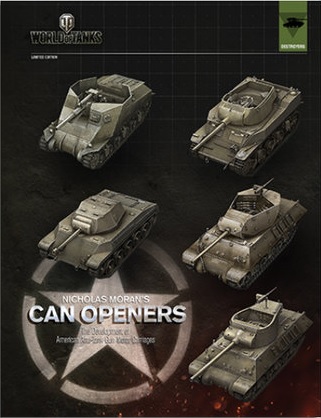
Can openersIn the video above, The Chieftain makes a reference to his book as a “Hunnicutt for tank destroyers.”  This is an apt description.  Those familiar with the works of Richard Hunnicutt will know that his ten volume work contains a detailed history of US armored vehicle development, each volume dedicated to a specific vehicle type, such as Medium tanks, Heavy tanks, halftracks, etc. However if you scan through the titles of his books you will find one title conspicuously absent, US tank destroyers. To be sure, tank destroyers are included in his books, but scattered over about five different volumes and generally regulated to the later pages of the volume. For example, if you want to read about the tank destroyers that saw service during WWII war, you will need to go to the Hunnicutt Sherman book for the M10 and M36, the Stuart book for the M18, the Halftrack book for the M3 GMC, and the Armored Car book for the various wheeled tank destroyer models.

Fortunately, this dilemma has been solved by the new book Can Openers: The Development of US Anti-tank Gun Motor Carriages by World of Tanks researcher and historian Nicholas “The Chieftain” Moran. Known in part to the wider public for his Inside the Hatch video series, this book marks his first foray into book writing. Those that follow his articles on the World of Tanks website and in the “Chieftain’s Hatch” section of the World of Tanks online forum will recognize his writing style in this volume. The sarcastic wit of The Chieftain comes through in the text, making it a bit more easy to digest than the relatively dry writing style of Hunnicutt.

It should be pointed out that this is a developmental history of US tank destroyers and is focused on describing the various different models and prototypes and providing some background as to why each vehicle was accepted or rejected. It is not an in-depth history of the tank destroyer branch itself. For that, we would suggest Charles Baily’s Faint Praise or Steven Zaloga’s writings.  For a history of the tank destroy battalions during WWII, we recommend Harry Yeide’s book The Tank Killers.  Speaking of Harry Yeide, he provides a nice forward for this new book.

It is obvious that Mr. Moran has spent a good deal of time in the archives compiling the information and collecting the photographs for the book. This is not a rehash of previously published materials, and those familiar with the subject will be pleased to find photos they have probably never seen before. The book is also sprinkled with quotes from letters and memos from the various US Army officers involved in the development of these tank destroyers. These quotes do much to explain the thinking and rationale of the people responsible for this assortment of oddities and experiments, helping to explain how some of these vehicles that seem so obviously flawed to those of us with the benefit of hindsight came to be.

The history of US anti-tank Gun Motor Carriages (GMC’s) presents some of the stranger armored vehicles to come out of the ordnance department during the war. Certainly, there is much in the pages of this volume to make one shake their head and wonder what exactly was going through the heads of the designers. In particular, the early attempts to mate a high velocity anti-tank weapon to a light wheeled chassis produced a number of ill-conceived contraptions.  For those that enjoy contemplating such machines, The Chieftain has assembled an admirable history.

Since we reviewed this from a digital copy, we have not had a chance to examine an actual copy.  However, we have been informed that in terms of size and paper quality, this book is very similar to the World of Tanks reprint of the Hunnicutt Firepower book by Echo Point.

If you would like to pre-order this book, please do so at http://www.echopointbooks.com/history/can-openers

New Book Alert: M-60 Main Battle Tank In Action

A new entry in the “In Action” series by David Doyle has been released by Squadron Signal, M-60 Main Battle Tank In Action.  This is an 80 page softcover volume containing both black and white and color photos.  For a preview of the book, check out the video preview posted below.

Publisher’s Description:

The M60 Main Battle Tank was conceived as the successor to the M48 Patton with the hope that it would prove a better adversary to the Soviet T-54A. Introduced in 1959, the 105mm-armed M60, and its variants, the M60A1 and M60A3, remained in production into 1987, forming the backbone of the U.S. armored force until it was supplanted by the M1 Abrams. In addition to the conventional cannon-armed versions of the M60, the M60A2 variant, sometimes dubbed “the starship,” featured new departures in tank armament. The M60A2 was armed with a 152mm projector, which could fire a conventional round with a fully combustible casing, or the MGM-51 Shillelagh anti-tank missile. Completing the M60 family were the M728 armored engineer vehicle, and the still-in-service M60 Armored Vehicle-Launched Bridge. Packed with 155 vintage color photos, 69 historic black-and-white images, by numerous fine line drawings, and a detailed data table, this 80-page volume traces the history of America’s iconic Cold War tank

Book Alert: Sturmgeschütz: Panzer, Panzerjäger, Waffen-SS and Luftwaffe Units 1943–45

Osprey has released a new hardcover book by German armor researcher Thomas Anderson titled Sturmgeschütz: Panzer, Panzerjäger, Waffen-SS and Luftwaffe Units 1943-45.  Anderson has written several books for Osprey over the last few years on German tanks and armored units.  This book is a 272 page hardcover with over 200 images.

Publisher’s Description:

During the inter-war years a new kind of support weapon was recommended to the German general staff by Erich von Manstein: an armored assault gun designed to destroy prepared defensive positions and enemy tanks, laying the groundwork for an assault by the Panzers and Panzergrenadiers.

First rolled out in 1940, the Sturmgeschütz assault gun was an instant success, and played a vital role in the Wehrmacht throughout the war. Cheaper and quicker to produce than the German Panzers, it was deployed widely and with great success, particularly in the later years of the war, forming an integral part of armored units as well as its more traditional infantry support role.

This book traces the story of the Sturmgeschütz from its original design in the 1930s to its use in the last desperate days of the German war effort. Drawing on original material from German archives and private collections, and replete with over 200 images, Sturmgeschütz tells the thrilling story of the Wehrmacht’s unsung workhorse.


Book Alert: The Tanks of TOG

A new book on the history of the tanks designed by “The Old Gang” during WWII is available on createspace.com.  Written by Andrew Hill, this is a 462 page trade paperback volume.  Copies may be purchased here.

Publisher’s Description:

THUMBNAIL_IMAGEThe previously untold story of the Special Vehicle Development Committee, better known as ‘The Old Gang’ or by the abbreviation ‘TOG’. These were the men who were mainly responsible for the creation of the British tanks in WW1. Men like Sir Albert Stern, Sir William Tritton, Sir Harry Ricardo, and Major Walter Wilson. At the outbreak of WW2, they were given a new task, that of breaching the heaviest German defences, with a heavily armoured tank able to cross the worst mud soaked ground of Flanders.
The SVDC managed in very short time to design more than one vehicle to accomplish this seemingly impossible task and built tanks bearing their acronym as TOG-1 and TOG-2. This book covers the development of both vehicles as well as several variations and other work such as an underwater tank and connections to the gigantic Cultivator machines of the Naval Land Equipment division.
The work of the SVDC was conducted in secrecy with documents, photographs, and blueprints sent to various companies and people. Places where sadly since the war so much has been lost. This book was the culmination of several years of research by the author. A search which brought together archival information from as far afield as Canada, the USA, Australia, and the UK to tell the story of these incredible men and their incredible machines.

Book Review: Pershing Vs Tiger Germany 1945 (Duel 80)

Book Review

Pershing vs Tiger: Germany 1945 (Duel) by Steven Zaloga

Osprey Publishing

Pershing VS Tiger is the 80th entry in the Osprey Duel series, and the eleventh authored by Steven Zaloga.  Several of his past Duel series titles have dealt with US versus German armor during the last year of the war, including Sherman vs Panther, Sherman vs Pz IV, M10 vs Stug III and Bazooka vs Panzer.  With this title, he addresses one of the very last contests between German and American armor, the handful of encounters between the US Pershing heavy tank and the heavy German “cats.”

The first thing worth noting is that the title of the book is perhaps a bit misleading.  The artwork on the cover depicts the US Pershing and a German Tiger I tank.  And while the book does describe a combat encounter involving these two types of vehicle, there is only one incident of this type.  The other examples involve other types of German armor, including a Panther, Nashorn, Pz IV, and possibly a Jagdpanther.  This is not surprising, since the number of Pershing tanks operating in the ETO in 1945 was very low.  As Zaloga points out, by March of 1945 there were only 20 Pershing tanks in the field.  It is no wonder that the number of tank vs tank clashes involving Pershing tanks can be related individually in one volume.

For those who have read previous Duel series books, the layout of this book will be familiar.  The first section of the book traces the design and development of the Tiger, Tiger II and the Pershing. This is followed by a technical description of each tank, focusing on crew layout, firepower, armor and mobility.  After this are chapters on the combatants and the strategic situation, describing the activities of the Tiger heavy tank battalions and their encounters, or more accurately, their lack of encounters with US forces in the ETO.  All this sets up the heart of the book, which is the descriptions of the various combats by Pershing tanks and German armor.  The book delivers on its title with a description of the duel at Elsdorf, in which a Pershing tank destroyed a German Tiger and several other German tanks in exchange for the loss of one Pershing tank named “Fireball.”

The book finishes up with an analysis chapter, focusing primarily on the Tiger tank.  For those invested in the idea that the Tiger was some sort of super-tank, this analysis will prover rather deflating.  Zaloga points out that Tiger units were relatively rare in the West, suffered from low readiness rates due to poor reliability and high maintenance demands and were generally less effective than the Tiger units in the East.  The Tiger II he refers to as “an extravagant waste in the West”.  Little final analysis is offered regarding the performance of the Pershing in the final chapter.  Zaloga notes that the number of Pershings in the field were so few, and the state of the German opposition so poor by this point in the war, that few lessons regarding the tank can be learned (for more on the combat record of the Pershing, check out Zaloga’s T-34-85 vs M26 Pershing: Korea 1950)

For those interested in US and German armor in the West 1944-45, this book is certainly worth picking up.  With this volume, Zaloga seems to have covered most of the well-known US and German tanks that faced each other after D-Day until the German surrender.   This volume may prove particularly useful for those looking for an antidote to the Tiger myth.

Book Alert: Panther

Osprey has released a new book by German author Thomas Anderson on the Panther tank, simply titled Panther.  This is a 224 page hardcover with photographs and illustrations.  Anderson has written several books on German WWII armor, including volumes on the Tiger, the Ferdinand and the Sturmgeschutz.  Oddly enough, this is the second hardcover that Osprey has released in the past few years on the Panther, in 2012 they published Panther: Germany’s quest for combat dominance by Michael Green.

Publisher’s Description:

The German Panther is one of the most famous, and greatest, tanks of World War II. Often considered the most elegant tank design of the war, it embodied a balance of firepower, armour protection, and mobility unmatched by any other tank of the period. This new study by German armour expert Thomas Anderson draws upon original German archival material to tell the story of the birth of the Panther in response to the Soviet tanks encountered in 1941. He then analyzes its success on the battlefield and the many modifications and variants that also came into play. Illustrated throughout with rare photographs and drawings, many of which have never been published in English before, this is a unique history of one of the most famous tanks of World War II.

Book Alert: Pershing vs Tiger: Germany 1945

Osprey Publishing has released a new entry in their Duel series,Pershing vs Tiger: Germany 1945 (Duel) by Steven Zaloga.  This book follows the pattern set out in other Osprey Duel books, and is a softcover of 80 pages.  Next week we will be posting a more detailed review of this new book.

Publisher’s Description:

During the final battles on World War II’s Western Front, the legendary German Tiger I heavy tank clashed with the brand-new M26 Pershing fielded by the United States. The Tiger I had earned a formidable reputation by the end of 1944, although its non-sloped armour and poor mobility meant it was being superseded by the Tiger II or ‘King Tiger’. While the Tiger I had been in the front lines since 1942, the US Pershing first entered combat in late February 1945, and more than 20 Pershings would see action before war’s end.

This book examines the dramatic Tiger/Pershing duel at Elsdorf in Germany, and also assesses the clashes between German armour and the sole ‘Super Pershing’ deployed to Europe. Featuring full-colour artwork, carefully chosen photographs and specially commissioned maps, this is the story of the first US heavy tanks in combat with the fearsome Tiger I during the last months of World War II in Europe.