Youtube personality “Lindybeige” takes a trip through the Bovington tank museum to show off his five favorite tanks. Actually, only three of the vehicles in his list are technically tanks since the Jagdpanther is a tank destroyer and the Universal Carrier is a….universal carrier. Of the three actual tanks he picked, the WWI era Mark IV, the Churchill, and the S-tank, only one of them has a turret. Does Lindybeige hate turrets? Inquiring minds want to know….
Army Heritage Days salutes a century of the Armored Corps
May 17, 2017 by Leave a Comment
If you happen to be in Pennsylvania this weekend and are looking for something to do, you might want to look into the Army Heritage Days event at the US Army Heritage and Education Center at the US Army War College in Carlisle Pennsylvania on May 20 and 21. This is an annual event and this year the theme is a century of the US Armored Corps.
Here is the event description from their website:
Come out to the U.S. Army Heritage and Education Center (USAHEC) Armed Forces Weekend, Saturday, May 20 – Sunday, May 21, 2017 from 9:00AM to 5:00PM, for Army Heritage Days! Each year the USAHEC hosts Army Heritage Days, a timeline living history event that features several hundred reenactors from all eras spread out over the one mile long Army Heritage Trail. Decked out in period uniforms and weapons, these living historians will have their historical equipment and weapons on display and will be available to talk to the public and answer any of your burning history questions!
As always, this event centers on one specific theme. This year’s focus will be tanks and armored vehicles! This event will be one of a kind, featuring armored vehicles from many different eras that will be allowed to DRIVE on the USAHEC’s tank course to demonstrate MANUEVERS and TACTICS! There will also be a logistics and operations competition with various challenges to complete.
In addition to the tank display, we will be bringing back old favorites, such as the Veterans Meet and Greet, lectures by notable historians, the kid’s passport program, and informational programs by the reenactors on the Army Heritage Trail. As always, the event will also feature a book sale in the Museum Store and several food vendors with a variety of different cuisine offerings.
So be sure to mark your calendars for Saturday, May 20 – Sunday, May 21, 2017 for a weekend full of history, tanks, and family fun! As always, the event is free and open to the public. Check back for a schedule of events and additional information, closer to the event.

Combat Dealers: Panther Tank
May 17, 2017 by 2 Comments
 We noticed that earlier this month an episode of the TV show “Combat Dealers” was posted on youtube. This particular episode deals with a WWII German Panther tank that show host Bruce Crompton. The episode also features German tank expert Hilary Doyle. Unfortunately, the episode does not mention where or from whom Mr. Crompton purchased his Panther tank. We found a recent article concerning Mr. Crompton in the Mirror, but it provides few details regarding this Panther tank.
Inside the Chieftain’s Hatch: Strv 103C part 2
May 16, 2017 by Leave a Comment
In this second part of the Inside the Chieftain’s Hatch episode about the Strv 103 tank, Nicholas “The Chieftain” Moran looks at the crew positions, height restrictions, the number of people required to control the S-tank, and show the unique position of the radio operator/driver who faces backwards.
Tank Chats #37 Daimler Armoured Car
May 12, 2017 by Leave a Comment
Historian David Fletcher MBE, of the Tank Museum at Bovington discussing the Daimler Armoured Car.
Inside the Chieftain’s Hatch: Strv 103C part 1
May 11, 2017 by 2 Comments
Nicholas “The Chieftain” Moran of Wargaming examines the Swedish Striv 103C part 1. This first part looks at the exterior of the vehicle.
Unofficial High-Speed Tour of Saumur, Part 2
May 9, 2017 by 1 Comment
Nick “The Chieftain” Moran posts part 2 of his quick video tour of the French tank museum at Saumur.
The Matilda Diaries Part 12
May 8, 2017 by Leave a Comment
Episode 12 of The Matilda Diaries chronicling the restoration of the Matilda infantry tank at the Bovington Tank Musuem is now online. This clip looks at the restoration of the turret interior.
Article on Tank 785
May 4, 2017 by Leave a Comment
The Daily Mail recently posted an article on the WWI era Mark II tank identified at tank 785. This tank currently resides at the Tank Museum at Bovington. According to the article, this tank was unwittingly sent into combat despite being built not out of armor plate but of untreated steel, leaving it vulnerable to rifle fire.
British tank crews unwittingly went into the first ever major tank battle in vulnerable unarmoured vehicles, historians have revealed 100 years after the event. Researchers have found that the 45 Mark II tanks that went into action at the Battle of Arras in May 1917 were training vehicles which had no armour. Experts believe the crews were not informed the steel the tanks were made from was untreated and therefore could be penetrated by rifle fire. The weakness of the vehicles actually ended up helping the British war effort after one was captured by the Germans, who then abandoned plans to develop more advanced armour-piercing weapons. But it was actually mechanical issues that proved the most costly, with just 11 of the tanks eventually crossing No Man’s Land due to breakdowns.
Translated Articles from Tankarchives.com (April 2017)
April 30, 2017 by Leave a Comment
Here is part two of our post bringing us up to speed with the translated Russian articles from Tankarchives.com. Click on the headline to read the full article.
Halftrack Experiments
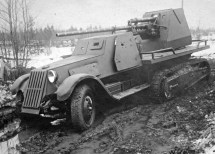 Ever since their appearance in the mid-1910s, halftracks have been considered as a chassis for armoured vehicles, especially SPGs. Better off-road performance than wheeled vehicles and stability made these vehicles an attractive chassis for artillery. Halftrack SPGs were popular in Germany and the United States. The heroes of this article, Soviet ZIS-41 and ZIS-43 halftracks, are not as well known.
Medium Tank M2: Last Place in the Arms Race
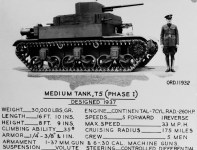 The late 1930s were a time when armoured vehicles were developing rapidly. The start of WWII in September of 1939 gave an even bigger push to the flywheel of progress. Designs that were considered revolutionary suddenly fell behind. There were cases where tanks became obsolete soon after coming out of the factory. The American Medium Tank M2 is among those unlucky ones. You can read a lot of mockery of the combat abilities of this tank, but they are unreasonable. American engineers made a decent medium tank, but by the time it entered mass production there were already other tanks with more armour and better armament.
Light Tanks T1E4 and T2E1: Experiments on an Ideal Platform
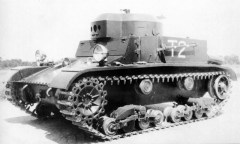 The idea of a light tank with a front engine that the American Ordnance Department insisted on was at a dead end by 1932. Trials of the Light Tank T1 family and later the Medium Tank T2 showed that the idea was unacceptable. Poor visibility, excessive mass, bad crew conditions, and, most importantly, the limits of further development, put an end to such tanks. Designers moved on to working on other tanks with different layouts. Harry Knox, the father of the front engine American tanks, did not abandon his idea, and kept looking for a place for his idea. Stooping down to plagiarism, he crossed his Light Tank T1E1 with the Vickers Mk.E, its overseas competitor. The resulting “hybrid” Light Tank T2E1 was not that bad.
Combat Car M1: Armour for American Cavalry
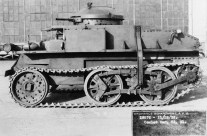 Traditionally, cavalry occupied a very strong position in the American army. As soon as there was an opportunity to obtain its own tanks, the cavalry took it. Since, officially, the cavalry was not allowed to have tanks, the name “combat car” was used, even though these vehicles were actually tanks. The Combat Car M1 and several similar vehicles on its chassis are typical representatives of the small family of interbellum cavalry tanks.
T18 HMC: Quick Howitzer
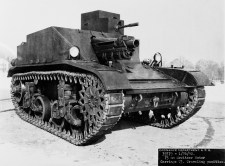 The American army began thinking of motorizing their artillery back in WWI. For a long time, attempts were made to build an SPG on the chassis of the light tracked Holt tractor. In parallel, John Walter Christie was working on a similar vehicle. Neither project satisfied the US Army for various reasons. A second attempt at an SPG was made in 1930, but the Howitzer Motor Carriage T1 remained an experiment. The next opportunity to obtain self propelled artillery came a decade later in the form of the Howitzer Motor Carriage T18.
Gun Motor Carriage M10
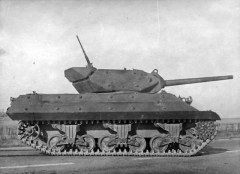 Unlike many tanks, few tank destroyers arrived in the USSR within the Lend Lease program. The Gun Motor Carriage T48, or SU-57, built on the chassis of the M3 halftrack, was the only exception. Initially, they were built by the Americans for a British order, but the British barely used them. The USSR gave them a completely different reception: they were used actively and showed themselves as an effective anti-tank measure. As for tank destroyers on a tank chassis, the only Western vehicle that was accepted into the army was the Gun Motor Carriage M10, known widely under the British nickname “Wolverine”.
Infantry Tank Mk.I: the First Infantry Tank
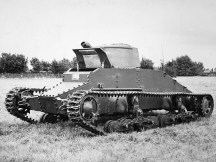 There are many tanks in the history of armoured warfare that were simply unlucky. The British Infantry Tank Mk.I is one of them. Even its name was lost when it became the Matilda due to some historian’s error, even though that name applies to a completely different vehicle. As Britain’s first infantry tank, it was hopelessly obsolete by the start of the war. Even its thick armour was not enough to survive in a war that it was simply not suitable for.
Hummel: Bee with a Long Stinger
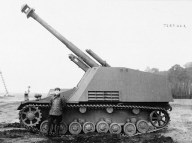 German engineers invented the “self propelled gun mount” class of artillery. The first work in this area was done during WWI, but it truly became a mass event 25 years after it ended. The recipe was simple: take a light or medium tank and use its parts to to build a chassis with bulletproof armour. A slightly modified version of a towed gun was installed on that chassis. Thanks to this phenomenon, the mobility of German artillery grew significantly. The Hummel became the post powerful of German “self propelled gun mounts”. This SPG earned its position as one of the symbols of German self propelled artillery.
E-50 and E-75: A Story of Failed Unification
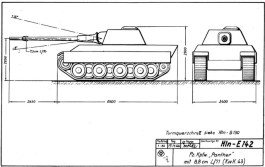 Tanks that could have been built are often discussed within certain circles. Aside from the superheavy Maus and E-100, there are the light and medium E-10 and E-25 tank destroyers. Despite very incomplete data about these vehicles, the overall characteristics are known, including the armament. Meanwhile, the core of “Panzerwaffe-46” was going to be composed of the medium E-50 tank and heavy E-75 tank, at least in the minds of fans of alternative history. The story with these tanks is a lot more complicated, since work stopped at an early stage, and a good half of the information available on these tanks is divination at best. Let’s try to figure out what about the E-50 and E-75 is true and what is blatant misrepresentation.

 Tank and AFV News