Overlord’s Blog on “A Killa” Sherman tank

Overlord’s Blog has posted a piece by David Lister on the wartime career of WW2 British tank commander George Dring.  While the details are a bit unclear, George Dring and his tank, named “Akilla”, managed to destroy or damage several heavy German AFVs during the Normandy campaign.

Excerpt:

MBa47HyAs Sgt Dring approached a crossroads his habit of getting out for a shufti payed off. He sneaked through a cornfield and saw five tanks in a copse of trees below him, suddenly one started moving out. This is where some confusion comes in. By Sgt Drings words it appears he thought it might be a new tank that had recently been reported by intelligence, a Jagdtiger. However with hindsight we know it can’t have been. Sgt Dring does say it was a very large tank, which he’d ever seen before. However a later intelligence report simply calls it a “Panther”, but Sgt Dring was familiar with Panthers. So your guess is as good as mine as to what it could have been, a King Tiger? A Jagdpanther? Or a normal Panther? Either way it was bad news for a 75mm armed Sherman! Sgt Dring reversed his Sherman a little way up a side road and waited, the enemy tank moved out in front of him, and his first shot hit it in the drive sprocket shredding the track and immobilising the tank. The crew promptly bailed out.

Read the entire article at Overlord’s Blog.

Tank Chats #8 Renault FT-17

The Tank Museum has released the eighth video in their Tank Chats series staring David Fletcher.  This episode focuses on the Renault FT-17

Conceived by General Jean-Baptiste Estienne and manufactured under the control of the Renault Company this was the world’s first mass-produced tank, 3800 being built in all.

They went into action for the first time on 31 May 1918 near Ploissy-Chazelle and proved very successful when they were used in numbers. British forces used a few Renaults as liaison vehicles while the United States Army used them in combat and copied the design.

Civilian Sherman Photo Gallery

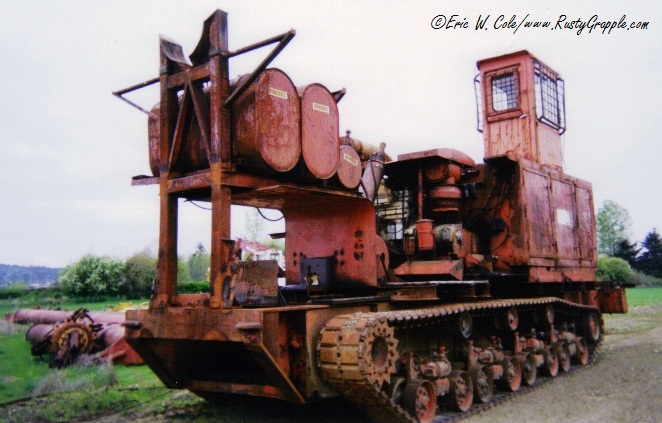
133560578_xIj4RvAh_1aMadill046Tank1HEFWar History Online has posted some interesting photos of Sherman tanks converted into civilian work machines after the war.  Most of these pictures show vehicles in which the turret and upper hull were removed and then used as the basis of a heavy vehicle for construction, forestry or mining.  Some of the pictures show rather extensive modification to the hulls, including at least one example where a fourth suspension station was added (see picture to the left.)  A couple photos also show vehicles based on M3/M5 light tanks, although this is not noted in the original article.  The three page gallery may be viewed here.

Blog Profile: Tankograd

1023367375People interested in Soviet tanks and armor may find the blog “Tankograd” worth checking out.  Authored by Tiles Murphy, this blog features extremely long and detailed posts focused on a specific Soviet vehicle.  So far the author of the blog has posted three entries, looking at the BMP-3, BTR-80, and the T-72.  These posts are quite possibility the most detailed and extensive descriptions of these particular vehicles on the internet in English.  In fact, they probably contain as much or more information than many of the books written on these vehicles.  If ever a blog entry could rightfully be called “epic”, this is it.

BMP-3: The Under-appreciated Prodigy

BTR-80: Modest Overachiever

T-72: Soviet Progeny

Fv3805 Restoration Project

The Wright military and Heritage Museum on the Isle of Wright in the UK has announced that they have started a restoration project of a Fv3805.  The Fv3805 was a British self propelled gun design, of which only two prototypes were built.  One of these prototypes still exists and is at the Wright museum.  A kickstarter campaign has been launched to support the project.  Here is the project description from the kickstarter site.

About this project

Our project is to raise fund and restore the only FV3805 vehicle left in the world with the aim to have it driving at Bovington tank museum by 2017. The vehicle will be restored by volunteers and disabled ex-servicemen and women and when running will be the first vehicle in the UK specifically restored to carry wheel chairs and have access to the insides.

This project will allow anyone with the suitable training which can be provided for free to access the vehicle regardless of gender or ability and will be shown at tankfest 2017 by the female staff and volunteers from the museum” ‘With your help and support this machine can once again be returned to a working condition and find a role far more peaceful than for what she was designed for.

Risks and challenges

The Vehicle current is sitting outside the back of a museum workshop as it’s the safest place to store her, the crew that work on her in their free time are from a variety of engineering backgrounds and almost all have been involved in restoration projects before. Each member is H&S trained and each has extensive knowledge in their own fields, the only obstacle is time and money.

The project is described further in this “Mingles with Jingles” video.

The sad story of the M73 coax machine gun

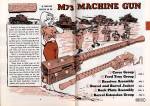
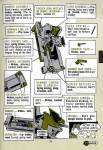
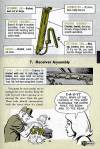
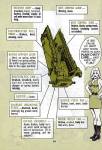
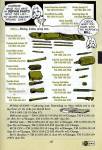
sad storyOne of the more surprising stories of cold war US tank development is the M73/M219 machine gun.  Developed for use in US armored vehicles, the M73 served most prominently as the coax machine gun in the M48/M60 “Patton” series of tanks and the M551 Sheridan light tank.  During its time of service, the M73 distinguished itself as one of the worst machine guns ever adopted by the US military, suffering from numerous malfunctions which lead to frequent jamming.  This was particularly frustrating for US tankers who were accustomed to the reliability of the .30 and .50 cal machine guns designed by John Browning which equipped US tanks during WW2 and the early cold war period.

A nice overview of the sad history of the M73/M219 is provided by an article over at the small arms review. The article sums up the M73/M219 saying:

In retrospect, the design of the M73/M219 was an accumulation of novel concepts that should have been thoroughly tested in the application before finalizing the design. The off and on development program challenged the ever-changing design teams with a new learning curve every time the project was restarted. It was a costly program in time, assets, money and loss of face. She was an ugly little baby and somebody should have told her Mama so.

For those interested in primary documents, here is a link to a government report from 1975 detailing tests to find a suitable replacement for the M73/M219.  Interestingly, the guns tested include not just US designs, but also the Canadian C1, the German MG3, the MAG58 from Belguim, the British L8A1, the French AAT52 and even the Soviet PKM.

Attribute Analysis of the Armor Machine Gun Candidates (PDF)

Here is a video showing the operation of the M73.


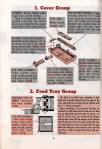
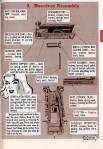
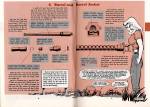
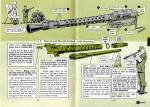
And finally, here are a couple PS Magazine articles on The M73.  These are part of the “Be Your Own Inspector” series aimed at helping train soldiers properly maintain their equipment.

Issue 130 (1963)

Issue 200 (1969)

Sentinel Cruiser footage at Fishermans Bend

unnamedA new video has appeared showing the Australian Sentinel Cruiser along with other tracked and wheeled vehicles being put through their paces at a test sight in Australia.  The date and location of the vehicles is listed as Fishermans Bend 1942.  The video is featured in a news article in The Age Victoria, pointing out that the Fisherman’s Bend facility where these vehicles were manufactured is planned to become Melbourne’s newest high-rise apartment precinct.  According to a report commissioned by the Nation Trust, the 19 Salmon Street factory was an experimental tank depot which produced fully sized timber mock-ups of what would become the Sentinel Cruiser from 1941 to 1943.  A plan has been submitted to demolish the original factory and replace it with townhouses.  The National Trust is calling for the original Art Deco style administration building to be retained, as well as a sample of the factory.  Fishermans Bend was also a large car manufacturing area, from 1946 to 1972 being home to Rootes and later Chrysler car factories.

Article on the Fishermans Bend factory.

“Mephisto” A7V goes on display in Canberra

6654296-3x2-700x467According to ABC (Australia), Mephisto, a unique weapon of war and the only surviving German A7V tank from World War I, has gone on display at the Australian War Memorial in Canberra as part of centenary commemorations.  Panzerkampfwagen 506, known as Mephisto, was part of the initial German tank detachment which participated in the first German tank attack at St Quentin in France.  In its second and final battle at Villers-Bretonneux, the Mephisto tank was disabled and abandoned on the battlefield.  Now the rare tank has been moved temporarily to Canberra to mark the 100th anniversary of significant WWI battles.

Michael Wittmann’s headstone stolen

11665542_905219942870076_8661211230239328796_nThe Times of Europe is reporting that the headstone of Nazi SS Panzer ace Michael Wittmann has been stolen from a German cemetery in Normandy.  According to the Times, the theft was discovered by an unnamed German national living in the town of La Cambe, where the unsecured cemetery is situated, “a few days ago”.  The website Argunners had more information on the story.  They note that there has been a series of Nazi headstone thefts.  Walter Model’s headstone was also recently stolen.

Canadian War Museum: “Awesome Tanks” event

On Sunday July 26 the Canadian War Museum hosted an event called Awesome Tanks.  This event included the running of several of the museums tanks, including an Scorpion light tank and an M4 Sherman (Grizzly.)  Also involved in the event were the Ottawa Valley Amour Modellers Association, who provided over 100 models to display for the event.

Footage of a Grizzly tank being run at the event:

Here is an video showing some of the tanks and armored vehicles on display at the Canadian War Museum

And here is a video showing the restoration of a Panther tank at the Canadian War Museum.