 IHS Jane’s is reporting that the Swedish Army has ordered upgrades to 350 of its Leopard 2 main battle tanks and CV90 infantry fighting vehicles. According to Jane’s the cost of the upgrade work is worth nearly USD300 million. Under the work both vehicles will have their existing Tactical Command and Control System (TCCS) replaced with a new Battlefield Management System (BMS).
Under the first contract, worth EUR92 million (USD105 million), Krauss-Maffei Wegmann (KMW) will provide renovation and refurbishment kits for 88 of the Swedish Army’s Stridsvagn 122 MBTs (analogous to the Leopard 2A5) and 8 Bärgningsbandvagn 120 (Bergepanzer BPz3 Büffel) armoured recovery vehicles. Besides the addition of the BMS, work will be undertaken to replace obsolescent parts.
After the upgrade, due to be completed in 2023, the 77 Stridsvagn (Strv) 122A MBTs being modified will be designated Strv C, with 11 upgraded Strv B MBTs being renamed Strv D.
The second contract, worth SEK1.55 billion (USD190 million), will see BAE Systems conduct work to upgrade 262 CV90 IFVs between 2018 and 2020. Alongside replacing the TCCS with the new BMS, this work is to include the replacement of the CV90’s existing Ksp m/39 (M1919A4) coaxial machine guns with the Ksp m/59 (FN MAG) and refurbishing their chassis.
All five of the Swedish Army’s CV90 variants will go through the upgrade, namely: 172 Strf 9040 IFVs, 40 Stripbv 90 command vehicles, 22 Epbv 90 forward observation vehicles, 16 Lvkv 90 air defence vehicles, and 12 Bgbv 90 armoured recovery vehicles.
Besides the generic upgrades across all the variants, the Epbv 90 and Lvkv 90 variants will have their thermal imagers replaced by the same one used by the Strf 9040C IFV. The Strf 9040s will also receive a software update to their fire control systems.
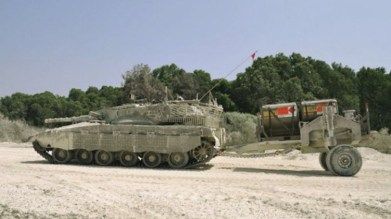 Jane’s is reporting that the IDF is taking delivery of Urdan Backtrail logistics trailers that can be towed by tanks, APCs, and other heavy AFVs. The trailers have a cargo area measuring 4×2 meters and can carry approximately two tons. According to the article, Urdan says the Backtrail was “developed in response to the critical logistic requirements of the modern battlefield. It enables the continuous provision of supplies – including fuel, water, weapons, etc – to forces fighting in remote and inaccessible locations.” Urdan developed the trailer over a four year period starting in 2008, which included driving Backtrail models around the Golan Heights and southern Israel. The trailer received IDF approval to begin mass production and deliveries in 2014. The article notes that the trailer can be towed by the Merkava tank , the Namer and Achzarit heavy APCs, and the Puma armored engineering vehicle, but is too heavy for the M113 APC
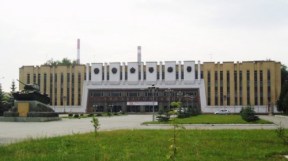 The tour will also include a visit to the Museum of Armored Vehicles, which features more than a thousand exhibits, from the T-34 to the T-90, as well as samples of armor, shells, and other individual components of the plant’s production, plus rare books, other literature and paintings. Visitors, the press release says, will be able to get a look at some of the vehicles on display both inside and out.
 According to Uralvagonzavod deputy general director Alex Zharich, who spoke to theRussian-language daily Izvestia, Russia plans to spend 2.5 billion rubles to upgrade one hundred and fifty T-72Bs to the new B3M standard for an average of 17 million rubles per tank. In U.S. dollar terms, that’s a total of $35 million for an average of $234,000 per tank—which means the T-72B3M upgrade is a relative bargain for the capability the vehicle is expected to deliver.
 The British Army has retired is ST Kinetics Warthog articulated tracked armored vehicles from service, IHS Jane’s can reveal.
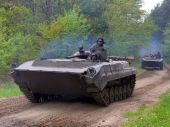 The Polish government is planning to spend up to 80 billion zloty (US $21 billion) to replace its military’s Soviet-designed BWP-1 and BWP-2 infantry fighting vehicles (IFVs) with new tracked vehicles, Deputy Defense Minister Bartosz Kownacki told local news agency PAP.
 The US Marine Corps (USMC) in early March received the first of 10 initial redesigned Assault Amphibious Vehicles-Survivability Upgrade (AAV-SU) platforms from contractor SAIC.
 With nearly 600 units in service, the Soviet T-72 main battle tank serves as the backbone of the Polish Army today. There’s just one problem: These tanks, built by Russia and requiring Russian spare parts to maintain them, are currently pointing their guns at Russia — which became an increasingly urgent threat after its 2014 invasion of Poland’s eastern neighbor, Ukraine.
 Tank and AFV News