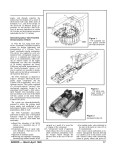
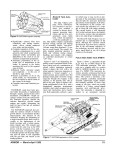
Over at the WoT discussion forum, someone started a thread about the Abrams TTB (tank test bed). That thread reminded us of this article from the Mar-Apr 1995 issues of ARMOR. We have posted the article below as an image gallery. For those that prefer PDF, you can download the entire issue here.



North Korea holds tank biathlon style competition
March 11, 2016 by Leave a Comment
NKnews.org is reporting that North Korea recently held a tank competition event similar to the Russian Tank Biathlon. The event was attended by dictator Kim Jong Un and featured a variety of different tank types. According to Kim Min-seok, senior researcher at the Korea Defense and Security Forum, the majority of the North Korean tanks observed at the event our outdated types no match for modern South Korean armor.
“Most of the tanks seen in the pictures are outdated models,” said Kim. “The tanks in pictures are Chonma-ho Ga(Na) type, PT-72 the amphibious tank and Chonma-ho Ma type. Except for the Chonma-ho Ma type, all the rest are outdated by today’s standards.”
Nonetheless, Kim believes that the Pokpung-ho, the tank shown in the red circle of the photo is formidable adversary.
“This Pokpung-ho Tanks have gone through many phase of modifications to upgrade its defense. Such a model will be able to fight evenly against South Korea’s old tanks such as M4845, however its firepower will still not match that of South Korea’s main tanks such as the K-1 or K1a1.”
Despite the outdated tanks, the rules introduced in this first North Korean tank competition look very similar to the the Tank Biathlon, the Russian tanks competition, Kim said.

More Armored Oddities of Syria/Iraq
March 5, 2016 by Leave a Comment
Back in mid-January we presented a photo gallery of some of the armored oddities from Syria and Iraq that have shown up around the web. Here is an update to that earlier post.
First, lets start with armored pickup trucks.


Next we have a variety of armored trucks, gun trucks and other wheeled vehicles.


Here are some construction vehicles converted to armored vehicles.


Our final gallery consists of various armored personal carriers modified with extra armor and/or cannons. The 23mm ZU-23 seems to be a particular favorite for mounting on these vehicles.


Credit to LooSeR over at SH forum for digging up most of these.
“Tank Shredder” company purchased by KMW
March 1, 2016 by 1 Comment
Jane’s is reporting that German tank manufacturer Krauss Maffei-Wegmann (KMW) has puchased GmbH Koch, a company that specializes in dismantling tanks and armored vehicles. According to Jane’s:
The company, which takes apart tanks at a facility in Rockensussra, Germany, is the only NATO-certified company to dismantle tanks, KMW said in a press release. The company has been shredding tanks since 1991, and has dismantled 16,000 military vehicles to date. Battle Tank Dismantling was previously owned by the Scholz Group, a scrapping company.
Here are a few images of vehicles at the GmbH Koch facility. (more images here.)

Spahpanzer Luchs

BTR-50
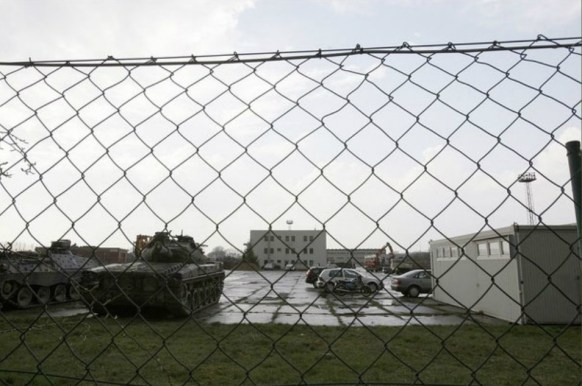
Panzer 68

Marder IFV
Photo of the Day 3/1/2016
March 1, 2016 by Leave a Comment
Here’s a version of the Maus tank that actually lives up to it’s name.

(Thanks to SuperComrade over at SH forum)
Video of the Day: Running with Tanks in Belgrade
February 29, 2016 by 1 Comment
From Euronews comes this unusual footage of people running with tanks.
Video: TOW missle vs T-90
February 27, 2016 by Leave a Comment
The Washington Post has shared a video of their site which claims to show a TOW missle being launched at a Russian built T-90 MBT. In the video, which was posted to YouTube Friday, Syrian rebels appear to have filmed themselves firing for the first time a U.S.-made TOW anti-tank missile at a Russian T-90 tank. According to the video’s caption, the TOW strike occurred in the Syrian town of Sheikh Aqil, a suburb just northwest of Aleppo.
The Washington Post article notes that:
In November 2015, the tanks appeared well to the east of Latakia, near Aleppo. Around the same time, a report from Al-Masdar Al-‘Arabi news indicated that a small detachment of T-90s was given to a Syrian Army mechanized unit to help with current offensive operations in the region. In recent weeks, the advanced battle tanks were filmed during a CNN segment on the outskirts of Raqqa.
In the video, the missile appears to strike the turret of the tank. As mentioned on other blogs, the T-90 appears to be equipped with a Shtora–a device designed to disrupt incoming wired-guided and infrared guided missiles, much like the TOW. In this case, it appears the system failed or wasn’t active. Though the video shows the tank’s crew member bailing out, it looks like the strike did not penetrate the turret and potentially glanced off. T-90 tanks are covered in what is called “reactive armor.” The armor serves an outer shell to the tank’s hull that, when struck, counter-detonates to disrupt the flight of the incoming enemy missile. Reactive armor can be mounted on various other tanks and is not unique to the T-90. However, the T-90’s reactive armor is likely a more advanced version of the types found on older Russian and Syrian tanks.
Tankograd on T-80
February 27, 2016 by 1 Comment
The Tankograd blog has released another of their in-depth posts examining a Soviet era armored vehicle. This new post takes a look at the T-80 MBT.
Excerpt:
Although nowadays the T-80 isn’t nearly as famous as the T-72 and the T-90, it was understandably the most highly regarded item in the entirety of the vast Soviet tank fleet, and though they had T-72s stretching as far as the eye could see, it was the T-80s and the T-64s that formed the vanguard of the Soviet tank armies of the Rhine. However, it wasn’t planned out this way in the beginning.
As one should come to expect from anything on the other side of the Iron Curtain, the T-80 has a rather intriguing story of inception. While the designers were still ironing out issues on the 5TDF opposed-piston engine for the T-64, experiments on mounting a turboshaft engine were already in full swing. It was requested that production expand from just Kharkov (KMDB) to Kirov (LKZ) and Nizhny Tagil (UKBTM) as well. Both of the latter plants struggled to produce some of the more complex parts for the T-64 – namely the engine – due to a lack of personnel familiar with the intricacies of the fundamentally different engines, and hence, created their own variations of the basic T-64. UKBTM (today a part of UralVagonZavod) and LKZ split design elements and ended off designing what came to be known as the T-72 and T-80 respectively. LKZ’s progeny were defined by their signature turbine engines and more robust suspension, hybridized with the turret of the T-64A, thus forming the original model T-80.
This new vehicle was more extravagant and expensive than the ones preceding it, making the
T-80 much less common than the T-64 and T-72. It also came off as being a more ambitious project than UKBTM’s T-72 (evidenced by a far longer development span). The T-80 came too late for its’ own good. The instant it entered low-rate production in 1976, it was already surpassed in capability by both the T-64B and T-72A: a troubling situation for a vehicle meant to replace and supplement them, made worse by its excessive price tag. As a result, the T-80B was quickly ushered into service a mere two years after the T-80, boasting the ability to fire ATGMs from the cannon while on the move with the Kobra system, and an updated armour layout that had better prospects against the latest and future anti-tank munitions, and beginning from 1980, a more powerful 1100 hp GTD-1000TF engine. These upgrades along with the addition of Kontakt-1 explosive reactive armour – and a further enhanced armour package, formed the basis of the T-80BV, which arrived in 1985. The most advanced direct T-80 variant – the T-80U, also arrived in 1985, while . This new model presented improvements to just about everything; a new digital fire control system, engine, explosive reactive armour, and some other tidbits.
Rheinmetall upgrading Polish Army’s Leopard 2 tanks
February 24, 2016 by Leave a Comment
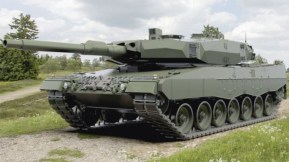 Jane’s is reporting that Poland has signed a contract with German firm Rheinmetall to modernize 128 Leopard 2 tanks of the Polish Army in cooperation with Polska Grupa Zbrojeniowa and ZM Bumar-Łabędy S.A. Rheinmetall will supply key capabilities for the upgrade. Included will be electronics and weapon technology to bring the tanks to Leopard 2 PL standard, an improvement over the current Leopard 2A4. The contract is worth $144 million for Rheinmetall. The Leopard tanks were bought from German Army surplus in 2002.
In total, more than 50% of the programs budget is to be subcontracted for Polish firms, including: WZM (power-pack overhaul); PCO (KLW-1 Asteria and KDN-1 Nyks cameras delivery); ZM Tarnow (EWNA turret drives manufacturing); Rosomak (licenced production of additional turret armament); and OBRUM (modification and repairs of MBT simulators) The first prototype Leopard 2PL is planned to be completed in Germany in March 2018.
Photo of the day: Return of the Half-Track?
February 22, 2016 by 4 Comments
From the Singapore Airshow comes today’s photo of the “track over wheels” concept being put forward by ST Kinetics for the Terrex armored vehicle.


 Tank and AFV News