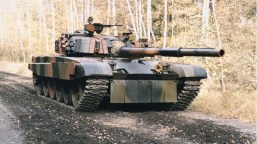
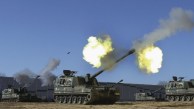
Hamas shows off fake Merkava tank

Multiple news outlets are reporting on a rather strange story concerning a “tank” on display during a funeral rally for seven dead Hamas militants.  Video of the event prominently features what appears to be a somewhat unconvincing replica of an Israeli Merkava 4 MBT.  According to the news stories, the speaker at the event claims that it is a captured and rebuilt Israeli tank, a claim that is rather dubious considering that the vehicle in question appears to be riding on wheels hidden behind the tracks.

CaIOscnXEAAy-cI

Marine AAVP-7 to get upgrades

AAV7According to the Marine Corps Times, the AAVP-7 (Assault Amphibious Vehicle) is slated to receive upgrades to add 20 years of service life to the vehicle.  The primary focus of the upgrade is survivability, including the replacement of the Enhanced Applique Armor Kit with 49 buoyant, flat ceramic panels: 23 on the front and sides, and 26 thinner panels on the top. According to the article, each panel has four attach points and can be lifted by two Marines. Full assembly takes about 90 minutes. In addition, an aluminum armor underbelly provides MRAP-equivalent blast protection, along with a bonded spall liner  armor-protected external fuel tanks, and AAV7 interiorindividual seats replacing benches.   The increased weight (10,000 pounds) will be offset by a new, more powerful VT903 engine that boosts horsepower from 525 to 675, as well as a new power take-off unit and KDS transmission.  SAIC is handling the upgrades, which run $1.65 million per vehicle. The Corps looks to beef up 392 personnel variants, which would provide lift for four infantry battalions.
Full article here.

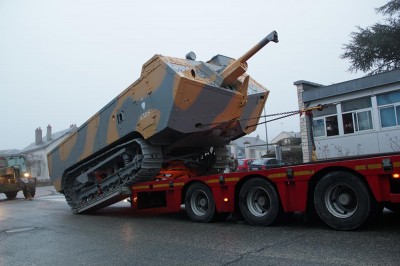
Last remaining Saint-Chamond to be restored to running condition

IMG_03910_c9b3e969f5af8fe857ea7ef65c273bd4The French armor museum at Saumur (Musee des Blindes Saumur) is in the process of restoring their First World War era Saint-Chamond tank to running condition.  This vehicle is the last remaining example of a Saint-Chamond in existence.  Originally, this particular vehicle had been donated by the French government to the USA who stored it (set it outside in a field) for years at Aberdeen Proving Grounds.  In the mid 80’s, the USA gave the Saint-Chamond and the sole surviving Schneider tank (also stored at Aberdeen) back to the French where they joined the collection at Saumur.  The Schneider tank has since been restored to running condition while the Saint-Chamond went through a cosmetic restoration.  The Musee des Blindes Saumur is currently in the process of restoring the Saint-Chamond to running condition in preparation for the centennial of the first use of French armor on the battlefield in 1917.  According to the website for the Musee des Blindes Saumer, the engines of the Saint-Chamond are being restored by a company near Roanne called APRESS.  Those interested in supporting the restoration with a financial donation may do so here.
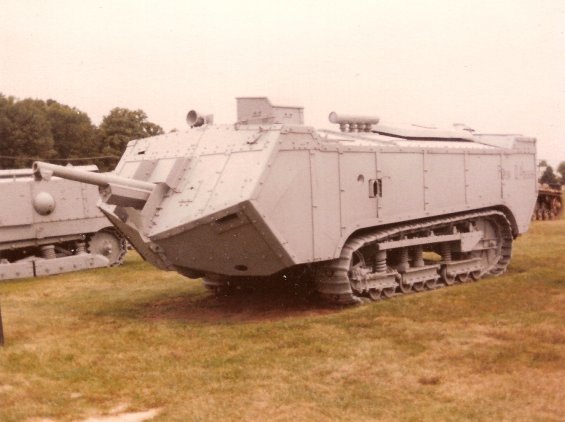
Saint-Chamond tank at Aberdeen Proving Grounds in early 1980’s:

Saint-Chamond

Saint-Chamond Tank


Pakistan interested in Turkish Altay MBT?

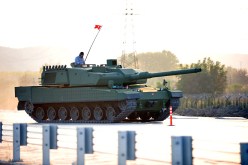
ALTAY MTR Prototype in action 2The Diplomat is reporting that Pakistan may be interested in purchasing the new Turkish Altay MBT.  The article notes that the head of Turkey’s defense procurement agency, the Under-secretariat for Defense Industries, Ismail Demir announced earlier this month during a testimony in parliament that Pakistan’s military is interested in procuring the Altay.  Demir is quoted as saying “Including Pakistan and the Gulf countries, we can say that countries that we have good relations with are showing a large interest in the tank. Representatives of some countries are being invited to the ongoing firing tests.”  The article notes that Pakistan has not officially expressed interest in the procurement of the Altay, although in January 2015, representatives of Pakistan’s defense industry said that they are considering procuring the Altay’s third generation thermal imagining sight for the Al-Khalid MBT, jointly developed by Pakistan and China.

New issue of ARMOR available for download

armor oct-dec 2015The latest issue of ARMOR: The Professional Bulletin of the Armor Branch, is available for download.  The majority of articles in this issue seem to deal with either leadership principles or logistics issues.  Unlike cold war era issues of ARMOR, there is not much here that will be of much interest for AFV enthusiasts.
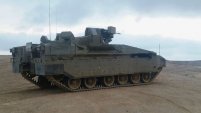
Israeli Namer APCs equipped with Trophy

p1650267Jane’s IHS is reporting that Israel has announced that it has completed the installation of the first Rafael Trophy HV active protection system on a Namer APC.  Trophy is an active defense system which uses radar to detect and track incoming rockets and missiles and destroys them by firing multiple explosively formed projectiles.  Trophy has been deployed in the field on Israeli Merkava tanks.  The article notes that Trophy will be included in all new production Namer vehicles but that there are no immediate plans to install it on existing vehicle.

Industry video about Trophy:

Book Review: M48 vs Centurion: Indo-Pakistani War 1965

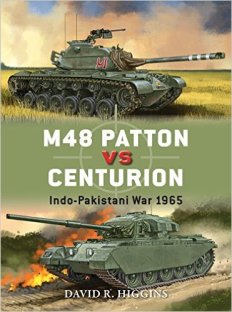
M48 vs Centurion: Indo-Pakistani War 1965 by David R.  Higgins

51LwRVTUmDL._SX369_BO1,204,203,200_The Indo-Pakistani War of 1965 featured the largest tank battles seen up to that point since the Second World War.  However, these battles would soon be eclipsed in size and in the popular consciousness by the armored battles of the Arab-Israeli wars of 1967 and 1973.  While much ink has been spilled regarding the tank battle of the Arab-Israeli wars, far less has been written about the Indo-Pakistani War of 1965.  Fortunately, author David Higgins seeks to fill the void with his new entry in the Osprey Duel series with M48 Patton vs Centurion: Indo-Pakistani War 1965.
While the Indo-Pakistani War of 1965 may have some superficial similarities to the more well-known Arab-Israeli wars, there are some important differences.  While M48 Patton tanks and Centurion tanks were used in both conflicts, in the Arab-Israeli wars both of these tanks were operated by the Israelis against Soviet built Arab operated tanks.  The Indo-Pakistani war of 1965 features U.S. built Patton tanks lined up against British Centurion tanks, making it one of the few examples of a postwar armor conflict featuring Western built tanks on both sides.  The other noticeable difference between the two conflicts was that the difference in crew training and quality was not nearly as pronounced in the Indo-Pakistani war as it was between Arab and Israeli forces.

The format of the book follows the same pattern as earlier Osprey Duel books and is Mr. Higgins fifth book in the series.   A good deal of technical information is presented about both tanks, as is the norm in this series.  While there are considerable differences between the two tanks, it becomes clear that they are fairly well matched adversaries.  The Centurion and the M48 are both well-known and the technical descriptions of the vehicle may be “old hat” for well-read on the topic.  That said, the vehicle descriptions are well written and contain some nice illustrations.  The technical descriptions are followed by a section describing the history and organization of the Indian and Pakistani armored forces, information which will probably be new to many readers.   This section is followed by a description of the events of the campaign, interesting reading of a war which has not been described often in other sources.

The conclusion of the book notes that neither vehicle proved itself as markedly superior to the other, factors such as morale, crew training and leadership being more important in determining the outcome of any particular engagement between the two combatants.  The war was essentially a draw and while crews on both sides often fought bravely, higher level leadership was often tentative and ineffective on both sides.   The book does not really say if Western observers took many lessons from this particular war, either in regards to the performance of the vehicles or the tactics used.

Available through Amazon for under $15, this book is well worth the price.  By our count, Mr. Higgins is second only to Steven Zaloga in the number of tank themed “Duel” series books authored thus far.  Based on this book and his previous entries in the series, we hope to see more “Duel” books from Mr. Higgins in the future.


UK to Upgrade Challenger 2 MBT

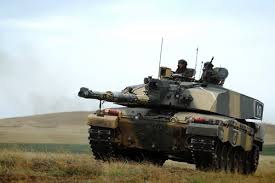
chally 2According to an article in Defense News.com, the UK Ministry of Defence has initiated a program to update the British Army’s neglected Challenger 2 main battle tank fleet with at least three contractors submitting initial proposals.  BAE Systems,  General Dynamics UK and Lockheed Martin UK, have all thrown their hat into the ring regarding the upgrade program. Officially known as the Challenger 2 Life Extension Program (LEP), the update, including initial logistic support, could be worth up to US $1 billion.  The article notes that “industry executives said the update would focus mainly on updating turret subsystems and would not involve replacement of the L30 gun or the powerpack.”  The article notes that one such subsystem that may be included in the upgrade is the Thales UK’s TOGS II thermal observation and gunnery sight.

Full article here.


James Warford on the USMLM and the T-64

Today we present an article written by retired US armor officer MAJ James M. Warford about US efforts to gather intelligence on Soviet armor during the Cold War involving the US Military Liaison Misison.  This article originally appeared in the Nov-Dec 2011 issue of ARMOR magazine in edited form.  Mr. Warford has provided us with the original and unedited version for your reading pleasure.

————————————————————————–

 The United States Military Liaison Mission, its Tri-Mission Partners and the Quest for the “Holy Grail”

By James M. Warford

His weapons are stealth and discretion. He knows that successful collection is a deliberate and persistent endeavor which reveals the correct picture about his opponent from an emerging mosaic of separate information. Upon his individual judgment, initiative and courage, the success of USMLM is built.

 Randall A. Greenwalt, Colonel, GS

Chief of Mission (1982)

The United States Military Liaison Mission, or USMLM for short, was officially established by the Huebner-Malinin Agreement, in April 1947. The agreement authorized the exchange of military liaison teams or “missions” as there we commonly called, between US and Soviet military headquarters’ in Germany. USMLM’s primary (official) mission was to, “carry out responsibilities for liaison between CINCUSAREUR, on behalf of the US Commander in Chief Europe, and CINCGSFG (Group of Soviet Forces, Germany).”1 It was, however, in USMLM’s secondary and until the end of the Cold War, secret role where its contributions can truly be measured. Its secret role was to “exploit its liaison status and attendant access for the collection of intelligence information in the German Democratic Republic.”2 This meant that throughout its 44 year history, members of USMLM were able to spy on and gather critical intelligence information concerning the Soviet Forces deployed in East Germany.


Of all their real-life missions, many of which rival the most daring exploits described in best-selling spy novels, the task of getting up-close and personal with the brand new Soviet T-64 MBT (later confirmed to be the T-64A), and obtaining metallic scrapings of the tanks armor, ranks as one of the most daring and critically important they ever conducted. The desire to touch the enemy’s truly revolutionary new tank (the best the Soviets had to offer), represented more than just a high-priority mission; it was in fact, the quest for the “Holy Grail.”

August 1978 USMLM technical quality photography of T-64As

August 1978: USMLM technical quality photography of T-64As (USMLM History – 1978)

While in many ways, USMLM’s intelligence experts and linguists were an elite team, they were not unique. At Yalta in 1945, President Roosevelt, Prime Minister Churchill and Central Committee Secretary Stalin agreed that post-World War II Germany (and Berlin) would be reorganized into zones of occupation. Ultimately, this reorganization would include four zones; the American, the British, the Soviet and the French. Each zone was granted a liaison mission. The British mission was known as BRIXMIS, the Soviet mission was known as the SMLM (often abbreviated even further by American military forces to “smell ’em”) and the French mission know as the FMLM. The official headquarters’ for the three western missions were set-up in the city of Potsdam. Once established, the American, British and French missions were able to use their quasi-diplomatic status to observe, track and appraise Soviet military forces as they “toured” through East Germany. These “tours” normally consisted of two or three mission team members in a modified civilian sedan or (more recently) small SUVs. They would drive through East Germany both on and (more often than not), off-road. In many cases, the mission tours included tense stake-outs while hidden in the East German countryside for days at a time. If they were spotted by the Stasi (the East German State Security Police) or Soviet military forces, the chase was on. Tour members would do everything they could to avoid being detained (or “clobbered”) by their pursuers; including dangerous high-speed chases and escape and evasion maneuvers.

[Read more…]

Latest News from Jane’s

Here are three new stories concerning AFVs from Jane’s IHS.

1323097_-_mainEstonia buys extra CV90s from Norway

Estonia has bought additional CV90 armoured fighting vehicles (AFV) for its armed forces, signing a contract for 35 more CV90 hulls from Norway on 8 January.

The additional units will complement the 44 CV9035NL infantry fighting vehicles (IFVs) that Estonia purchased from the Netherlands in December 2014.


0014437_-_mainUkrainian firms look to upgrade business on Polish PT-91s

Ukraine’s state-owned defence industrial holding UkrOboronProm is in negotiations on possible participation in an upgrade programme centred on Poland’s PT-91Twardy (Hard) main battle tanks.

According to a UkrOboronProm release and news agency Interfax Ukraine, the organisation will continue to hold talks through January with Poland’s Polski Holding Obronny (Polish Defence Holdings – PHO). As part of the discussions, a PHO delegation is expected to visit the Lviv Armor Vehicle Factory in western Ukraine, which undertakes a range of maintenance, upgrade, and modernisation work on the T-72 tank.


1535228_-_mainIndian MoD looks to close deal for 100 modified K-9 self-propelled howitzers

India’s Ministry of Defence (MoD) began price negotiations with Indian private-sector company Larsen & Toubro (L&T) in late December 2015 for 100 modified South Korean self-propelled howitzers (SPHs) for around USD800 million.

Military sources said the K-9 Vajra (Thunderbolt), which is an L&T-modified version of Samsung Techwin’s K-9 155 mm/52-calibre tracked SPH produced under a collaborative agreement, was shortlisted for acquisition in late September 2015 following extended field trials that were concluded in early 2014.