A video shot with a phone has been making the rounds recently showing a T-72 flipping over during the 2015 Tank Biathlon in Russia. The accident involved a Kuwaiti crew who roll their T-72 over while practicing taking a corner in the style of a drift racer. The flip occurs at 1:55 into the clip. Earlier in the clip can be seen an Armenian crewed T-72 stalling out after passing through a water obstacle.
Tank Biathlon drift flip video
August 8, 2015 by Leave a Comment
Jane’s article on IDF M48 Tamuz missle launcher
August 7, 2015 by Leave a Comment
Jane’s has posted an article about the IDF missle-firing Peres artillery vehicle. Details of the vehicle have only recently released, despite the fact that it entered service in 1982. This vehicle has generated a great deal of discussion recently, as the true purpose of the vehicle has been revealed.
Interesting details from the article:
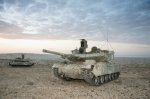 The manual guidance system restricts each Pere to having only one missile in the air at any given time, although a battalion of vehicles working together could potentially fire volleys at an enemy tank formation.
- The Pere vehicles are now linked to the IDF’s Torch command-and-control system, allowing them to receive intelligence on the co-ordinates of targets from a range of sources.
- Unlike the IDF’s Merkava Mk 4 tanks, the Peres have not been fitted with Rafael’s Trophy active protective system.
- The Peres can be used to fire either Tamuz 2 missiles with a 15 km range or Tamuz 4 missiles with a range of 30 km. The Tamuz 4 is similar to the Tamuz 5, which is the IDF’s name for the Spike NLOS missile that the company has marketed internationally since 2009. The main difference is that the Tamuz 5 has advanced day/night capabilities and can be used with a semi-active laser guidance system.
- The Pere’s first operational use was not until 2005, when it returned fire on Palestinian attackers in the Gaza Strip. It then participated in the July-August 2006 war with Hizbullah, during which Pere units fired 527 missiles. In the 2008-09 Operation ‘Cast Lead’ against Hamas in the Gaza Strip, Peres fired 26 Tamuz missiles.

More photos of 80’s era Soviet “Buntar” tank revealed
August 1, 2015 by Leave a Comment
The Russian news source Sputnik is reporting that “the image of a top-secret Soviet tank of the late-1980s appeared on the Web earlier this week, along with a short list of its technical characteristics.” The article notes that photographs of the Buntar (Rebel) tank have appeared on several online forums, including recently posted pictures of the the vehicles modular armor, an antiaircraft gun placed under the commander’s seat and fiber optic observation instruments instead of the conventional prism-type ones. The article goes on to note:
Online forum participants all agree that, back in its day, the Buntar was a major breakthrough in the field of tank design.
The Buntar tank was designed in Kharkiv, Ukraine, as part of an effort to develop a new generation of battle tanks for the Soviet armed forces.
A number of prototypes were built as part of the program, launched in the early 1980s with two-stroke diesel engines, gas-turbine engines, T-64 chassis, electric transmission and two- and three-man crew configurations.
The year 1987 saw the advent of a principally new concept, built around 152mm smoothbore cannon.
Many of the tank designs developed as part of that program are still classified.
Unfortunately, the article does not contain any of the pictures that it mentions. Combing though the forums, we have been able to assemble a photo gallery of the “Buntar”, also known at Object 490A.
-

- Model of 490 “Buntar” This vehicle never got past “paper and wood” stage in development.
-

- Another Object 490 model. This was a Karkov project. Suspension appears to be derived from T-64 but with extra roadwheel.
-

- Object 490A model.
-

- Object 490A model. 152mm gun with autoloader and low profile turret. 34 rounds in special 2-stage autoloader. RoF was expected to reach 14 rounds per minute.
-
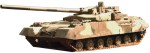
- Object 490A prototype. it could drive. It is unlikely that it could shoot. At the moment when we stopped working on it, FCS and autoloader were not finished. Redesign of suspension was planned, tank should have variants with completely external cannon.
-

- Object 490A prototye.
-
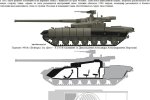
- Text reads “In 1982 it was decided to use 3-man crew. Tank had externally mounted main gun, driver was located at left part of hull, to the right from here there was 1290 litres fuel tank. COmmander was located to the left from gun, above [?] gunner”
-

- Front armor thickness
-
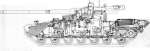
- Cutaway diagram.
-

- Object 490A digital render
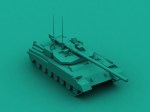
-
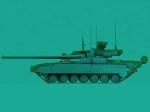
- Object 490A size comparison to T-14 Armata
-
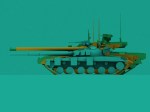
- Object 490A size compared to T-64 and T-14 Armata
Forum member “LooSeR” at the Sturgeon’s House online forum provides this description of the Object 490A Buntar.
Object 490A was most likely build in some kind of working prototype, but how far it reached is unknown. Project was not far from Leningrad Kirov factory programm to create new tank of the future – Object 299 / Project “Leader 2000-2005”. New tank had new turret with autoloader in the middle, 2 crewmembers in the low-profile turret, deiver in the front. Gun was mounted externally.
Tank is armed with 152 mm cannon with all 34 rounds in special 2-stage autoloader. 2 stage were 2 mechanized ammoracks with 12 rounds each, while first stage loading device had capacity of 10 rounds. RoF was expected to reach 14 rounds per minute.
FCS “Argus” had multichannel sights with TV, Thermal imager and (possibly) radar channels. Information from all channales was collected by computer, which generated picture for a crew, based on all data from TV, TI and Radar, which was expected to give very good perfomance in bad weather, smoke, dust enviroment + active jamming from enemy. FCS was expected to locate and remember positions of enemy targets, showing them to crew in easy-to-read display/image. On board computer will give information about location of the tank, and status of different systems.
Engine was planned to be 6TD, with later modification to 6TD-3 (1500 HP). Overall, it is rumored that tank would had:
-
Weight of 50 tons
-
Crew of 3
-
1200-1500 HP engine and ~28 hp/t power to weight ratio
-
More than 75 km/h max speed on road and 50-60 km/h max speed offroad
-
0.8 kg/sm2 ground pressure
-
152 mm gun with 34 rounds in fully-mechanized ammorack
-
Protection against APFSDS in frontal projection – at least 1200 in RHA eq. (without ERA)
-
Protection against HEAT in frontal projection – at least 1800 in RHA eq. (without ERA)
If anyone has any corrections or additions we can add to this post, please feel free to contact us or comment.
Russia to host “World Championship Tank Biathlon 2015”
July 29, 2015 by Leave a Comment
The Diplomat is reporting that Russia will host the World Tank Biathlon Championship starting on August 1. This competition, including tank crews from 17 countries, will take place a the Alabino firing range in the suburbs of Moscow. Participating countries include Belarus, China, Egypt, India, Nicaragua and Tajikistan as well as others. All participants save for China will be using T-72B3 tanks. The Chinese crews will be using their own ZTZ-96A MBT. Last year, Angola, Armenia, Belarus, China, India, Kazakhstan, Kuwait, Kyrgyzstan, Mongolia, Russia, Serbia, and Venezuela participated in the various competitions with Russia coming in first, Armenia second, and China third. Next to the tank biathlon, there will be a total of 12 other challenges including the “Masters of Air Defense,” “Masters of Artillery Fire,” as well as “Airborne Platoon” competitions. Russia is the only country to participate in all 13 events, according to the event’s website.
Video from Tank Biathlon 2014.
Armata to be showcased at arms expo
July 29, 2015 by Leave a Comment
 International Business Times is reporting that the new Russian T-14 Armata tank will be showcased in September at the Russia Arms Expo in Nizhny Tagil. The expo will run from September 9 through 12, with the Armata being on display on the second day. According to the article, the manufacturer of the Armata noted “As for the demonstration of the Armata, we’ll certainly show it. This will be either a closed show or Armata will be placed behind a glass anti-glare contour.” The expo will run Sept. 9 to 12. Previous expos have featured 20,000 visitors, 470 exhibitors and delegations from 40 countries. The Armata tank, which had long been cloaked in secrecy, will likely be a major draw.
USMC set to pick two bidders from field of five ACV options
July 27, 2015 by Leave a Comment
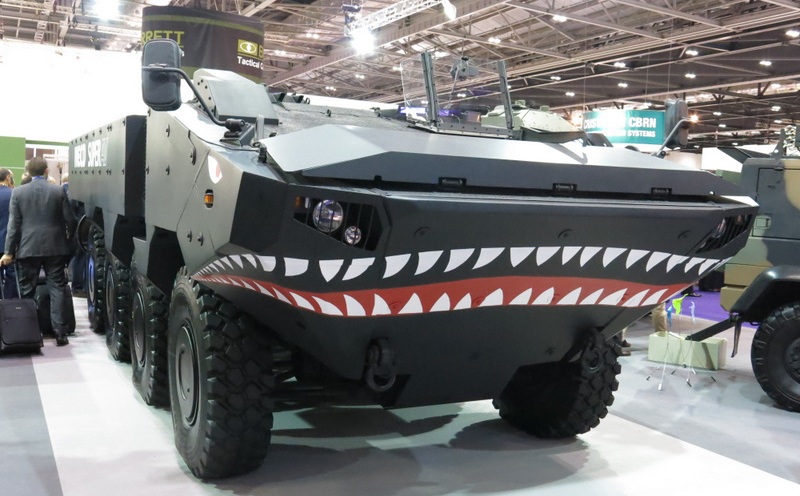 Jane’s is reporting that the USMC will soon select two designs from the current field of five options for the AVC (Amphibious Combat Vehicle) program. According to the article, the five proposed designs for ACV have come from Advanced Defense Vehicle Systems (ADVS), a relatively small company from Michigan; BAE Systems and Iveco with a version of the Superav; General Dynamics with a variant of its Piranha; Lockheed Martin offering a yet-unknown bid (it originally teamed with Patria Land Systems to offer a variant of the AMV called Havoc but separated earlier this year); and STK and SAIC with a version of the Terrex. All of these options are 8×8 wheeled vehicles, as opposed to the tracked Expeditionary Fighting Vehicle which was cancelled in 2011. These wheeled options also feature slower in water speeds than the Expeditionary Fighting Vehicle. According to the Jane’s article, the qualifications for the ACV as far as water speed are “the capacity to achieve water mobility performance on par with or greater than the existing assault amphibian (the AAV7A1 Assault Amphibious Vehicle.)”
Book Alert: Reprint of ‘Firepower” by Hunnicut is planned
July 26, 2015 by Leave a Comment
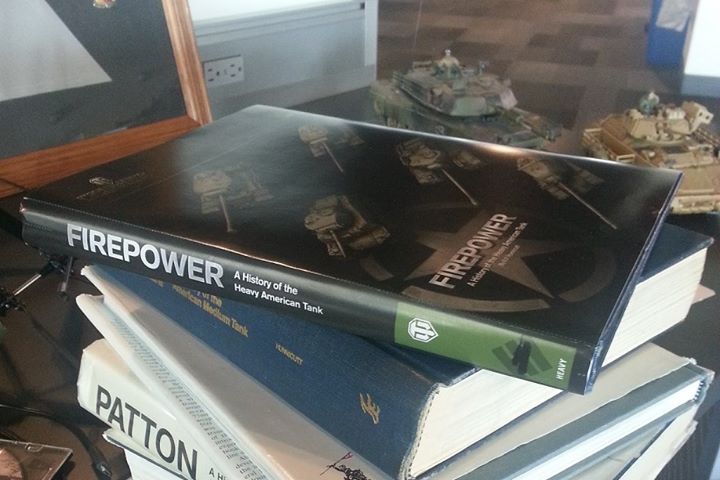
Nicholas “The Chieftain” Moran has posted on his facebook account that his employer WarGaming is planning a World of Tanks reprint edition of the book “Firepower” by R. P. Hunnicutt. This book is long out of print and typically commands several hundred dollars for used copies in good condition. Here is the post:
OK, so we’re suffering from a bit of a dilemma. We’re hoping to release a WoT Edition of a book. Improved on the original a bit, we’ve sent them recent scans of photos from the archives, foreword and some addenda by myself, and so on.
The idea is that we do a single print run, and pass on the economy of scale to you guys. So, the more that are sold, the cheaper it is for everyone. (We also don’t care much about the book profit, so that’s a cost reduction too. The bottom line is that it’ll never be cheaper). Fine in theory. The catch: Usually these low-volume books are made ‘print-on-demand’, which may be a slightly lesser quality, is certainly more expensive in volume, but is decidedly faster.To do this right, highest quality printing, lowest cost, etc, has a long turnaround time from the printer. In theory, if we went by “Announce on Day 1. Close orders Day 30. Tally number of orders. Print that many”, it could take up to three months between when someone clicks “Checkout, take my credit card info” to when the book is shipped. I don’t understand the technology/process, that’s just what the publisher has told me. In effect, it’s a pre-order. For ease, we may go with a fixed price, and then add gold codes of a value to make up the difference.
The alternative is that we take a wild guess as to how many might be sold, order that many in advance, and hope not too many people get disappointed (and that we didn’t wildly over-estimate). Those X many people will get their books pretty much immediately. We have absolutely no idea how big a number “X” should be, we don’t really have a basis for comparison.
So, on the basis that we want to get the most people to benefit for the least cost, the question becomes “Just how patient are you guys? Are you willing to wait several months for this?” My personal opinion is that anyone who’s willing to pay dollars for this particular book is also willing to wait, but you never know, especially when our customers are used to clicking ‘purchase’ and having their goods deposited in their account within a few minutes.
Photo is prototype. Expect the final product to look a little different (Author’s name on spine, etc)
Jane’s video: Singapore Army’s Peacekeeper Protected Response Vehicle
July 25, 2015 by Leave a Comment
Jane’s has posted a video describing the Singapore Army’s new Peacekeeper Protected Response Vehicle.
British Scout SV to be built in Wales
July 23, 2015 by Leave a Comment
 Jane’s is reporting that the British Army’s new Scout SV tracked reconnaissance vehicle will be built in the UK. Originally slated to be built at a General Dynamics facility in Spain, the article notes that General Dynamics will be building a new facility in South Wales where the majority of assembly of these vehicles will take place. The British vehicles are an updated version of the ASCOD armored machines built for the Spanish armed forces by Santa Barbara Sistemas. General Dynamics has been working on the British vehicles since 2010 when the company signed a £500 million development contract with the MoD. According to the GDUK spokesperson, the first 100 of the 589 Scout SVs will still be built in Spain. Once the new facility is up and running, the company will then transfer the “assembly, integration and test work of the remaining 489 vehicles” to Wales.
Photo of the Day: Odd ways to transport an AFV
July 20, 2015 by 2 Comments
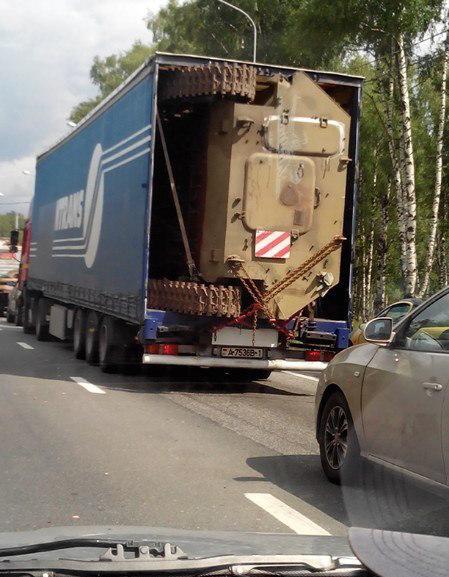
This picture has been making the rounds the past few days. While we have no idea if this is real or a photoshop job, we thought it was amusing enough to warrant sharing. Our understanding is that the license plate on the truck is Belorussian. The vehicle appears to be a MT-LBu of some sort. Based on a quick search of the width of an MT-LBu and the height of the average semi-trailer, it seems plausible that the MT-LBu could fit inside a trailer as shown in the picture.

 Tank and AFV News