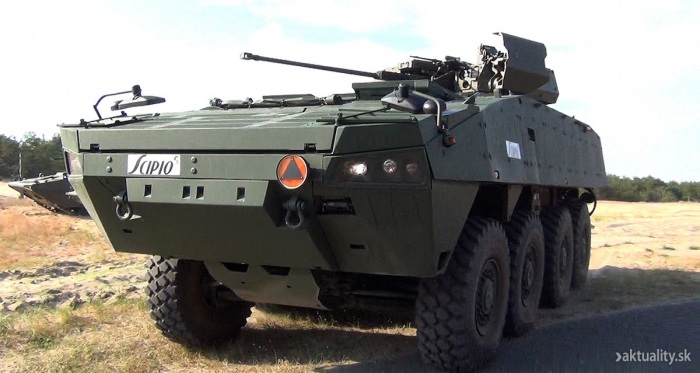
 Jane’s is reporting that Slovakia plans to purchase 31 Rosomak 8×8 armored personnel carrier vehicles for $31 million. In Slovakian service the vehicles will be armed with the Slovakian TURRA 30 unmanned turret, and known as the Scipio infantry fighting vehicle (IFV). The Rosomak is a version of the Finnish Patria AMV (specifically the XC-360P variant) built under licence in Poland by Siemianowice Slaskie (formerly known as WZM), part of Polska Grupa Zbrojeniowa (PGZ). Each Rosomak chassis costs $1.1-1.4 million. The TURRA 30 is armed with a 2A42 30×165 mm cannon (the same that equips the BMP-2), a PKT 7.62×54 mm machine gun, and two anti-tank guided missile (ATGM) launchers (for either the 9K111 Fagot ‘AT-4 Spigot’ or 9K113 Konkurs ‘AT-5 Spandrel’). For the export market a version of the TURRA 30 was unveiled in May at IDET 2015 armed with an ATK Mk 44 Mod 1 Bushmaster II cannon (30×173 mm) and a M2HB 12.7 mm (.50 cal) machine gun. It can optionally be equipped with other ATGMs such as the Rafael Spike
Slovakia buys Scipio 8×8 IFVs
UK orders CTAS 40mm cannons
 Jane’s is reporting that the UK Ministry of Defense has placed a $236 million order for CTA International 40 mm Case Telescoped Armament System (CTAS) cannons for its future fleet of tracked armored fighting vehicles. This order of 515 cannons are slated for the new Scout SV recon vehicle and the upgraded Warrior infantry fighting vehicle. According to the article, the CTAS features a novel telescoped ammunition that means the cannon and its ammunition takes up a significantly reduced internal volume within a vehicle’s turret. This in turn allows a larger calibre cannon to be fitted to smaller vehicles, and for more ammunition to be carried. The UK has a total of 589 Scout SVs on order, of which 245 are of the turreted, cannon armed version. Under the Warrior Capability Sustainment Programme (CSP), the British Army is also upgrading 380 vehicles from the Warrior family. Of these, 245 will be of the infantry fighting vehicle variant – fitted with the CT 40 mm cannon in a new Lockheed Martin UK turret.
For information on the 40 Cased Telescoped Armament System, click here.
Mitsubishi building amphibious assault vehicle
Reuters is reporting that Mitsubishi Heavy Industries in Japan has built a prototype of an amphibious assault vehicle. The article notes that the prototype uses engines adapted from the main battle tank made by Mitsubishi as well as new water jet propulsion technology. The full size prototype is undergoing pool tests and is likely several years from being ready for production. The goal of the project is stated as producing an AAV (amphibious armored vehicle) that can move through water at 20 to 25 knots. For the sake of comparison, the AAV7 used by the US Marine Corps has a water speed of 7 knots. Little other information is given in the article describing the prototype.
Israel to upgrade Argentinian TAM tanks
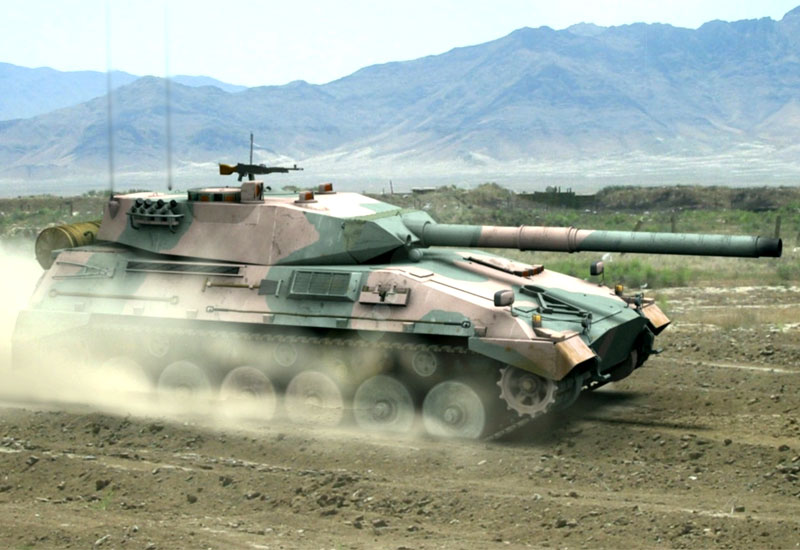 Jane’s is reporting that Israel has won a contract with Argentina to upgrade 74 of their TAM tanks. The contract is stated to be worth $111 million. According to Jane’s:
The deal was signed by Argentine minister of defense Agustin Rossi and Mishel Ben-Baruch, director of the Israeli Ministry of Defense’s International Defense Cooperation Division (SIBAT), on 26 June.
Rossi announced that the contract includes an offset agreement clause that will establish joint ventures to oversee technology transfers to Argentina. The work is to be performed at the 601 Arsenal Battalion in Boulogne Sur Mer in Buenos Aires province.
The article stub from Jane’s does not include details about what the upgrade will entail. According to the wiki page for the TAM:
In 2010, a modernization program was announced. Israeli defense contractor Elbit Systems was chosen to provide 3-axis gyro-stabilization, and most probably the L7A2 105 mm cannon will be replaced with a more powerful 120 mm cannon, like the L44 120 mm Cannon.
Serbia sells 282 T-55 tanks to Pakistan?
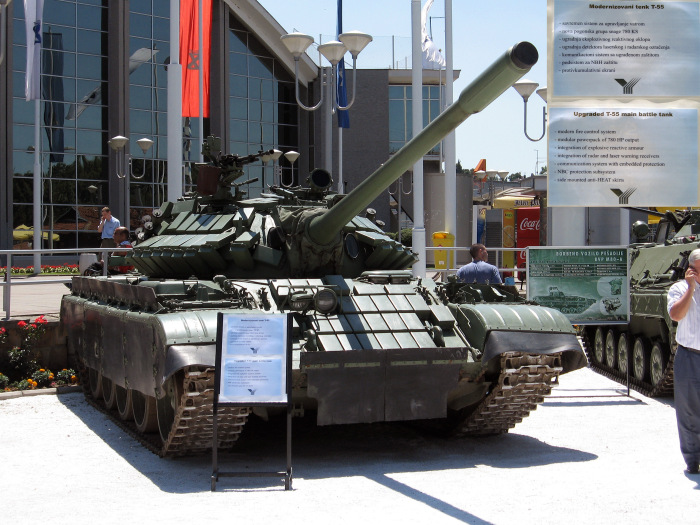 An article on In News is reporting that Serbia has reportedly agreed to modernize and sell 282 obsolete T-55 tanks to Pakistan. According to the article, the contract is worth tens of millions of dollars and that the proceeds from the sale will be used by Serbia to purchase new weapons. The Chief of the Defense Technology in the Ministry of Defence, Major General Bojan Zrnic indirectly confirmed the sale, saying “It is true that there was an agreement in principle for the sale of 282 tanks from the arsenal of retired and obsolete military equipment, but I do not want to talk about with which country and the army this deal was made. It would not be appropriate because the contract has not been signed. What can I say is that the offer is extremely favorable for the Army of Serbia as the tanks will not be sold in its current state, they will be modernized first. This task will be entrusted to our defense industry.” No details are given in the article as to what sort of modifications the Serbians will be making on these vehicles in order to modernize them. It is probably safe to assume the modernization will be similar to their T-55H variant.
Video: Abrams rolls over car bomb
This video showed up on youtube today. We have no idea when this footage was taken or if it has appeared online before.
War is Boring article on T-55
 The blog War is Boring has a new article on the history of the T-54/55. Like most articles on War is Boring, this is not an in-depth article nor does it delve much into technical matters concerning the tank. However, people may find it an entertaining quick read. We did take the liberty of posting in the comment section of the article pointing out the authors error in referring to the T-34 suspension as a “leaf spring” system.
Excerpt:
Like the AK-47 but for tanks, T-54 and T-55s endure on battlefields around the world. Simple to operate and maintain, these decades-old Soviet armored beasts are still popular in small nations and with non-state irregular forces — a true “people’s tank.”
If a coup or fratricidal civil war breaks out in one of Moscow’s current or former beneficiaries, there’s good chances T-54 or T-55s are taking part.
When Afghanistan collapsed in the 1990s, the Taliban and Northern Alliance coalition both inherited T-55s formerly belonging to the communist government. The tanks served in Yugoslavia’s multi-sided civil war during the same decade.
Today, captured Iraqi and Syrian T-55s serve under the black flag of Islamic State and other rebel groups fighting in the region. For these insurgent armies, the 60-year old tanks are just as useful as far more modern designs such as the M1 Abrams.
Video: Norwegian Telemark Battalion live fire exercise
From War News Today comes this video showing Norwegian ground forces conducting exercises.
Article declares that T-14 Armata is “Pretty Stale”
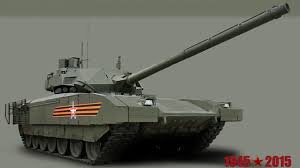 An article from ISH ETH Zurich by Joseph Trevithick attempts to deflate some of the hype surrounding the new Russian T-14 Armada tank, declaring it to be pretty “stale.” The author of the piece seems to be basing his conclusions on some comments made by noted tank expert Steven Zaloga, who is quoted as saying “A lot of this stuff is really stale” in regards to the new family of Russian armored vehicles displayed during the May Victory Parade. Zaloga is also quoted as saying that in the end “the Russians are not leaping ahead” and that “this is an attempt to catch up.” Considering the amount of media hype and nationalistic pride that the Armata has attracted, these comments from one of the worlds foremost tank and AFV researchers are bound to grab some attention.
Article excerpt:
But despite these and other boasts, the Russia’s new fleet is much less impressive when compared to many Western designs, even some that are decades old at this point. The T-14 is lighter and not necessarily any better armed or armored than the American M1A2 Abrams, the British Challenger 2 or the German Leopard 2, according to an infographic originally specifications sheet made up by the Russian TASS news service. The specifications were later translated into English by the U.S. Army’s Foreign Military Studies Office (FMSO). Of course, both Moscow and Washington are generally tight-lipped about the exact details.
In terms of armor protection specifically, the T-14 is probably no more impressive than the tanks Washington and Berlin have had in service for two decades now, based on educated estimates. And while Western engineers have generally focused on passive armor, the Pentagon and others continue to experiment with their own active protection systems. The Armata’s Afghanit system is also just the latest development in a series countermeasures the Russian Army has been using since the fighting in Afghanistan – an experience the new device’s moniker clearly references. Soviet commanders – like their counterparts around the world – have found active protection systems and explosive reactive armor can be very dangerous to ground troops near vehicles equipped with these protective measures too.
As for armament, the range estimates for the T-14 seem generous. However, Leopard 2s can already hit targets at similar distances with the help of Israeli LAHAT missiles. Armata crews would probably have to fall back on gun-launched guided weapons when trying knock out enemies beyond some 5,000 to 6,000 meters too. Not that much of this matters, since the Russian sensors can’t necessarily find the mark much farther away. The “target detection range” is only vaguely “greater than 5,000 meters,” the TASS-provided specs said.
Video footage of Tank vs Infantry fighting in Yemen
This video appeared on youtube this week showing footage of Yemeni Houthi forces in combat with tanks from the Army of Saudi-Arabia. The Saudi tanks appear to be of two different types, US built M60 tanks or French built AMX-30.

 Tank and AFV News