Osprey Publishing has released a new entry in their Duel series,Pershing vs Tiger: Germany 1945 (Duel)
Publisher’s Description:
During the final battles on World War II’s Western Front, the legendary German Tiger I heavy tank clashed with the brand-new M26 Pershing fielded by the United States. The Tiger I had earned a formidable reputation by the end of 1944, although its non-sloped armour and poor mobility meant it was being superseded by the Tiger II or ‘King Tiger’. While the Tiger I had been in the front lines since 1942, the US Pershing first entered combat in late February 1945, and more than 20 Pershings would see action before war’s end.
This book examines the dramatic Tiger/Pershing duel at Elsdorf in Germany, and also assesses the clashes between German armour and the sole ‘Super Pershing’ deployed to Europe. Featuring full-colour artwork, carefully chosen photographs and specially commissioned maps, this is the story of the first US heavy tanks in combat with the fearsome Tiger I during the last months of World War II in Europe.

 There is an important distinction to be made between data, analysis and information. In the military, it is particularly the case when referring to intelligence. Information coming into the intel office is data. Information being put out by the intel office is intelligence.


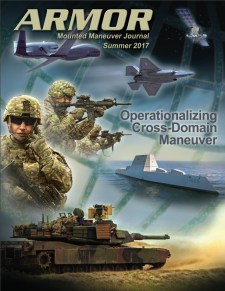 The Summer issue of ARMOR magazine is available for download at the
  Six Marines are in critical condition and another six are in serious condition after their amphibious-assault vehicle caught fire Wednesday morning while training at Camp Pendleton, the Marine Corps said.
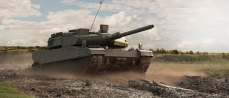 ANKARA, Turkey — Turkey’s military and procurement authorities have fine-tuned their multibillion-dollar competition for the production of an indigenous battle tank with a view to selecting a winner in mid-2018. “A timetable has shaped up,” according to a procurement official familiar with the tank program. “The procurement/management side has been synchronized with the military requirement.” The initial phase of the Altay tank program involves the serial production of a batch of 250 units. Military officials say the program would eventually reach 1,000 units. Industry sources say the final figure could reach billions of dollars.
 KIELCE, Poland — South Korea is this year’s featured country of MSPO, Poland’s annual defense industry show, where defense giant Hanwha Corporation is pitching its flagship K9 self-propelled howitzer to Eastern European allies. Jinhwan Jeong, the director of the overseas business division of Hanwha Land Systems, told Defense News that some of the major contracts under development in Eastern Europe include the planned howitzer procurement to Estonia.
 NEW DELHI ― As preparation for a possible conflict with China in high, mountainous areas, the Indian Army’s armored directorate has begun setting requirements for a small tank order, according to a source in the Ministry of Defence. Military planners in the MoD asked the Army to draw up requirements for a light tank after China tested its homegrown light tank, Xinqingtan, which is equipped with a 105mm main gun and a 1,000-horse-power engine.
 ABERDEEN PROVING GROUND: The Army is rapidly upgunning its 8×8 Stryker vehicles to better deter the Russians in Eastern Europe, as we wrote yesterday. But soldiers are still figuring out how they’ll use the new vehicles. And the service as a whole is struggling to update the entire armored force, from the 20-ton Stryker to the 70-ton M1 Abrams, let alone develop all-new vehicles the way Senate Armed Services chairman John McCain would want.
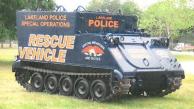 Central Florida law enforcement agencies applauded a White House decision that will once again allow them to acquire a range of surplus military equipment. At least two local agencies are planning to take advantage of the overhaul and buy their tanks back after they were recalled in 2015 due to restrictions by former president Barack Obama that banned certain military-style equipment, including grenade launchers, bayonets and high-powered firearms.
 Several years ago, the United States debated supplying Syrian rebels with high-tech armaments such as anti-tank and surface-to-air missiles. Critics contended that the weapons might fall into the hands of US-designated “terrorist organisations”. But it is in Iraq, that the fear has become real: the US has armed American-killing Iranian proxies and terrorist groups with its best tank, the M1 Abrams.
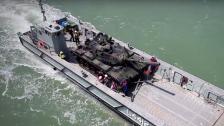 A Spanish company vying for a $30 billion Navy ship building contract is using a Youtube video to imply its landing craft can carry Australia’s heavy tanks despite the boat sinking too low in water when the armoured vehicle was put on board. Navantia, one of three contenders for Australia’s $30 billion Future Frigates contract, has a contract worth about $240 million to supply Australia with 12 landing craft supposedly capable of carrying the army’s 62 tonne M1A1 Abrams tanks.
 Designers at Kyiv Armored Plant presented on Aug. 20 a new, upgraded version of the Soviet-era T-72 main battle tank, Ukrainian President Petro Poroshenko reported on his page on Facebook. The battle effectiveness of the tank has been improved with the help of lessons learned on the front in the east of Ukraine, the president’s post says. Ukrainian defense industry concern UkrOboronProm said the new tank, called the T-72AMT, is based on the T-72A, which went into service with the Soviet army in 1979.
 The Somali National Army (SNA) released photographs on 3 September showing new tactical vehicles it has received. One photograph showed at least 12 Chinese-made Shaanxi Baoji Special Vehicles Company Tiger 4×4 light armoured vehicles parked in what appeared to be a secure compound in Somalia. A second showed at least 13 Ford Super Duty double cabin pick-up vehicles fitted with weapon mounts.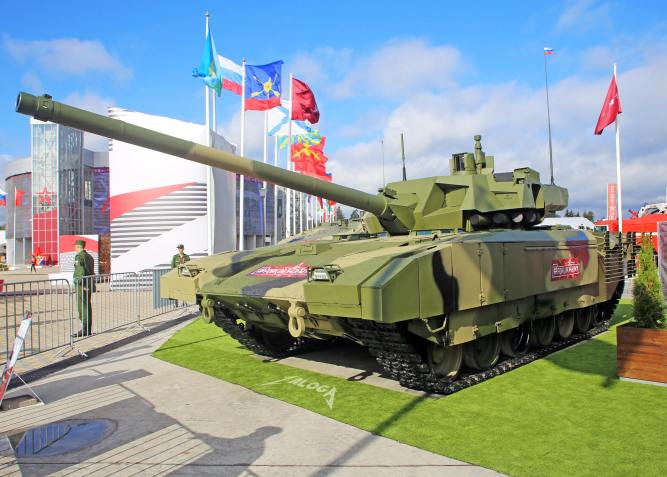
 The Israeli Ministry of Defense (MoD) has unveiled a prototype of an upgraded version of its Namer heavy armoured personnel carrier (APC) fitted with a turret that is armed with a 30 mm gun. In a statement released on 31 July, the MoD said the prototype was developed by its Merkava Tank Administration together with the Israeli Defense Forces (IDF) Ground Forces and will begin a series of trials in the coming days.
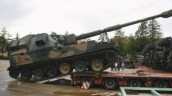 Deliveries of Krab 155 mm self-propelled howitzers (SPHs) to the Masurian Artillery Regiment (11 MPA) will be completed this month, marked by a ceremony on 31 August in the presence of officials from the ministry of defence, the unit said on its website. Fourteen Krabs were delivered to the regiment by tank transporters on 31 July.
 ANKARA — Turkey’s procurement authorities have decided to go ahead with a draft program for the local production of scores of armored amphibious assault vehicles. Turkey’s procurement agency, the Undersecretariat for Defense Industries (SSM) and FNSS, the company that has been tasked to design, develop and manufacture the vehicles, held a “successful” review meeting over the program mid July.
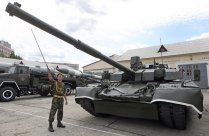 WARSAW, Poland — Ukraine is negotiating the sale of 100 T-84 Oplot main battle tanks to Pakistan, and plans to use the funds to modernize the production capacities of its state-owned defense industry and invest in research and development, according to daily Gazeta Wyborcza. The potential deal, which is to be handed to Ukraine defense group Ukroboronprom, would mark another export contract for the supply of the tanks following a deal signed in 2011 with Thailand. Bangkok is to obtain a total of 49 Oplots.
 Three years ago, Ukraine announced it would sell 50 of its T-64BV-1 tanks to an unspecified foreign customer, rumored to be the Democratic Republic of the Congo. This became official in 2016 with the delivery of 25 of the tanks to the country, according to information just released by Ukraine to the U.N. Register of Conventional Arms.
 In the summer of 2016, a French magazine published some curious photos of a Leclerc main battle tank of the French Army, painted in the jagged new Scorpion camouflage scheme—and sporting a massive 140-millimeter, fifty-five-caliber gun. You can check out pictures here and here and here. The huge smoothbore gun came from the experimental T4 gun turret built in 1996 by GIAT and the Bourges arsenal.
 The U.S. Army‘s chief of staff said he wants future versions of its main battle tank, the M1 Abrams, and other ground combat vehicles to feature active protection systems, as-yet-undeveloped lighter armor and a driverless option. Gen. Mark Milley outline such technologies when speaking Thursday at the National Press Club in Washington, D.C. He was responding to a question about whether he was concerned that Russia plans to field a new tank, the T-14 Armata, in 2020.
 A FINAL series of blast tests have been completed on the two short-listed contenders vying for a multi-billion-dollar Australian Defence Force contract to build its new Combat Reconnaissance Vehicle. The bid — hotly contested between Victoria and Queensland — would be based at the old Holden factory should defence giant BAE Systems be awarded the $5 billion contract to build 225 combat vehicles.
 Tank and AFV News