Walk around videos of M114, M3A1 and Ferret

East Coast Armory has posted a series of walk around videos on their youtube channel.  These clips show some nice exterior and interior detail on three different vehicles, the M114, the M3A1 and a British Ferret.  These videos may prove particularly of interest to model makers looking for reference material.


Tank Chats #26 Peerless Armored Car

From the Tank Museum at Bovington:

In 1919 the British Army found itself short of armoured cars when many were needed quickly to police various trouble spots around the world.
In reality it did not make a very good armoured car. It was too big, too unwieldy and slow while the crew got a rough ride on solid tyres. However it was durable and quite a few were still in service when the Second World War began.

Patton versus the Panzers: An Interview with Steven Zaloga

Two years ago we had a chance to interview author and historian Steven Zaloga.  That interview became the first feature of this website when it launched in January of 2015.  We recently had the chance to do a follow-up interview with Mr. Zaloga in late August, 2016.  We were able to get his thoughts concerning his two latest hardcover books, Patton Versus the Panzers: The Battle of Arracourt, September 1944 and Armored Champion: The Top Tanks of World War II, as well as a variety of other topics, including Soviet tank development, the 1940 Campaign in France and the tank book publishing business.


sz15Steven Zaloga is an author and defense analyst known worldwide for his articles and publications on military technology.  He has written over a hundred books on military technology and military history, including “Armored Thunderbolt: The US Army Sherman in World War II”, one of the most highly regarded histories of the Sherman Tank.  His books have been translated into Japanese, German, Polish, Czech, Romanian, and Russian. He was a special correspondent for Jane’s Intelligence Review and is on the executive board of the Journal of Slavic Military Studies and the New York Military Affairs Symposium. From 1987 through 1992, he was the writer/producer for Video Ordnance Inc., preparing their TV series Firepower.  He holds a BA in history from Union College and an MA in history from Columbia University.


Why did you decide to choose the battle of Arracourt, September 1944 as the topic for this book?

There were two reasons. The first reason is that I wanted to cover a big US-versus-German tank battle. The underlying theme is stated in the forward of the book- there is this impression that US tanks are always getting defeated by German tanks because the German tanks technically were so much better. But I’ve spent so much time doing campaign books, not tank-oriented books but general campaign books on the ETO for the Osprey Campaign series, that I was aware that that was simply not true. There weren’t that many large US-versus- German tank battles. As I mention in the book there were really two big ones: Arracourt in September 1944, and of course the Ardennes in December 1944 – January 1945. I selected Arracourt partly because it’s not very well known. So it makes a more interesting and fresh subject. And also it’s relatively confined in time and space. It took place over a couple of weeks and it’s not over a very large area. Doing the Ardennes would be interesting. But the problem is that inevitably I have to basically do the whole Ardennes campaign all over again to explain what is going on. And that would make it unmanageable in a book the size that Stackpole wants. So I ruled out the Ardennes for that reason. Also I had done the earlier Osprey Ardennes book (Panther vs Sherman: Battle of the Bulge 1944 (Duel)).

The second big reason was availability of research materials on both sides. The German side in a lot of battles is not especially well covered because a lot of records were lost. The Germans lost the war. At one point in the war the main German Army archive was basically burned down. So a lot of records were lost there. And a lot of records were lost during the course of campaigns. But I knew from having done some previous work on the Lorraine campaign that the German records from that battle were fairly good. I actually have day-to-day reports at corps-level and in some cases at divisional-level explaining what’s going on. And the US side also is fairly well covered. The strange thing is that in many cases you would think that US battles are very well covered because we have all the records. In fact, there often times are after-action-reports, but they are very skeletal and don’t give much detail. But I knew that in the case of the Arracourt battles there had been an Army historical team stationed with 4th Armored Division and they did a set of interviews after the battle of Arracourt. This included a lot of maps, which of course, is very useful for trying to explain exactly what happened in the battle. So those were the two reasons; there was some inherent reasons in the nature of the Arracourt battle that made it attractive for a book; and I knew from having done previous work that there was enough historical material that would enable me to make it detailed enough to keep it interesting.

In the course of researching this book, did you find anything that surprised you or was it more a case of fleshing out the framework you had established in earlier works? [Read more…]

Video: British Army Cribs – Challenger 2

This video recently appeared on youtube.  It’s a slightly silly video but it does give a quick look at the interior of the vehicle.

Sudan orders Russian T-72 MBTs

t-72av-tankAccording to an article by Russia Beyond the Headlines, Sudan has ordered 170 T-72 main battle tanks from Russia.  This order is said to consist of 150 combat ready tanks plus an additional 20 vehicles for spare parts.  The version of the T-72 acquired by Sudan is said to be T-72AV.  The T-72A is an early variant of the T-72 that first appeared in 1979.  The “AV” version is essentially an “A” with the addition of Kontakt-1 explosive reactive armor.  According to the Military Balance 2016 report issued by the International Institute for Strategic Studies, the Sudanese Armed Forces operate 465 tanks, including 20 M60A3, 60 Type 59/Type 59D, 305 T-54/55, 70 T-72M1, and 10 Type 85-IIM.

Video: A Rather Battered Looking M3 Grant

This video from late August shows footage of a rather worse for wear looking M3 Grant tank being driven around.  Fortunately, a good deal of information on this vehicle is provided in the description on youtube:

Originally used by the British army in North Africa, this tank sustained battle damage from German anti tank and small arms fire during it’s tour of duty.  After the Germans were defeated in North Africa, a number of these British owned Grants were transferred to the Australian army.  All of these ex British Grants were delivered to Western Australia and that is where they remained for the duration of the war.  All surplus Grants were sold off at disposal auctions state wide. This particular Grant was most probably sold from the wheatbelt town of Nungarin.  It was a farmer who bought T24676 for the purpose of using it to clear scrub and other towing duties around the farm. To lighted the weight of the tank, the turret was removed and disposed of.  Eventually abandoned on the farm, T24676 has embarked on a new lease of life after a collector found her sitting in paddock.  Transported to her new home in rural Western Australia, T24676 will undergo a full ground up restoration.

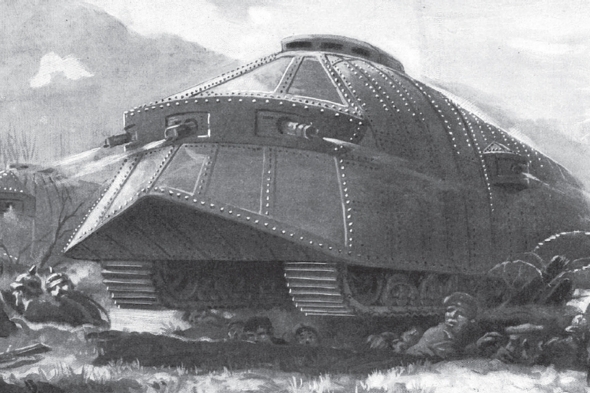
Photo of the Day: Scientific American 1916 tank drawing

This rather fanciful drawing comes from the October 7 1916 issues of Scientific American and shows a depiction of the new “tank” that had just seen combat on the Western front.  Obviously, the artist had limited information regarding the appearance of the first tanks.

c243bafa-b035-42f6-91fea41c36d834ce

Video: Replica tank on display in London

One hundred years ago, the very first tank, the Mark I, hit the battlefield. A feat of British engineering brilliance, the Mark I helped change the face of warfare as we know it. Wargaming celebrated this centenary with a host of online and offline festivities, including a unique event in the heart of London, organized in partnership with The Tank Museum, Bovington. On September 15, 2016, a replica Mk. IV was brought to London’s Trafalgar Square to mark the occasion.

Video: Austrian pre-WW2 Armor

Here are a couple clips from British Pathe showing Austrian armor in the late 1930’s.  Vehicles shown include Italian built L3 tankettes and the ADGZ armored car.


Tanks sold off at Normandy Museum

7496130619222104RFI is reporting that the planned auction of military vehicles and artifacts at the Normandy Tank Museum took place this weekend. A M4 Sherman tank was sold for 280,000 euros and an M5 Stuart was sold for 230,000 euros.  A German WW2 era side car equipped motorcycle fetched a price of 130,000 euros, significantly higher than the 45,000 maximum price established prior to the auction.  The Normandy Tank Museum had been open for three years and was owned by a 67 year old former Air France pilot and collector of militaria named Patrick Nerrant.  Reasons for the closing of the museum included a decline in tourism and problems with the economy.

Read the RFI article here.

Correction: We found a full list of items and prices and it appears the numbers reported in the RFI article are not correct.  Here is the full list:

1 défense anti-aérienne 1500
2 Pilote de Chasse 2500
3 Pilote de P47 3500
4 ensemble pilote Briefings 3400
5 officier pilote 1500 [Read more…]