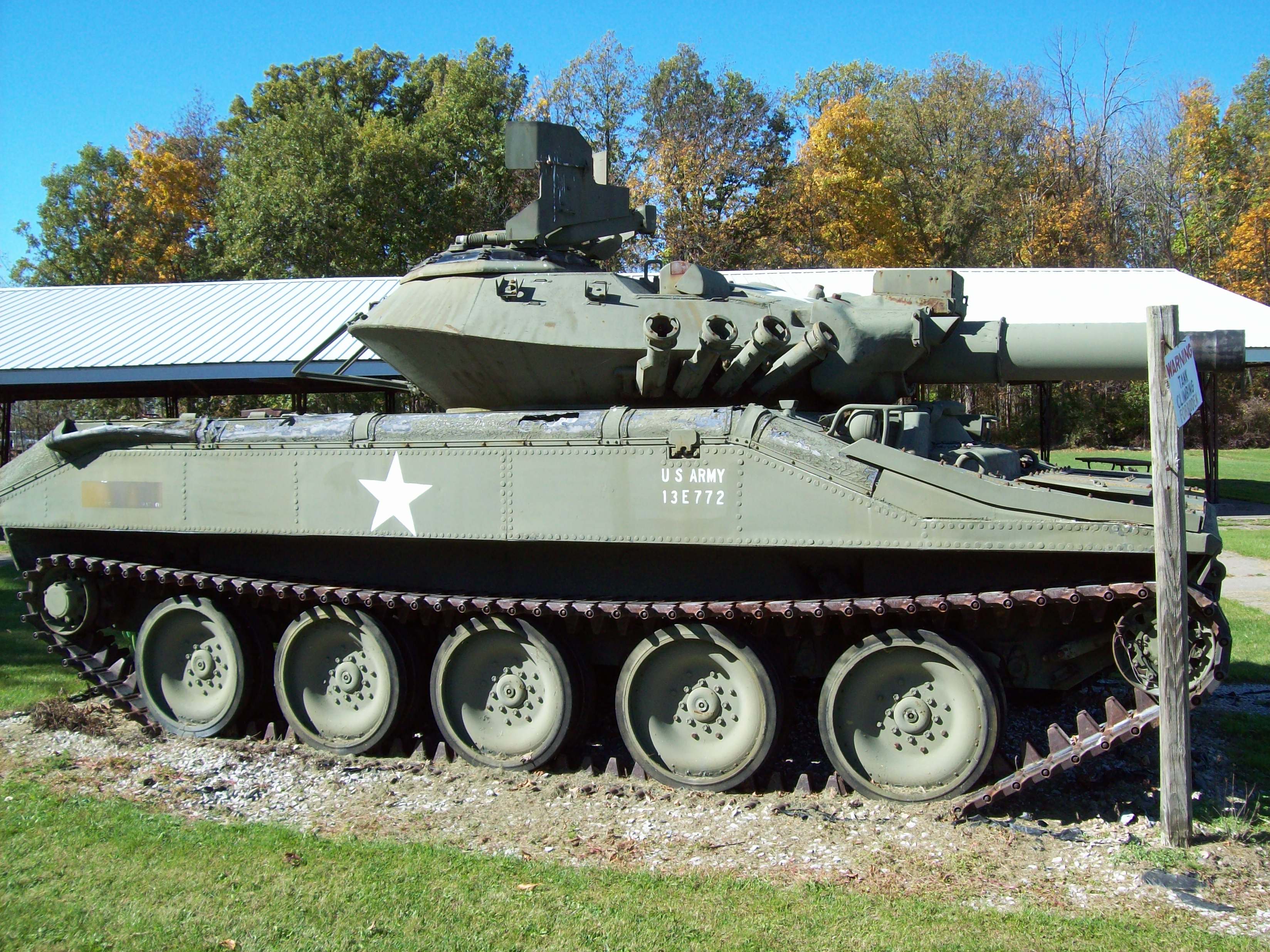
 Today we present a photo gallery of the M551 Sheridan light tank on display outside the VFW hall in New Lothrop Michigan. These photos were taken in fall of 2013. As far as we can determine, this is the only M551 on display in Michigan. There are many Sheridan light tanks on display around the country, primarily in museums or on military bases. Several are on display outside of National Guard armories. Only a few serve as monuments outside VFW or American Legion halls such as this one in New Lothrop. For those interested in finding tanks on display near where they live, please consult the Historical AFV register homepage.
From the Editor: Photo Gallery of M551 Sheridan at New Lothrop MI
April 15, 2015 by Leave a Comment
Armored Warfare article on “The Sheridan Story”
April 15, 2015 by Leave a Comment
The website for the video game Armored Warfare has posted a two part article on the history of the M551 Sheridan. The articles make for an interesting read although no sources are provided, making it hard to confirm any of the information provided. For those wanting to view the articles, click on the links below.
US World War II tank nicknames
April 14, 2015 by 1 Comment
 Over at War History Online they have posted an article by Wargamings Military Specialist, Nicholas “the Chieftain” Moran on how US WW2 tanks got their names. In particular, Moran focuses on some comments made during the WoT Operation Think Tank forum in which several prominent armor experts were in agreement that there was no official US recognition of the nicknames based on famous generals given to US tanks. To make his case, Moran provides an image of a memo from November 1944 from General Barnes of the Ordnance Dept. listing approved nicknames for several US tanks, artillery and small arms. Included in the list are the nicknames General Stuart (M5 light tank), General Sherman (M4 medium tank), General Jackson (M36 tank destroyer) and General Chaffee (M24 light tank.) However, Moran points out that:
There is one very obvious and disappointing omission here, however, that being the 3″ GMC M10. I have never been a supporter of the name “Wolverine”, and though it’s commonly stated on websites, I have seen no War Office documentation to support the proposal that it was a British name. Further, it fits in with neither the British policy on naming US tanks, nor on their policies of naming artillery pieces after the clergy or the letter “A.” Even “Achilles” didn’t show up as a name until very late in the war.
The full original article can be read here.
From the Vault: Anti-Armor Defense Data Study (A2D2)
April 13, 2015 by 1 Comment
 Today we present a very interesting group of documents called the Anti-Armor Defense Data Study (A2D2). This report was put together in the early 90’s and examines instances from World War II of US anti-tank units fighting against German armored attacks. There are five separate documents, one of which is a “how to research” guide and the others are labeled Volume I-IV. Volume I is titled “Technical Report” and primarily deals with methodology, sources and appendices. Volume II, III and IV are more interesting, for they include the meat of the report. Each volume examines a particular battle, providing detailed descriptions of the actions that took place. Volume II looks at the US anti-tank defense in Mortain France in August 1944. Volume III focuses on US anti-tank operations at Dom Butgenbach, Belgium in December of 44 and volume IV looks at Krinkelt-Rochrath, Belgium in December of 44.
Here is an unusual excerpt from Volume IV, page 149 :
Tank Museum introduces New Tank Factory Exhibition
April 13, 2015 by Leave a Comment
The Tank Museum at Bovington, England has announced the opening of a exhibition with explores the design and manufacture of British armored vehicles from 1916 to the present. According to the Museum website:
Funded by the Heritage Lottery Fund, the exhibition tells the often overlooked story of the men and women who built these complex war machines and how the demands of factory life affected the workforce and wider society. The display also showcases an impressive line-up of vehicles and through a series of themed bays, cover a variety of topics including Materials, Armour and Weapons and Testing.
The exhibition covers issues around who builds tanks and why they look the way they do, what makes a good and bad tank and, via a touchscreen interactive, the public have the chance to design their own armoured vehicle. ‘Tank Factory’ is housed in one of the older museum buildings – a perfect backdrop as it is in fact an old factory building – re-erected at the site in the 1998. The main centrepiece is a production line of Centurion tanks, arguably the best tank Britain ever made.
Israel to select a new self-propelled howitzer
April 13, 2015 by Leave a Comment
 Jane’s is reporting that the Israeli Defense Forces have announced that they are in the advanced stages of selection a replacement for their 155 mm M109 self-propelled howitzer. According to the Jane’s article, a senior source from the Israeli Artillery Corps said that the new howitzer system would have to have a longer range and smaller crew than the M109, as well as the ability to relocate positions more rapidly. The new artillery system will be based on the Lockheed Martin M270 multiple launch rocket system chassis to maximize commonality with Israels existing inventory. The gun component of the vehicle will be a system by either Israeli company Elbit Systems or a system based on the Artillery Gun Module by German company Krauss-Maffei Wegmann (KMW) optimized for the IDF by state-owned Israel Aerospace Industries.
Recent Yuri Pasholok articles at Status Report blog.
April 13, 2015 by Leave a Comment
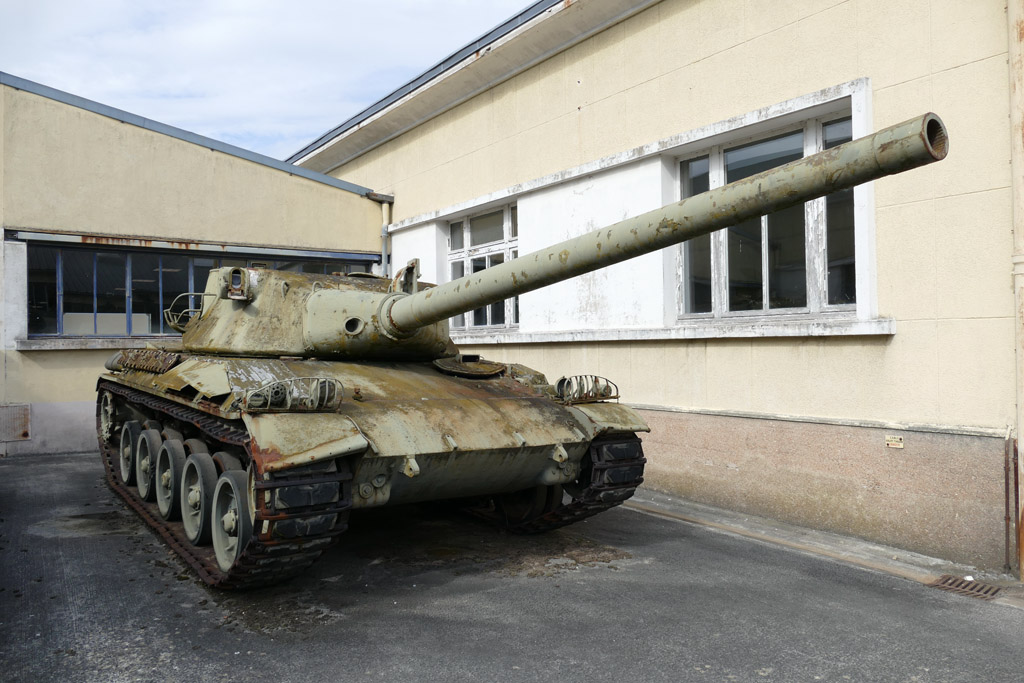 The blog “Status Report” has posted two English language translations of articles by Russian armor researcher Yuri Pasholok this past couple days. An article posted on Monday contains a number of pictures of the AMX-30 prototype that is stored at the French Armor Museum in Saumur. People interested in the AMX- 30 Status Report article may read it here, the original Russian language article is available here.
 An article posted on Sunday provides a history and photo gallery of the 47mm gun on Renault R35 chassis at the Panzermuseum in Thun, Switzerland. This vehicle was an improvised tank destroyer, consisting of a captured French tank hull being mated with a captured Czech 47mm gun. By the time of the Normandy campaign, 110 of these converted panzerjagers were still in service. The article notes that the one at Thun most likely saw combat as it exhibits signs of battle damage. The original Russian language version of the article can be read here, the translated Status Report version is here.
Workers find tank hatch in Hereford, England
April 13, 2015 by Leave a Comment
 The Hereford Times is reporting that workers at at a construction site found a heavy metal hatch while digging. The object was identified as one half of the split hatch for an M4 Sherman tank. The location of the construction site, Skylon Park in Rotherwas, was at one point home to the Royal Ordnance Factory at Rothewas. The Factory closed in September of 1945 and taken over by the Ministry of Supply for use in breaking down obsolete or scrap armored vehicles. The article quotes Daniel Rees of the Herfordshire Light Infantry Museum how notes “The find … pinpoints one of the actual models of vehicle being broken down, this is very important in building a picture of the site after the Second World War. If anyone has any further details of the armoured vehicles or the breaking operations in Rotherwas it would be gratefully appreciated.”
From the Vault: The Patents of General Barnes
April 11, 2015 by 3 Comments
For those with an interest in the history of US Armor, the name General Gladeon Barnes may be a familiar one. Barnes served as the head of the Technical Division of the Ordnance Department during World War 2. In his book “Armored Thunderbolt”, Steven Zaloga refers to Barnes as “the single most influential U.S. Army officer in the development of wartime tank designs.” During World War 2, Barnes and the Ordnance Dept. often butted heads with Army Ground Forces and the Armored force. in particular, Barnes and the ordnance dept. were known for their advocacy of a heavy tank for the US Army and for the development of the T20 series of vehicles to replace the M4 Sherman.
Barnes started his career with the U.S. Army in 1910 as a lieutenant of Coast Artillery. He transferred to the Ordnance Department and spent World War 1 designing heavy artillery. According to the book “Faint Praise” by Charles Baily, Barnes’ post war assignments gave him experience in both production and design, and he owned some thirty-four patents. We thought it might be interesting to do a search for some of these patents and see what they looked like. A quick search in Google patents revealed four pages of results (click here to view them.) Most of the results are for various gun designs or vehicle components. However, there are two rather unusual patents from 1942 and 1944 simply described as “tank.” Both patents seem to describe the same vehicle. Let’s take a look.


Germany to bring 100 Leopard 2 tanks back into service
April 11, 2015 by Leave a Comment
 Reuters is reporting that Germany plans to bring back into service more than 100 Leopard 2 tanks that had been mothballed. The decision to increase it’s inventory of tanks comes as NATO tries to hasten the response time of its rapid reaction force following Russia’s annexation of Crimea last year and conflict in Ukraine. The article notes that before the end of the Cold War, in the 1980s, the then West Germany had more than 3,500 tanks. Now, seventy years after World War Two, it has just 225. As a result soldiers have to share tanks and heavy equipment across different units. A defense ministry spokesperson confirmed that “the ministry has decided to raise the upper limit for the future to 328 (tanks)”

 Tank and AFV News