No posts today as we will be out participating in Memorial Day activities. Everyone, have a safe and enjoyable Memorial Day and keep in mind the reason for the holiday.
News for all things related to Tanks and Armored Fighting Vehicles
No posts today as we will be out participating in Memorial Day activities. Everyone, have a safe and enjoyable Memorial Day and keep in mind the reason for the holiday.
Yesterday we were able to snap some pictures of a M41 Walker Bulldog tank sitting outside of VFW Hall 5315 in Baldwin MI. From what we could gather, this vehicle has been on display at this location since at least 1987. The vehicle obviously is not sporting its original paint job, at some point the entire vehicle had been painted light tan, including the tracks. As to the specific model of M41, the USA AFV Register says this tank is an M41A3. We took these with a phone camera on a very sunny day so some of the photos might be a little over or under exposed. Perhaps these will come in handy for a model building looking for some reference images.


that brought him to our attention. This book started out as his doctoral dissertation and was later expanded on for publication. The premise of the book is to examine the various different factors and components that made up the German Panzer force. These include the organizational, economic, personnel, doctrinal and tactical factors that affected the Panzer arm’s performance. The book manages to accomplish all this in a very readable 199 pages.
Since the end of WWII, its fair to say that barrels of ink have been put to page concerning the German Panzer forces of 1933 to 1945. Most books have focused on vehicles and/or battles. This book does neither. What it does is explain the underlying factors that made the Panzer forces what they were. As such, we think it should be required reading for anyone looking for an understanding of German Panzer forces beyond just memorizing tank model numbers or Panzer division names.

Both books are available in softcover as part of the Stackpole Military History Series.
While we recorded this interview in spring of 2015, we have not had the opportunity to publish it until now due to technical reasons. That is, we lost the files due to a computer mishap. Fortunately, we recently were able to recover the files and finish transcribing (most of) the audio. The interview is posted below, our questions in italics and Dr. DiNardo’s answers in regular font.
How did you get interested in the topic of World War II German panzers?
It’s the old saying by Thomas Hardy, peace makes for dull history. War makes for rattling good reading. Like a lot of kids I was drawn to the German military because I thought the uniforms were cool. It’s that simple.
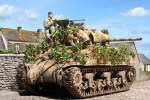
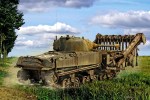
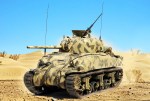
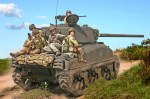
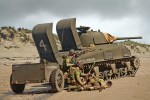
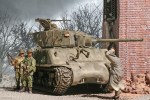
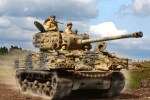
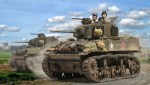
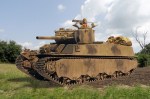
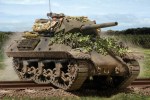
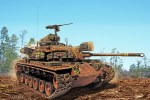
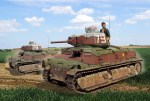
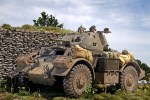
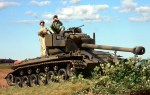
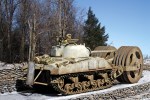
Author and master model builder Steven Zaloga has given us permission to post this gallery of some of his 1/35 and 1/48th scale models. We hope you enjoy these images and we thank Mr. Zaloga for sharing them with us. The models can be viewed in the slideshow directly below or click on the individually labeled thumbnails to view the full size images.
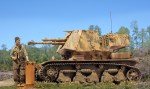
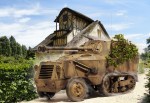

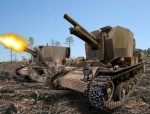
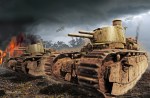


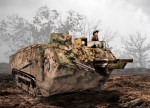
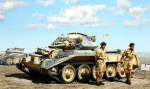

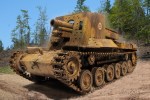
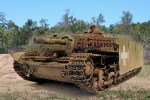
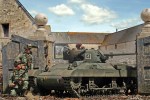

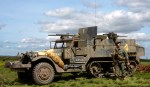












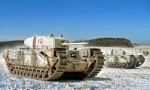
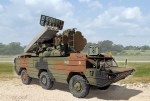
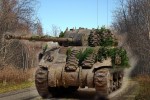
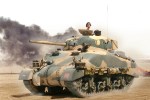

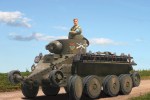

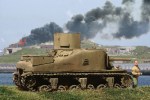

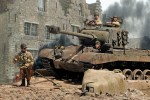
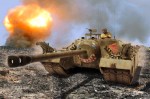



Mike Dobrzelecki has sent us some pictures and a description of a model he built of the Polish Ford FT-B (Tfc) Armored Car. It’s a nicely done model of a rather rare and unusual vehicle.


Description:
Polish Ford FT-B (Tfc) Armored Car 1/35th Scale
By Mike Dobrzelecki
Designed in 1920 by Tadeusz Tanski the Ford FT-B (tfc) was based on the classic Ford Model T chassis. He used plates made from German trench armor scrounged from Polish battlefields and filled the tires with wood pulp to protect them to a certain degree against rifle and machine gun bullets (probably a rough ride). The Ford FT-B was the first Polish armored vehicle built in series, with between 16 and 17 completed, depending on whose information you believe. All of the other armored vehicles in Polish service were either WWI vehicles captured from the Russians (Austin Pulitov Armored Cars, amongst others), Imperial German forces (Ehrhard Armored Cars, amongst others), Austrians, furnished as war material by the French Government (Renault FT-17’s, amongst others), or one-off armored conversions of civilian vehicles. The Ford FT-B acquitted itself well during the Polish-Bolshevik War of 1920 excelling in the highly mobile combat, which characterized that conflict, so unlike the static trench warfare of WWI. The Ford distinguished itself particularly in “The Raid on Kovel” and saved many a Polish kiester during the retreat from the Ukraine back to Warsaw. It them supported the counter-attack eastward, after the successful defense of Warsaw, known as “Miracle on the Wistula” (Wisla River in Polish), where Sikorski defeated the Reds, routing them in the process and sending [Read more…]
Today we present an original article written by Matt Dedrick titled “Reading Between the Lines: Estimating Tiger Tank Production.” Mr. Dedrick has spent a good deal of time wrestling with the topic of Tiger tank production during WW2, particularly the effects on Tiger 1 production caused by the strategic bombing of Kassel on October 22,23, 1943.
Excerpt:
This is the first of a series of articles intended to explore the effects on Tiger 1 production caused by the Royal Air Forces’s area fire-bombing of the medieval City of Kassel on the night of October 22,23, 1943. Though the bombing of Kassel was regarded by Henschel management and the Heereswaffenamt to have been the singular event most affecting Tiger 1 production, it has been virtually ignored in the available literature As a result, the production of Tiger 1 tanks during the four months following the bombing of Kassel has been poorly understood by modellers and tank historians alike.
Most of the data and documents on Tiger 1 production was lost during the war. Much of what is available has been researched, interpreted and published in the many books compiled by those two remarkable research-historians, the late Mr. Tom Jentz and the late Mr. Walter Spielberger The data found in their books has been largely based on Henschel monthly production statistics, wartime documents, minutes from the Heereswaffenamt /Henschel meetings, post war interviews, photographs as well as the data found in the various army manuals, journals and publications.
Today we present an article written by retired US armor officer MAJ James M. Warford about US efforts to gather intelligence on Soviet armor during the Cold War involving the US Military Liaison Misison. This article originally appeared in the Nov-Dec 2011 issue of ARMOR magazine in edited form. Mr. Warford has provided us with the original and unedited version for your reading pleasure.
————————————————————————–
“His weapons are stealth and discretion. He knows that successful collection is a deliberate and persistent endeavor which reveals the correct picture about his opponent from an emerging mosaic of separate information. Upon his individual judgment, initiative and courage, the success of USMLM is built.”
Randall A. Greenwalt, Colonel, GS
Chief of Mission (1982)
The United States Military Liaison Mission, or USMLM for short, was officially established by the Huebner-Malinin Agreement, in April 1947. The agreement authorized the exchange of military liaison teams or “missions” as there we commonly called, between US and Soviet military headquarters’ in Germany. USMLM’s primary (official) mission was to, “carry out responsibilities for liaison between CINCUSAREUR, on behalf of the US Commander in Chief Europe, and CINCGSFG (Group of Soviet Forces, Germany).”1 It was, however, in USMLM’s secondary and until the end of the Cold War, secret role where its contributions can truly be measured. Its secret role was to “exploit its liaison status and attendant access for the collection of intelligence information in the German Democratic Republic.”2 This meant that throughout its 44 year history, members of USMLM were able to spy on and gather critical intelligence information concerning the Soviet Forces deployed in East Germany.
Of all their real-life missions, many of which rival the most daring exploits described in best-selling spy novels, the task of getting up-close and personal with the brand new Soviet T-64 MBT (later confirmed to be the T-64A), and obtaining metallic scrapings of the tanks armor, ranks as one of the most daring and critically important they ever conducted. The desire to touch the enemy’s truly revolutionary new tank (the best the Soviets had to offer), represented more than just a high-priority mission; it was in fact, the quest for the “Holy Grail.”

August 1978: USMLM technical quality photography of T-64As (USMLM History – 1978)
While in many ways, USMLM’s intelligence experts and linguists were an elite team, they were not unique. At Yalta in 1945, President Roosevelt, Prime Minister Churchill and Central Committee Secretary Stalin agreed that post-World War II Germany (and Berlin) would be reorganized into zones of occupation. Ultimately, this reorganization would include four zones; the American, the British, the Soviet and the French. Each zone was granted a liaison mission. The British mission was known as BRIXMIS, the Soviet mission was known as the SMLM (often abbreviated even further by American military forces to “smell ’em”) and the French mission know as the FMLM. The official headquarters’ for the three western missions were set-up in the city of Potsdam. Once established, the American, British and French missions were able to use their quasi-diplomatic status to observe, track and appraise Soviet military forces as they “toured” through East Germany. These “tours” normally consisted of two or three mission team members in a modified civilian sedan or (more recently) small SUVs. They would drive through East Germany both on and (more often than not), off-road. In many cases, the mission tours included tense stake-outs while hidden in the East German countryside for days at a time. If they were spotted by the Stasi (the East German State Security Police) or Soviet military forces, the chase was on. Tour members would do everything they could to avoid being detained (or “clobbered”) by their pursuers; including dangerous high-speed chases and escape and evasion maneuvers.
We will be on vacation starting today until the 13th of December. Expect very little posting during this period as we will be away from the computer.
We leave you all with this GIF that appeared at Popular Mechanics.com of an Abrams crew loading and firing the main cannon (Via Redditor /TheStrid at r/MilitaryGfys)


Sahara (1943)
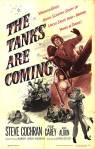
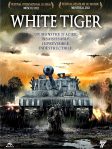
Regular readers may have noticed a lack of posts in the past several days. We have had to deal with some family emergencies which pulled us away from the keyboard. Fortunately, it does not seem that the past few days have generated much important news regarding AFVs so perhaps our timing was good. We were thinking about movies today and started to google movie posters. We put together a small gallery of posters for movies featuring tanks. Unfortunately, there have not been very many great films featuring tanks, although there are a few that have developed a cult following. Kelly’s Heroes, The Beast and Sahara are decent films and they are fun to watch. “Tank” staring James Garner is somewhat painful to sit through, and films such as “Tank Force”, “Tank Battalion”, and “The Tanks are Coming (1951)” are painfully dated. And then there is the Battle of the Bulge, a film which transforms the the Ardennes Forest in winter into an arid Spanish plain with US Chaffee light tanks battling M47 “Tiger” tanks. The less said about the 1995 remake of Sahara staring James Belushi, the better. Below is a list of the films in the gallery with links to either the trailer or the entire film. There are of course many other films that feature tanks. These are just a few that we thought had interesting posters.
Sahara (1943) Excerpt
The Tanks are Coming (1951) Trailer
Tank Battalion (1958) Full Film
Tank Force! (1958) Excerpt
Battle of the Bulge (1965) Trailer
Kelly’s Heroes (1970) Trailer
Tank (1984) Trailer
The Beast of War (1988) Trailer
White Tiger (2012) Trailer (Russian language)



Tank and AFV News.com will be taking the next few days off from posting. We have to go out of town to take care of some things. But fear not! While we are gone, be sure to check out the numerous WW2 tank related documents available in the free section of the Digital History Archives. These documents include:
Article by US Army Tank Battalion Commander – Tank Versus Tank (1946)


 Tank and AFV News