It’s time to check up on the blog “Below the Turret Ring” to see what they have been up to. Since last time we checked, they have posted two lengthy pieces, one on the armor configuration of the early model M1 Abrams, and a follow-up to their post from last year on Leopard II tanks in Syria. Click on the headlines in the excerpts below to go to the full version.
Below the Turret Ring: Early M1 Abrams composite armor
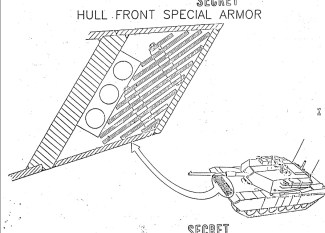 On the TankNet forums, a user with the nickname “whelm” has posted drawings from a formerly classified document on the earliest iteration of the US M1 Abrams main battle tank (MBT). He got this document from Vollketten, a user with accounts at the Sturgeon’s House forum, the WoT forum and other places. It details the armor layout of the tank, showing were the Burlington composite armor is located and how it is specifically implemented on different areas.
Burlington special armor, also known as Chobham armor, is a type of composite armor developed in the United Kingdom by the FVRDE from the late 1960s onwards. It consists of a number of sandwich plates – also called biscuits – which are mounted in a spaced configuration. It is understood that these sandwich plates work as a type of non-explosive reactive armor (NERA), by using an elastic interlayer located between two metal plates (usually steel or alumininum). On impact the rubber will compress to the point of maximum compression, until expanding again and bouncing back. This will move more material into the path of penetration and also shatter thin and fragile projectiles, such as the shaped charge jets created by high-explosive anti-tank (HEAT) warheads commonly used on anti-tank guided missiles (ATGMs) and rocket-propelled grenades (RPGs). Essentially NERA works like explosive reactive armor, but with a lot less plate movment, as it only reuses the energy from the impacting projectile, instead of using an external energy source (such as the detonation of an explosive layer) to move the metal plates.
Below the Turret Ring: Leopard 2 in Syria – part 2
 Yesterday a new video was released by ISIS terrorists showing a bunch of destroyed main battle tanks (MBTs) and armored personnel carriers (APCs) near the Syrian city of Al-Bab. This video however has proven something, that I understimated a certain weapon. Not anti-tank guided missiles (ATGMs), not improvised explosive devices (IEDs). A much older weapon: propaganda. The same weapon that turned the Tiger heavy tank – a rather mediocre design of it’s time – to a supposed super tank, that still is being worshipped by some individuals today. However the propaganda worked, invoking a Tiger-phobia on the side of the allies.
Now, what exaclty has happened? A new video showing the exact same area that the first few videos were showing. The destroyed or damaged tanks are probably all identical to the tanks already shown in earlier videos, that have been covered by numerous news articles and blogs. Still some people start writing articles in a sort of kneejerk reaction, claiming that these are newly defeated tanks and that the Turkish Army is just poorly trained or the Leopard 2 is a poorly designed tank, incapable of competing on the same level as the tanks of other countries (even though this is not tank-vs-tank warfare…). This again leads to people to come and reply or spread the articles, which are pushing for their own agenda. “The T-90 is so much better, only one was penetrated!”, “All people who think the Leopard 2 is a good are Nazi-tank fanboys” and “The Abrams/Challenger 2/T-84 is an inpenetratable super tank”. People love to ignore the fact that the Turkish Leopard 2A4 is fitted with out-dated armor, possibly still the first generation of armor technology introduced with the original Leopard 2 in 1979. The fact that the Turkish Army was purged after the failed coup attempt – in which most tank units were equipped with Leopard 2A4 tanks – is intentionally ignored.
 The World of Tanks series books are now available for the first time in English! They include never-before-seen photos, diagrams, and documents from Soviet archives—which is why we distinguish each volume as “The Russian View.”
 The latest version of the USA Historical AFV Register is now available for download. For those not familiar with this document, it is a list of every tank and AFV on public display in the US organized by state. This latest version is authored by Neil Baumgardner and Michel van Loon. It can be downloaded in PDF format either
 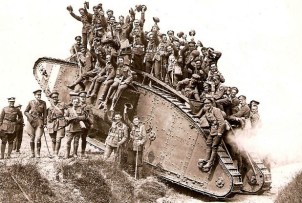 This summer sees the 100th anniversary of the start of the
  Israel’s Defense Ministry Property Director, together with the IDF’s ground forces and the Yad Lashiryon Organization, has announced a project to restore a variety of historical displays, including historical tanks which fought in all of Israel’s wars.

 This British Armour Branch report was recently linked to over at the
  The mittlerer Traktor (m.Tr., medium tractor), given the more widely known index Neubau Fahrzeug (Nb.Fz., newly designed vehicle) on October 3rd, 1933, began trials in 1933. The tank, an evolution of the Grosstraktor concept (Gr.Tr., large tractor) was supposed to become Germany’s medium tank. However, even as the tank began its trials, it was clear that the German military missed its mark. While the Grosstraktor was overcomplicated over its five years of development by three companies (it’s enough to say that it was also amphibious), the Nb.Fz. was in an even bigger hole.
 In December of 1936, the German military signed a contract with the Krupp conglomerate for a batch of 35 Begleitwagen tanks. This tank was designed to fight as a direct fire support tank, as its name suggests. The tank’s main targets were going to be enemy infantry and light fortifications. Ironically, this vehicle became Germany’s most numerous medium tank by the start of WWII. Later, the PzIII became more numerous, but only for a short time. By 1943, the Begleitwagen, known as the PzIV, retook the lead. The Pz.Kpfw. IV was the only German pre-war tank that never went through a radical chassis modernization.
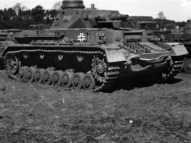 The German army entered WWII with a rather strange system of armament. The PzIII medium tank, which was built as Germany’s main tank, ended up being the least numerous in the Wehrmacht. As for the other medium tank, the PzIV, it was designed as a support tank, but ended up outnumbering the PzIII four to one. German industry could only equalize the number of both tanks by the end of 1939. By then, a new version of the support tank was in production, the PzIV Ausf. D, which was in a way a return to the original concept.
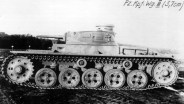 The appearance of John Walter Christie’s Medium Tank M1931 caused a revolution in tank building worldwide. A new type of tank appeared: the fast tank. Thanks to their speed, these tanks could carry out a number of other tasks in addition to infantry support. Many countries began working on conceptually similar tanks. The PzIII, Germany’s main tank in 1940-43 could be considered one of these tanks. What is the history of its creation?
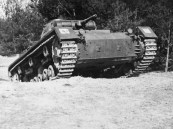 The PzIII, the main German tank for the first half of WWII, was at the same time its most problematic tank. Even though the PzII also had problems with its suspension, it was only seriously redesigned once. The PzIII, on the other hand, used five (!) different types of suspension, all of which went into production. Today, we will focus on the “intermediate” PzIII Ausf. B, C, and D. Even though none of these tanks were made in large numbers, they managed to see battle, and some of them remained on the front lines for a long time.
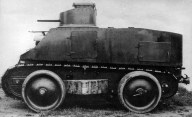 In the late 1930s, Czechoslovakia was the second largest exporter of tanks in the world. A small Eastern European country that only obtained independence in 1918 began to catch up with Great Britain, the world leader in arms exports. Of course, such impressive leaps in only 20 years of independence didn’t start with nothing. The first steps were made with inspiration from the British and German tank building schools. This experience resulted in a series of experimental vehicles and the mass produced LT vz. 34 light tank.
 By the middle of the 1920s, the British army received a new generation of medium tanks that served for a long time. The Medium Tank Mk.I and Medium Tank Mk.II became the first turreted medium tanks in the world. A good design and high reliability guaranteed a long life for these tanks, but by 1926, the British military was already thinking about their replacement. A Vickers design, the Medium Tank Mk.III, was suitable for the job. Even though the rather interesting design became the ancestor of a series of later tanks, including Soviet and German ones, its life in the British army was a difficult one.
 Tank and AFV News