To mark the first appearance of the German A7V on the battlefield 100 years ago, both the Great War channel and the Bovington Tank Museum have released videos looking at the German WWI tank. The Tank Museum video is part of their long running “Tank Chats” series as looks at the replica A7V housed at the Tank Museum. The Great War video looks at the A7V replica that resides at the German Tank Museum in Munster, Germany. Of course, the only surviving original A7V is at the Queensland Museum in Australia.
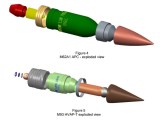 For those looking for a detailed report on the effectiveness of US 76mm tank guns, check out this new technical report from ARDEC, the U.S. Army Armament Research, Development and Engineering Center. Released in January of 2018, this document is a 58 page PDF and is a rather thorough examination of the topic.
  Kingdom of Jordan has opened up a new museum dedicated to tanks and military history and showcasing over 100 armored vehicles. According to news articles, the museum collection has been assembled over the last ten years and contains vehicles from the Jordanian Armed Forces as well as machines from other countries given as gifts or through military exchange programs. While we have not seen a complete list of all the vehicle types on display, based on the photos and videos made available so far, this is a very impressive collection of vehicles, including some relatively rare WWII era vehicles.
 The U.S. company that repairs Iraq’s American-made M1A1 Abrams tanks has pulled many of its people from Iraq after at least nine of the armored vehicles ended up in the hands of pro-Iran militias. Now, many of Iraq’s tanks are immobilized for want of maintenance, potentially jeopardizing the country’s ongoing campaign against Islamic State militants. While the Islamic State has retreated from large swaths of Iraq it once controlled, mobile groups of militants continue to stage attacks on Iraqi troops and their allies. An Islamic State attack near the city of Hawija in mid-February reportedly killed 27 militiamen fighting for Baghdad.
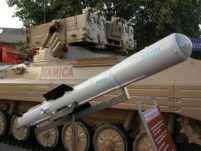 India’s Defense Research and Development Organization (DRDO) successfully tested its indigenously designed and developed third-generation anti-tank guided missile (ATGM) Nag in desert conditions against two tank targets on February 28, according to an Indian Ministry of Defense (MoD) press release. The tests “have once again proved its capability,” the statement reads. “With this, the developmental trials of the missile have been completed and it is now ready for induction.” The Indian Army has so far not publicly commented on the successful Nag ATGM test. Notably, DRDO had announced the completion of development trials already in September 2017.
 An order placed by the Russian Ministry of Defence (MoD) for two battalions of T-14 main battle tanks (MBTs) and a battalion of T-15 heavy infantry fighting vehicles (IFVs) has been confirmed by the Russian Ministry of Defence (MoD). “It’s no secret that we already have a contract for trials and combat operations: two battalions of Armata tanks and one battalion of heavy infantry fighting vehicles,” Deputy Defence Minister Yuri Borisov was quoted as saying by the MoD during a tour of the Uralvagonzavod factory in Nizhny Tagil on 9 February.
 The Chinese People’s Liberation Army (PLA) currently fields the world’s largest active service main battle tank (MBT) force, according to an analysis published in the newly released Military Balance 2018 report, produced by the International Institute of Strategic Studies (IISS). As of 2017, the PLA’s operational tank fleet is composed of roughly 3,390 third-generation, 400 second-generation, and 2,850 first-generation MBTs. In comparison, in 1997 the force consisted of 6,200 first-generation and 1,600 second-generation MBTs.
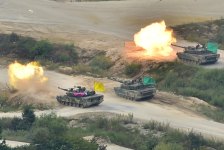 SEOUL — South Korea’s K2 main battle tank is to be equipped with a German transmission system, a part of the tank’s powerpack that includes a locally-developed engine. The Defense Acquisition Program Administration (DAPA) announced Feb. 7 that its top decision-making body, presided over by Defense Minister Song Young-moo, made a decision to adopt the German RENK transmission system for the production of a second batch of 106 K2 tanks.
 Tank and AFV News