The blog Below the Turret Ring has been busy lately, having made several new posts. Let’s take a look at what they have been up to. Click on the title to read the full post.
Austria won the Strong Europe Tank Challenge 2017
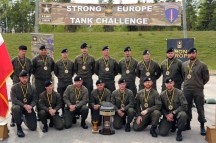 Two days ago the Strong Europe Tank Challenge (SETC) 2017 ended. The winning platoon comes from Austria, one of the first time participants. The soldiers of the Austrian Bundesheer deployed the 1980s’ Leopard 2A4 main battle tank (MBT), beating last year’s winner Germany. In the challenge held from 8th to 11th of May, teams from Austria, France, Germany, Poland, the Ukraine and the United States tried to show their skill in a number of different disciplines. These included offensive actions, defensive actions, target recognition/identification of thirty allied and enemy targets, estimating the range to a target without using the laser rangefinder, accurately reporting targets in a simulated urban area and firing crew weapons (pistols or submachine guns). Also part of the SETC was to recover a tank with simulated damage from an NBC attack, evacuating and treating wounded, calling for fire support by artillery/aircraft and precision driving along a pre-defined track. Crews also had to endure a physical fitness test. In comparison to last year the scoring was changed.
New Turkish combat vehicles presented at IDEF 2017
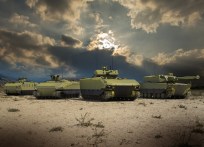 The thirteenth International Defence Industry Fair (IDEF 2017) has been held in Turkey. While not extremely popular with foreign companies – despite having “international” in the name, not many international AFV manufacturers were present – this exposition serves as an opportunity for all Turkish defence companies to present their latest and greatest developments. The company FNSS Defence Systems, a joint-venture of the Nurol Holding and BAE Systems, has presented a number of vehicles from the wheeled PARS family of vehicles (FoV) and the tracked Kaplan-20 and Kaplan-30 armored fighting vehicles (AFVs).
Leopard 2: Poland wants more; Germany and Turkey opt for upgrades
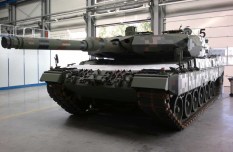 According to a news report from Defence24.com, the Polish Army is interested in buying more Leopard 2 main battle tanks (MBTs). Poland originally received 128 Leopard 2A4s for an extremely low price, a decision made in Germany in order to build up better political relationships between the two countries, which previously due to the second World War and previous conflicts had been terrible. A further 119 Leopard 2 tanks (including 105 relatively modern Leopard 2A5s) were ordered in 2013, after Germany (falsely) decided to downsize it’s tank force. These second-hand tanks also were extremely cheap, costing only €180 million.
Russian T-72B3 receive armor upgrades
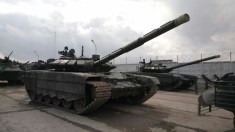 The Russian Army has decided to upgrade the current T-72B3 to a new configuration, which was first seen in the middle of last month. The exact number tanks upgraded has not been disclosed yet. The tank has been called “T-72B3M” or “T-72B4” by different websites, suggesting that the new designation may also not have been revealed yet. It might be known as “T-72B3 mod. 2016” rather than receiving a completely new designation. The upgrade is aimed to improve the survivability of the tank by installing explosive reactive armor (ERA) at the flanks of turret and hull. This armor is apparently identical to that used on the current version of T-90MS “premium” export tank. This reactive armor is not known to provide protection against kinetic energy ammunition such as APFSDS rounds nor against anti-tank guided missiles (ATGMs) or rocket-propelled grenades (RPGs) with tandem shaped charge warhead.



 The fine folks over at
  We noticed that earlier this month an episode of the TV show “Combat Dealers” was posted on youtube. This particular episode deals with a WWII German Panther tank that show host Bruce Crompton. The episode also features German tank expert


 This past weekend saw the Strong Europe Tank Challenge event take place in Grafenwoehr, Germany. Tank crews from six NATO or NATO-allied countries competed in a series of tests to prove which crew (and vehicles) were the best. The competing nations included the USA, France, Germany, Poland, Austria and Ukraine, each country entering a platoon of four tanks and crews. The inclusion of Ukraine marked a first time for that country in the competition, as well as for their T-64BV tank. The competition was won by Austria, whose crews were operating Leopard 2A4 tanks. Second place was taken by German tankers in Leopard 2A6 tanks. Third place was awarded to the US platoon and their Abrams M1A2 SEP tanks. Poland operated Leopard 2A5 tanks and France had their LeClerc MBT. Stars and Stripes noted that Poland, France and Ukraine all scored close to the top three countries, making for a tough competition.
 Russia displayed the first of 150 upgraded T-72B main battle tanks (MBTs) at the 5 May Victory Day Parade in Moscow. Under a 2016 contract with UralVagonZavod the MBTs are to be brought to what the Russian Ministry of Defence has referred to as the T-72B3 standard, although the upgraded tanks feature a number of differences to the existing T-72B3 standard, being variously reported under the designations T-72B3M and T-72B4. It is possible the MBTs will not receive a full type designation and will instead use a year designator, potentially T-72B3 obr.2016, or a minor modification designation such as T-72B3-1.
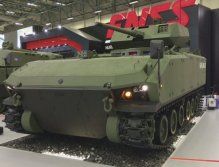 Turkey’s FNSS unveiled a version of its Kaplan tracked armoured vehicle armed with a 30 mm gun at the country’s IDEF 2017 exhibition, held in Istanbul on 9-12 May. The medium-calibre armament is designed to allow the new vehicle to operate alongside main battle tanks (MBTs). The Kaplan-30 Next Generation Armoured Fighting Vehicle (NGAFV) is fitted with an FNSS Teber-30 turret housing a 30 mm Orbital ATK Armament Systems MK44 dual-feed automatic cannon and 7.62 mm coaxial machine gun.
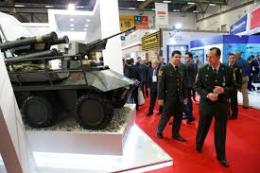 ISTANBUL — Increased insurgency-related violence in Turkey and more turmoil in regional conflict zones have led to a surge in competition among Turkish armored vehicle producers. A United Nations report on human rights in southeast Turkey says about 2,000 people were killed in security operations in the area between July 2015 and December 2016. The report also estimates between 355,000 to 500,000 people are displaced in the area.
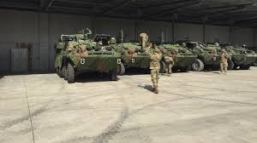 STOCKHOLM — A U.S. Army cavalry regiment in Germany is testing a Stryker upgrade that could increase the vehicle’s survivability as the service conducts training exercises in Europe meant to deter Russia. Soldiers from the Army’s 2nd Cavalry Regiment, stationed in Vilsek, Germany, have installed Saab’s mobile camouflage system, or MCS, on four of its Strykers, said Scott Caldwell, the company’s director of marketing and sales for its Barracuda business unit.
 Aselsan has partnered with the General Directorate of Military Factory (AFGM) to upgrade two of the Turkish Army’s M60T main battle tanks (MBTs) with enhanced survivability. The effort follows the service’s disastrous Euphrates Shield operation in Syria, where a number of its MBTs were destroyed or damaged. Turkey took delivery of 170 upgraded M60T MBTs which were originally updated by Israel Military Industries (IMI), with most of the work carried out by the 2nd Main Maintenance Centre Command at Kayseria. The command has extensive experience with upgrading and overhauling MBTs and other tracked armoured fighting vehicles.
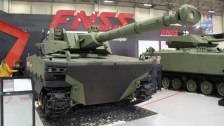 FNSS Savunma Sistemleri has unveiled the first prototype of the Kaplan MT Modern Medium Weight Tank (MMWT) at the IDEF 2017 exhibition. The vehicle under joint development by FNSS and Indonesian defence prime PT Pindad to meet the potential requirements of Indonesia, using internal research and development funding under an agreement signed in 2014.
 COLOGNE, Germany — The German Army is in line for an upgrade of its tanks, based on the expectation that future conflicts will rely heavily on ground warfare with armored vehicles. All told, the Bundeswehr stands to get 104 used Leopard 2 battle tanks out of storage that manufacturer Krauss-Maffei Wegmann will upgrade under a contract with the German Defence Ministry from the A4 configuration to the newest A7V standard. The latest package includes improvements in the areas of information technology, armaments and armor.
 In 2016, the Krasnogorsk plant finished tests of the heat-vision sighting system Irbis for modernized tanks T-80U and T-90. The sights will be supplied to the army after 2017 under the already concluded contract, says the manufacturer’s annual reporting. According to the experts of Mil.Today, commissioning of the new sight will for the first time give Russian tankers a homemade thermal vision device based on the mercury-cadmium-telluride (MCT) matrix, which will bridge a gap between the leading NATO countries in this area.
 Tank and AFV News