A video of several Sherman tanks lying on the sea bed has been making the rounds the past few days. The video shows a scuba diver swimming over at least seven Sherman tanks. These vehicles are from the shipwreck of the SS Empire Heritage located of the north coast of Donegal in Ireland in 70 meters of water. SS Empire Heritage was a 15,000 steam tanker torpedoed in 1944 by German submarine U-482. The ship took all 113 of its passengers down with it. The location is a popular spot for divers due to the scattered tanks and other interesting debris.
Captured Cromwell tanks in the Korean War
April 7, 2015 by Leave a Comment
 The blog “Thank you for Your Service” has posted an interesting article about captured Cromwell tanks in service with the North Korean Army during the Korean War. The article states that there has been a good deal of debate over how a handful of British Cromwell tanks ended up in the hands of the North Koreans. The answer to the question seems to be a battle in late 1950/early 1951 called “The Battle of Happy Valley” in which several Cromwell tanks were captured. The article notes that many of these Cromwell tanks were later recaptured by UN forces, and in one instance, a Cromwell was shot and destroyed by a British Centurion tank. The article also mentions a Cromwell in North Korean service that was captured by South Korean Marines during the Inchon landings. All in all, a rather interesting read accompanied with some good photos.
Read the entire article at “Thank you for Your Service” blog.
Czech Army on lessons learned regarding Russian armor in Ukraine
April 6, 2015 by Leave a Comment
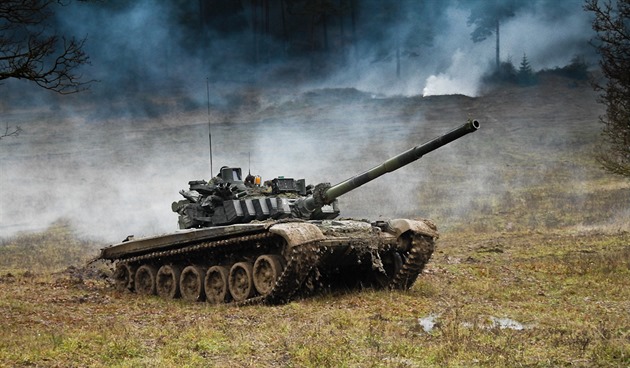 Status Report has posted a translation of an interesting article from Czech news source natoaktual.cz reporting on recent observations by the former Czech army chief of staff on lessons learned from the fighting in Ukraine. The article contains a rather harsh critique of Soviet/Russian designed tanks, criticizing them for their lack of interior space and poor crew safety. The author of the article concludes the article with the recommendation that the Czech Army should get rid of their Soviet designed vehicles and replace them with Western designs.
Article excerpt:
The Soviet armor concept is built around small dimensions and low silhouettes. Combined with the relatively high quality of armor as well as sharp armor plate angles, when these vehicles were introduced, they were considered highly effective. The development roots however reach back to the 50’s with the development continuing in 60’s and 70’s.
This Soviet concept required many solutions that were far from optimal. Especially the inside of the vehicles is so cramped that the crew often does not have enough space to perform their functions. This increases the crew fatigue especially during longer operations, leading to tiredness and mistakes. The worst issue however is the fact that the crew was limited to three members by replacing the loader with an automatic loading system.
The full translation can be read at Status Report. The original article in Czech can be viewed here.
From the Vault: Panther Videos
April 6, 2015 by Leave a Comment
Today we present for your viewing pleasure various videos about the German Pz. V Panther.
We will start with this Youtube playlist of clips of Panther restoration. For those interested in seeing various components of the Panther up close, these should prove satisfying. There are 20 clips in the playlist, click here to view.
Next is a playlist of five clips of Panther tanks moving around. These are nice in that they give the viewer an idea of what this vehicle actually sounded like.
Below is a clip called “Panther Graveyard” showing damaged and destroyed Panther tanks filmed at the end of the war.
WoT’s Chieftain posts new article: US Centurion Part 4
April 6, 2015 by Leave a Comment
 World of Tanks researcher Nicholas Moran, aka “The Chieftain” has published part 4 of his article on US testing of the Centurion III tank. Part one dealt with the US assessment of the Centurion III’s fighting compartment. Part 2 dealt with automotive tests. Part three covered the gun control systems. Part four examines the fire on the move capability of the Centurion.
All the Chieftain’s articles can be read at The Chieftain’s Hatch.
Article excerpt:
This is the last in the series of articles stemming from the US Army’s testing of Centurions II and III in late 1949/early 1950. We’ve already seen that they concluded that Centurion was a fairly competent vehicle, albeit that it was expected that the next generation of American tank would be no worse than equal in various characteristics, but they were particularly curious about the stabilization system as up until that point, nothing had been put into service on a tank which was claimed to provide a true fire-on-the-move capability. The gyrostabilised guns on American tanks in WWII, being single-axis only, could not make such a claim. As we go through the observations below, I suspect that even in the M4 the Americans had already started noticing such things, but it is still interesting to see how they are officially reporting them below. Anyway, I’ll let you read the observations, and will come back to you afterwards.
WW2 tank unit commander Larry Lantow tells story
April 6, 2015 by Leave a Comment
 The Tulsa World is running a series of articles documenting the stories of US WW2 veterans. This particular piece focuses on 92 year old veteran Larry Lantow, a former US tank commander who served in France. His story mirrors that of the fictional film “Saving Private Ryan” in that he was shipped home early by Presidential order due to his family losing two of his brothers in combat.
From the Vault: AMX-30 articles
April 6, 2015 by Leave a Comment
Some old articles on the French AMX-30 MBT. We primarily uploaded these to share with a friend that is doing some research on this vehicle but we figured there might be others that would find them interesting.
AMX 30 France’s Main Battle Tank by General Jean Marzloff (1971)


Controversy in Indiana over location of Sherman tank
April 5, 2015 by Leave a Comment
 The Kokomo Tribune is reporting on a controversy in Kokomo Indiana regarding the location of a Sherman tank. The dispute centers around the issue of whether or not to move the tank from it’s current location in Foster Park to a nearby VFW Hall. As to the tank itself, it’s an M4A1 with 76mm gun and HVSS suspension (M4A1E8.) Judging from Google maps images, the tank seems to have repainted in 2008. The M4A1E8 was the very last variant of the Sherman produced, with 1,465 built by the Pressed Steel Car Company from late 1944 to August of 1945. As far as we can determine, the M4A1E8 saw little to no combat service during the war and afterward most were issued to reserve units or given as military aid (the US Army’s preferred variant after the war was the M4A3E8.) Indiana seems to be the home of an unusual number of M4A1E8 tanks, according to the USA AFV register, there are 13 M4A1E8 Sherman tanks on public display around the state!
Report on British S-tank trials
April 4, 2015 by Leave a Comment
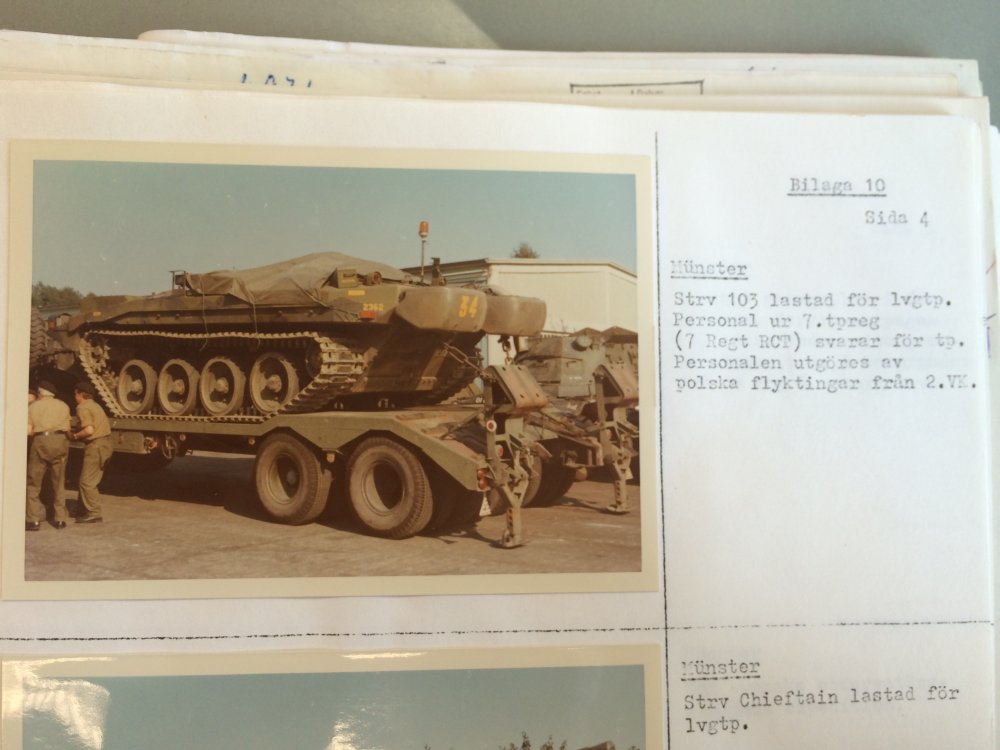 Swedish Tank Archives has posted an interesting piece concerning a report from British Strv 103 (S-tank) trails from 1973. In the Summer of that year the British Army on the Rhine (BAOR) sent several tank crews to Sweden to train on the S-tank for four weeks. These crews were then sent to Germany along with the S-tanks to be tested. The Swedish observers of the test considered the results of the evaluation to be highly dubious, claiming that they were conducted in a haphazard and unscientific manner. They also are quite harsh in their criticism of the BAOR.
Here is an excerpt on the quality of British Tank Gunners:
At the end of the gunnery training, there were two tests with a gun camera, one against a fixed target and one against a moving one, as per usual Swedish standard. The results were bad. The first time these results may possibly be explained by the gunners not taking the trial seriously, but even after they had evaluated their own results and re-did the test the results were very bad. It is possible that more training could have improved the results somewhat, but the more likely explanation is that a large portion of the British gunners simply weren’t suited to their job as gunners. In some cases, problems with bad eyesight were apparent. It should be noted that British tank personnel is not tested in the same way as Swedish personnel before being assigned as tank gunners.
Yikes!
To read the full piece, please go to the Swedish Tank Archives blog.
From the Vault: Latrun Armor Corps Tank Museum pictures
April 4, 2015 by Leave a Comment
 Tanks have played an important role in the history of the state of Israel. Fortunately, this history has been preserved in Israel at the Armored Corps Memorial Site and Museum at Latrun (Yad La-Shiryon.) The Museum was founded in 1982 and includes 110 tanks and armored vehicles displayed outdoors. The heart of the collection are Israeli vehicles and vehicles captured during Israels various wars, although the museum has also purchased other foreign vehicles in order to diversify the collection. The most famous sight associated with the location is an M4 Sherman tank on top of what used to be a water tank. This “Tank on a Tower” serves as the logo for the museum.
For those interested in viewing the vehicles located at Latrnn, there are several galleries and videos available online by people that have visited.
Photo Galleries:

 Tank and AFV News